Article
Who uses Webflow? A guide to the platform's users
Webflow6 min read

James BrunettoCo-fondateur & CEO
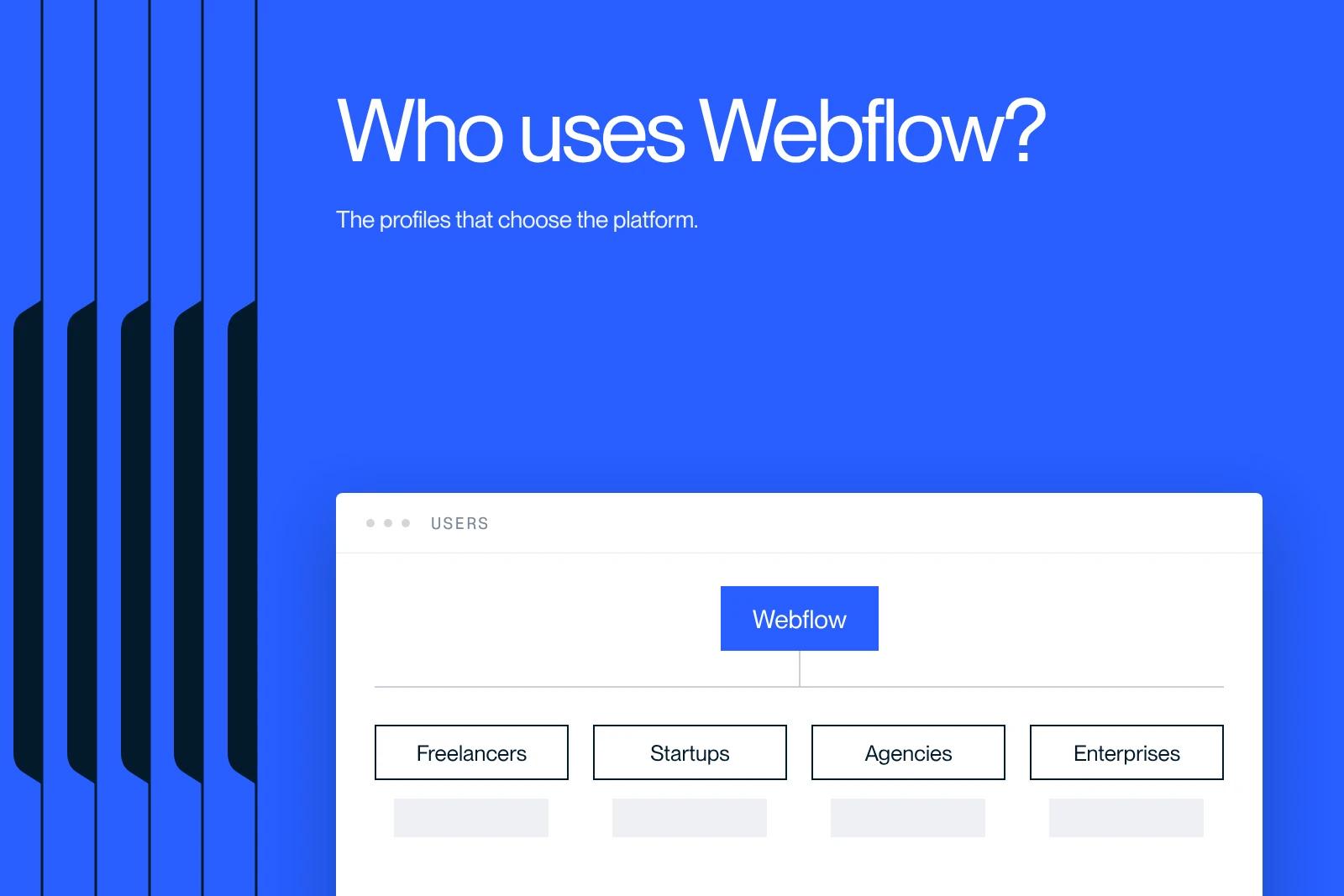
Startups, agencies, freelancers: Webflow appeals to a wide range of users. Here is who uses it, and why. Perhaps you will be next.
Explore this post with…
Over the past few years, Webflow has become a go-to no-code platform. No more static mockups, endless front-end builds or dependence on a dev team. With Webflow, design becomes interactive and website production runs smoothly.
But one question comes up often: who uses Webflow?
Is it only for tech startups? For tech-savvy freelancers? For design-driven agencies?
In reality, Webflow has gone mainstream very quickly. Today, very different profiles adopt it, sometimes for surprising reasons.
Here is how to tell whether Webflow is right for you.
Why does Webflow attract so many different profiles?
For designers: freedom without code
Webflow gives designers full control over the visual result. No compromise between the idea and the outcome:
- Intuitive drag-and-drop interface
- Advanced CSS styling without code
- Native animations without JavaScript
It is the ideal tool to deliver an interactive design without a developer.

For marketers: agility and built-in SEO
Marketing teams no longer want to wait weeks for a landing page. With Webflow:
- Campaign pages built quickly
- Native SEO management (tags, sitemap, meta, performance)
- Easy integration with tools such as HubSpot, Zapier, Make...
The result: full autonomy, without losing control of the strategy.
For developers: clean code and extensibility
Yes, developers use it too:
- Clean exportable code (HTML, CSS, JS)
- REST API to automate or connect external services
- Support for webhooks, dynamic collections and more
Webflow does not replace code, it complements it.
Who uses Webflow? The 4 main profiles
1. Freelancers and independents
Webflow = productivity + autonomy + quality.
Freelancers like Webflow because they can:
- Handle both design and development
- Work faster and deliver more projects
- Stand out with custom websites
On top of that: fewer bugs, less technical dependency, and satisfied clients.
2. Web agencies
Many digital agencies are moving to Webflow to:
- Speed up production: timelines are shorter
- Unify the design and development process: no more endless back-and-forth
- Give the client a custom CMS: with no plugins and no maintenance
For example, at Synqro, we use it to deliver fully custom websites, with a real return on investment for our clients.

3. Startups and small businesses
Webflow is a natural fit for agile organizations:
- Building landing pages independently
- Fast marketing A/B tests
- Adaptable sites without excessive costs
It is a growth lever, especially for teams that want to scale without carrying a heavy back end.
4. Large companies
No, Webflow is not just a tool for small organizations. It is used by some very big names:
- Dell → for product microsites
- Rakuten → for promotional landing pages
- Zendesk → for marketing content pages
Why? Because speed, security and UX freedom have become strategic.
How different companies and profiles use Webflow
| Company | Type | Webflow use |
|---|---|---|
| Dell | Large enterprise | Microsites |
| Rakuten | Marketplace | Landing pages |
| Zendesk | B2B SaaS | Marketing sites |
| Lattice | HR startup | Corporate site |
| HelloSign | Electronic signature | Support & docs |
Why use Webflow?
Because Webflow brings together the best of design, no-code and performance. It lets you build highly customized websites without depending on a developer, while keeping full control over the visual result, animation, SEO and even performance.
Whether you are a designer, a marketer, a freelancer or at an agency, Webflow increases your productivity, cuts down endless back-and-forth and helps you launch projects faster, with a professional level of finish. It is an all-in-one tool that changes how websites are built.
Conclusion: Webflow really is for everyone
Freelancers, agencies, startups or large groups: Webflow speaks to all of them.
It removes the barriers between design and engineering, gives freedom without sacrificing performance, and saves a great deal of time for those who adopt it.
Ready to move forward?
Let's talk about your project and build a Webflow site that stands out.
Frequently asked questions
Yes. Webflow is designed for users with no web development experience. Thanks to its intuitive interface and its ready-made templates, even a graphic designer or someone with no technical training can build a responsive website. The visual editor lets you design and customize your web pages in real time, with a result that matches the design.