Article
SEO Article Writing: How to Write a Post That Ranks on Google
SEO15 min read

James BrunettoCo-fondateur & CEO
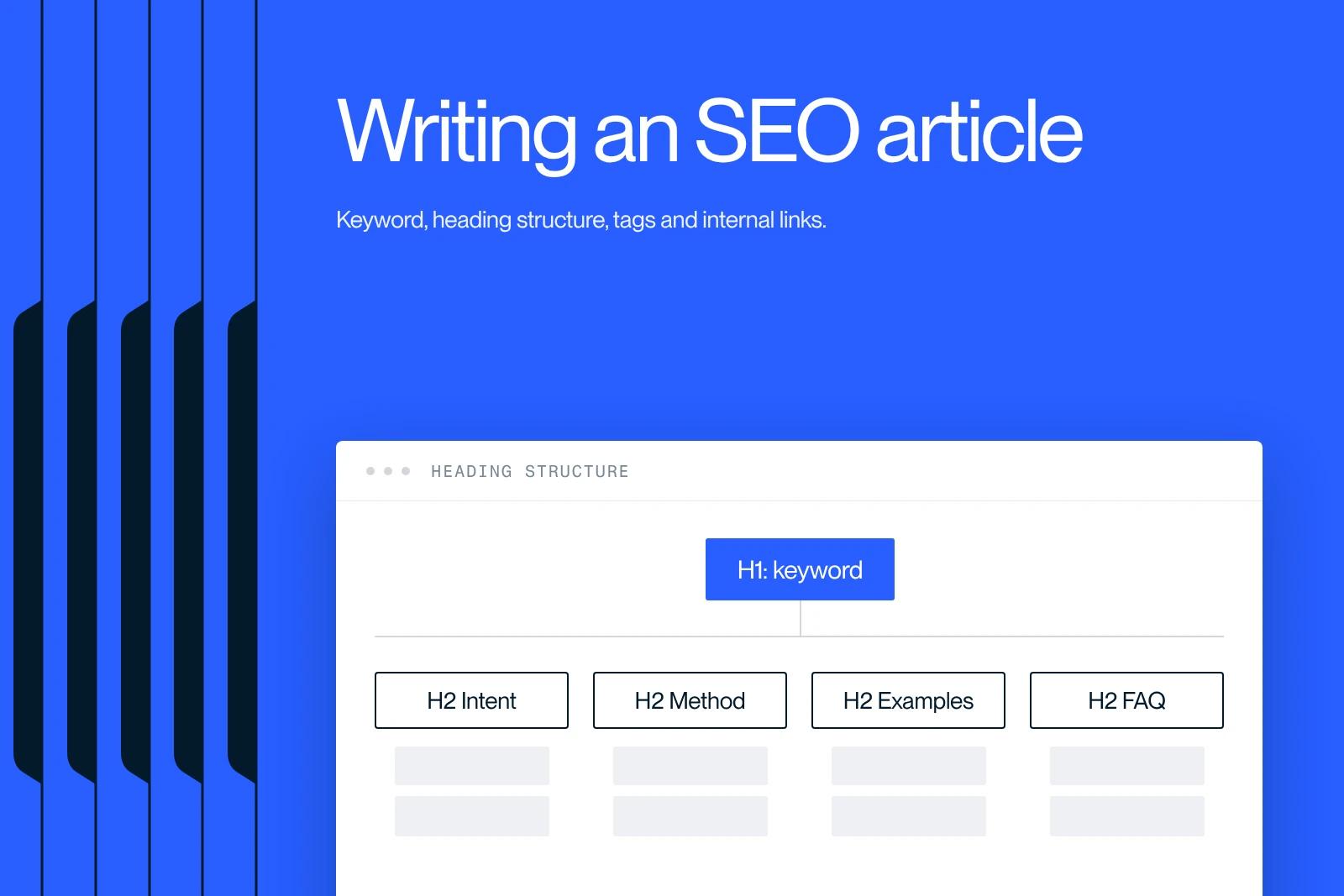
Good content is no longer enough. Learn to write for Google without losing your reader. Method, keywords, structure: here is everything you need.
Explore this post with…
Publishing an SEO article is one of the most powerful ways to bring qualified traffic to a website today. But for that content to have a real impact, writing is not enough: you need to structure it, optimize it, match search intent and hold your readers' attention down to the last line.
In this complete guide, written by our Webflow experts Synqro walks you through every key step to write an SEO article that performs on Google and engages your visitors.
Why write an SEO article?
An SEO article is content written to meet search engine requirements while giving real value to readers. Unlike a simple blog post, an SEO article is designed to be visible, readable, useful and strategic.
Millions of new pieces of content go online every day. Most of them stay invisible because they are poorly optimized or not relevant enough. Ranking well on Google has become a must if you want to exist online.
A well-structured SEO article helps you:
- Improve your rankings in search results,
- Attract qualified organic traffic,
- Build authority in your field,
- And support your conversion goals.
But be careful: a good ranking is not an end in itself. What matters is to match the search intent and deliver content that holds attention. That naturally increases time spent on your site and lowers your bounce rate.
Understanding how Google works
Before writing an SEO article, it is crucial to understand how the search engine works. Google uses bots to crawl, index and rank web pages by relevance.
The exact criteria are kept secret, but we know they include:
- Content quality,
- Structure (headings, paragraphs, tags),
- Relevant use of keywords,
- Internal and external links,
- And user experience (speed, mobile, etc.).
The more an SEO article is clear, structured, rich and well contextualized, the better its chances of showing up in the top results, or even in strategic positions such as featured snippets.
Step 1: Find the right main keyword
The success of an SEO article starts with choosing the main keyword. It is the cornerstone your whole piece is built around. This keyword is what your potential readers type into Google to find information. If you target the right query, you maximize your chances of appearing in the results and capturing qualified traffic.
Why this choice is strategic
A well-written but poorly targeted article is useless if it does not match a real search query. On the other hand, an SEO article built on a highly searched but overly competitive query may never surface in the SERP (Search Engine Results Page).
That is why it is essential to find a keyword that is relevant, searched and within reach.
Three criteria to choose the right main keyword
- Relevance
The keyword must be directly tied to your business, your offer or your expertise. It should also match a topic you can cover in a credible and useful way. - Search volume
There is no point targeting a keyword nobody types. Use SEO tools to check monthly search volume and estimate how much interest a phrase generates. - Competition level
Some keywords are very competitive, especially in sectors like finance, legal or e-commerce. It can then be smarter to aim for a long-tail query: more specific, less competitive and often closer to a conversion intent.
What is a long-tail query?
Long-tail queries are phrases made of 4 words or more. They target very specific needs.
Example:
Instead of "digital marketing" (too broad and saturated), go for a query like:
➡️ "digital marketing strategy for small businesses in 2025"
➡️ "examples of local digital marketing campaigns"
These queries attract a smaller but highly qualified audience. Above all, they give you better chances of ranking quickly.
Tools to find your keywords
Here are a few strong tools to find and analyze your keywords:
- Google Keyword Planner (free, through Google Ads): to see search volume and competition.
- Ubersuggest (freemium): very useful for finding long-tail keyword suggestions.
- SEMRush or Ahrefs (premium): for deeper analysis of competitors and SERPs.
- Answer the Public: generates ideas for common questions around a keyword.
- Google Trends: lets you track how a keyword evolves over time.
Step 2: Understand search intent
Behind every query there is a search intent. There are three main types:
- Informational: the user is looking for an answer (e.g. "what is an SEO article").
- Navigational: they want to reach a specific website or brand.
- Transactional: they are ready to buy or sign up.
Once you understand this intent, you can adapt the content, tone and structure of your SEO article. For example, a query like "best website builder" calls for a comparison or a practical guide, not a theoretical definition.
Step 3: Structure your SEO article effectively
The structure of an SEO article is essential, both for user experience and for organic search. Google, like your readers, rewards content that is well organized, clearly ranked and easy to scan. A logical structure answers readers' needs quickly and improves your chances of appearing in search results.
Why good structure matters
- It makes skimming easier, which is very common on the web.
- It helps Google quickly understand the topic.
- It increases time spent on the page, a positive SEO signal.
- It encourages interaction and conversions (CTAs).
The typical structure of an SEO article
Here is the recommended structure for a high-performing SEO article:
- Main title (H1)
It must be unique, engaging and include your main keyword. The H1 is used only once per page. - A compelling introduction
The introduction must hook the reader from the first lines. It should:- State the problem or question the article will solve.
- Use the main keyword.
- Make people want to keep reading.
- Structuring subheadings (H2, H3…)
H2s organize the main sections of the article, and H3s split H2s further when needed. Each section should cover one main idea.
This improves:- Readability,
- Accessibility (especially for mobile readers),
- SEO (every subheading is an SEO opportunity).
- Short, airy paragraphs
Text blocks should be kept to 3 to 5 lines max. Use:- Bullet lists,
- Simple sentences,
- Concrete examples,
- Quotes or callout boxes if needed.
- A clear, engaging conclusion
It sums up the key points and suggests an action: read another article, download a resource, sign up for a newsletter, etc.
Bonus SEO tip
Place your keywords:
- In the headings (H1, H2),
- In the first sentences of each section,
- And in the ALT tags of your visuals.
Step 4: Write quality content that is long enough
Content quality remains the number one criterion for Google. But today, length also plays an important role. A long, complete SEO article is more likely to be seen as relevant, because it can cover a topic in depth.
How long should it be?
- Recommended minimum: 800 to 1,000 words
- Ideal to rank on competitive queries: 1,500 to 2,500 words
The longer the content, the more likely it is to:
- Target several keywords,
- Answer every question related to the topic,
- Generate more shares and backlinks.
But length is not enough
Above all, an SEO article must deliver real added value. Writing to "fill space" or hit a word count is counterproductive. Google detects thin or repetitive content.
Goals of long, quality content:
- Explore a topic in depth: show your expertise and anticipate the user's needs.
- Cover secondary questions: what might a reader ask after reading the title?
- Bring concrete elements: examples, data, quotes, case studies, charts…
- Enrich the semantic field: use synonyms, related terms and co-occurring words.
Avoid at all costs:
- Pointless sentences,
- Excessive keyword repetition (keyword stuffing),
- Unnecessary jargon,
- Overly dense paragraphs.
Step 5: Optimize how you use keywords
Once your main keyword is chosen, the next step is to work it into your SEO article efficiently and naturally. The goal is twofold: clearly tell Google what your content is about, while keeping the reading smooth and pleasant for the user.
Why keyword placement is crucial
Google analyzes the structure of your pages to work out their main topic. The search engine therefore gives special weight to certain elements of your content, including headings, the first lines of text and HTML tags. If your keyword is well placed there, it makes indexing easier and improves your chances of gaining visibility in the SERP.
On the other hand, over-optimization, meaning excessive repetition of the keyword, can hurt content quality and user experience, and even get you penalized for SEO.
Key places to put your main keyword
Here are the strategic spots where your keyword must appear:
- The page title (H1 tag): it is one of the first elements Google reads. A catchy title that contains your main keyword gives an immediate signal about the topic.
- The URL: a short, descriptive URL that includes the keyword makes the page clearer. For example: www.synqro.fr/blog/article-seo-optimise.
- The introduction: Google gives a lot of weight to the first lines of content. Insert your keyword naturally within the first 100 words to anchor the article's topic from the start.
- At least one H2 subheading (or H3): subheadings structure your content and make it quick to scan. Putting the keyword in one or more subheadings tells search engines you are staying on topic.
- The conclusion: repeating the keyword at the end of the article closes the loop consistently and reinforces the topic.
- Image ALT tags: search engines do not read images, but they interpret their ALT tags. Including the keyword in at least one (relevant) image improves accessibility and the page's overall SEO.
What keyword density should an SEO article aim for?
There is no magic number, but a density of 0.8% to 1.2% is generally recommended. This means that in a 1,000-word SEO article, the main keyword should appear 8 to 12 times.
But keep in mind: quality always beats quantity. It is far more effective to use:
- Semantic variations (e.g. "SEO writing", "optimized content", "text for Google"),
- Smart synonyms,
- Co-occurring terms (words often tied to the topic: "SERP", "indexing", "organic traffic", etc.).
Thanks to the intelligence of its algorithm (BERT in particular), Google can now understand the context of a text. So you no longer need to repeat your keyword mechanically: a rich semantic field is just as effective, if not more.
More tips for natural keyword use
- Write for humans, not for the algorithm: your sentences should stay fluid, even when they contain a keyword.
- Read your text out loud: if the keyword repetition sounds awkward, you need to adjust.
- Feel free to vary your phrasing and use the passive voice or questions to work your keyword in without weighing the text down.
Step 6: Aim for featured snippets
Featured snippets, also called optimized extracts, are blocks of content Google highlights at the top of organic results. They usually appear as short definitions, bullet lists, tables or structured paragraphs.
Why aim for a featured snippet?
- Maximum visibility: you show up at the very top of the SERP (often above the first organic result).
- Higher click-through rate: the snippet draws attention and generates more clicks.
- Expert positioning: you are seen as an authority on the topic.
How to optimize your SEO article for featured snippets
To increase your chances of appearing in a featured snippet, follow these best practices:
- Ask a clear question in an H2 or H3
Use classic phrasings: What is…, How…, Why…, etc. - Give a concise, direct answer
Right after the question heading, write a paragraph of 40 to 60 words max that clearly sums up the answer. - Structure the information
Use:- Bullet lists for steps or items to list.
- Tables to compare or summarize data.
- Short definitions to explain a concept.
Concrete example:
H2: What is an SEO article?
An SEO article is content written to meet both readers' expectations and Google's technical requirements. It is built around a main keyword, enriched with relevant content and optimized to improve its visibility in search results.
Step 7: Take care of internal (and external) linking
Linking is a fundamental SEO strategy. It means creating hyperlinks within your content itself that point to other relevant pages.
Internal linking
Internal linking connects your pieces of content to each other. It helps you:
- Improve navigation for your readers by pointing them to related or complementary articles.
- Strengthen the SEO authority of certain pages (by passing on "link juice").
- Help Google crawl your site, making your pages easier to index.
Best practices:
- Add internal links naturally within the text.
- Use descriptive anchors (for example: "see our guide to HTML tags").
- Link to pages on the same topic or with strong SEO potential.
External linking
This means adding links to reliable, relevant external sources, such as:
- Studies,
- Government websites,
- Reference media outlets,
- Well-known SEO tools.
This helps make your points more credible, shows that you rely on concrete data, and improves the user experience.
Watch out: avoid linking to direct competitors or unreliable sites.
Step 8: Actively promote your SEO article
Publishing an SEO article is not the finish line. To generate traffic, it needs to be distributed, shared and amplified. Google likes popular content: actively promoting an article indirectly helps it rank well.
Where and how to promote your SEO article
- On your social networks
- Adapt your message to each platform (LinkedIn, Twitter, Facebook, Instagram).
- Add an engaging hook and a striking visual.
- Schedule several posts over time with different angles (excerpt, question, statistic…).
- In your newsletter
- Feature the article in a dedicated block.
- Explain how it brings value to the reader.
- Add a clear call-to-action button ("Read the full article").
- On other content platforms
- Republish a condensed or adapted version of your article on Medium, LinkedIn Articles or other partner blogs.
- Include a link to the full version on your site.
- Through targeted interactions
- Mention experts or brands quoted in the article and tag them on social media.
- Reply to comments, start discussions, ask your community questions.
- Share the article in forum discussions or Facebook/Slack groups related to your topic.
Conclusion: the SEO article, a core building block of your content strategy
Writing a quality SEO article means creating a web page that answers a specific query while also appealing to search engines. It takes time, tools, a good understanding of your audience and, above all, a genuine will to deliver value.
It is also a long-term strategy. A well-thought-out article can keep generating traffic for months, even years. Make it part of a broader vision for your content, with consistency, relevance and coherence.
Frequently asked questions
An SEO article is web content written and structured to meet search engine criteria while giving readers relevant, useful information. It combines technical optimization (keywords, tags, linking…) with quality writing.