Article
Outsourced marketing team: costs, scope and a 12-month plan
SEO14 min read

James BrunettoCo-fondateur & CEO
An outsourced marketing team is an external team that runs part or all of your marketing on a retainer, covering both strategy and execution. It sits between a fractional CMO, who sets direction but does not build anything, and a full in-house department. This guide sets out what it costs next to a hire, what a year of work looks like month by month, how to run it with KPIs and rituals, and the situations where it is the wrong choice.
Explore this post with…
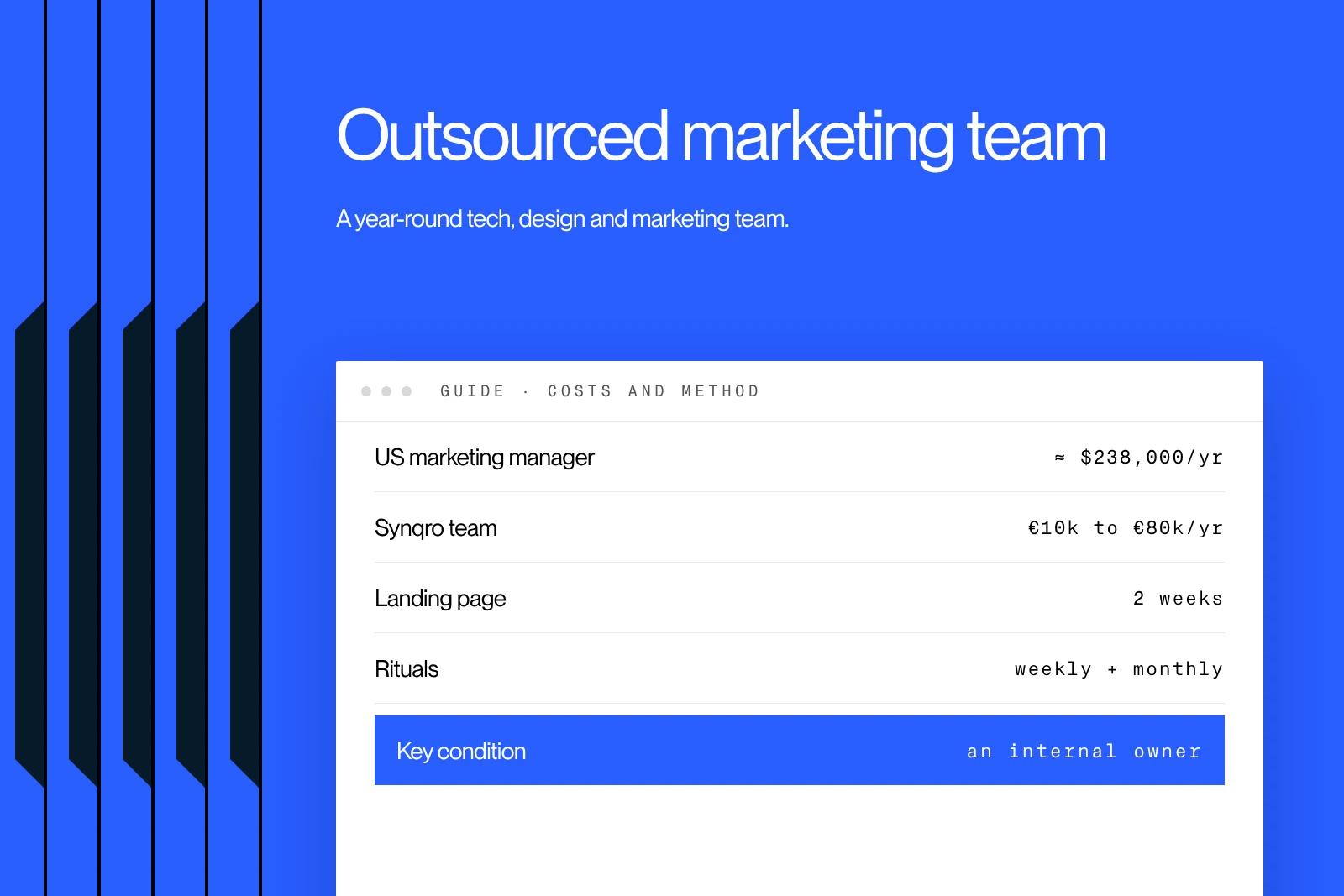
In short: an outsourced marketing team replaces or extends an in-house marketing function with an external team paid on a retainer. In the United States, the median marketing manager earned $166,790 in May 2025, and wages make up only 70% of what employers spend per worker, which puts the full cost of that hire at roughly $238,000 a year. At Synqro, a year-round outsourced team costs €10,000 to €80,000 excluding VAT a year and covers the website, design, SEO, GEO, paid search and conversion. The model works when one person inside the company owns decisions. It is a poor substitute for a first marketing hire while the product is still finding its market.
What is an outsourced marketing team?
An outsourced marketing team is an external group of specialists that does the marketing work an in-house team would otherwise do: strategy, content, website changes, search visibility, paid campaigns and reporting. It works continuously, on a written scope and an annual or monthly budget.
You will also see it called an outsourced marketing department. The idea is the same: one contract gives you access to several disciplines that would otherwise mean hiring a project lead, a designer, a developer, an SEO specialist and a paid media manager.
The label covers four very different set-ups. Mixing them up is the most common reason buyers end up disappointed, because they compare proposals that do not buy the same thing.
| Set-up | What you buy | Who does the work | Right choice when |
|---|---|---|---|
| Fractional CMO | Strategy, plan, leadership | Your team or other suppliers | You have people to execute but no direction |
| Outsourced marketing team | Strategy and execution across several disciplines | The external team | You have neither, or a single marketer in-house |
| Freelancers | One specific skill each | Each freelancer, coordinated by you | The need is narrow and well defined |
| Project agency | One deliverable: website, identity, campaign | The agency, then your team | The project has a clear start and end |
Outsourced marketing team vs fractional CMO
A fractional CMO is a senior marketing leader who works for you part time. The two are often confused. A fractional CMO gives you a head. They set priorities, write the plan and chair the meetings. They do not build pages, design screens or fix code, so you still pay someone else to deliver.
An outsourced marketing team gives you both. At Synqro, that is the point of our annual engagement: our team acts as the client's tech, design and marketing team. It covers brand, website, visibility in Google and in AI assistants, paid search, conversion rate optimisation and training.
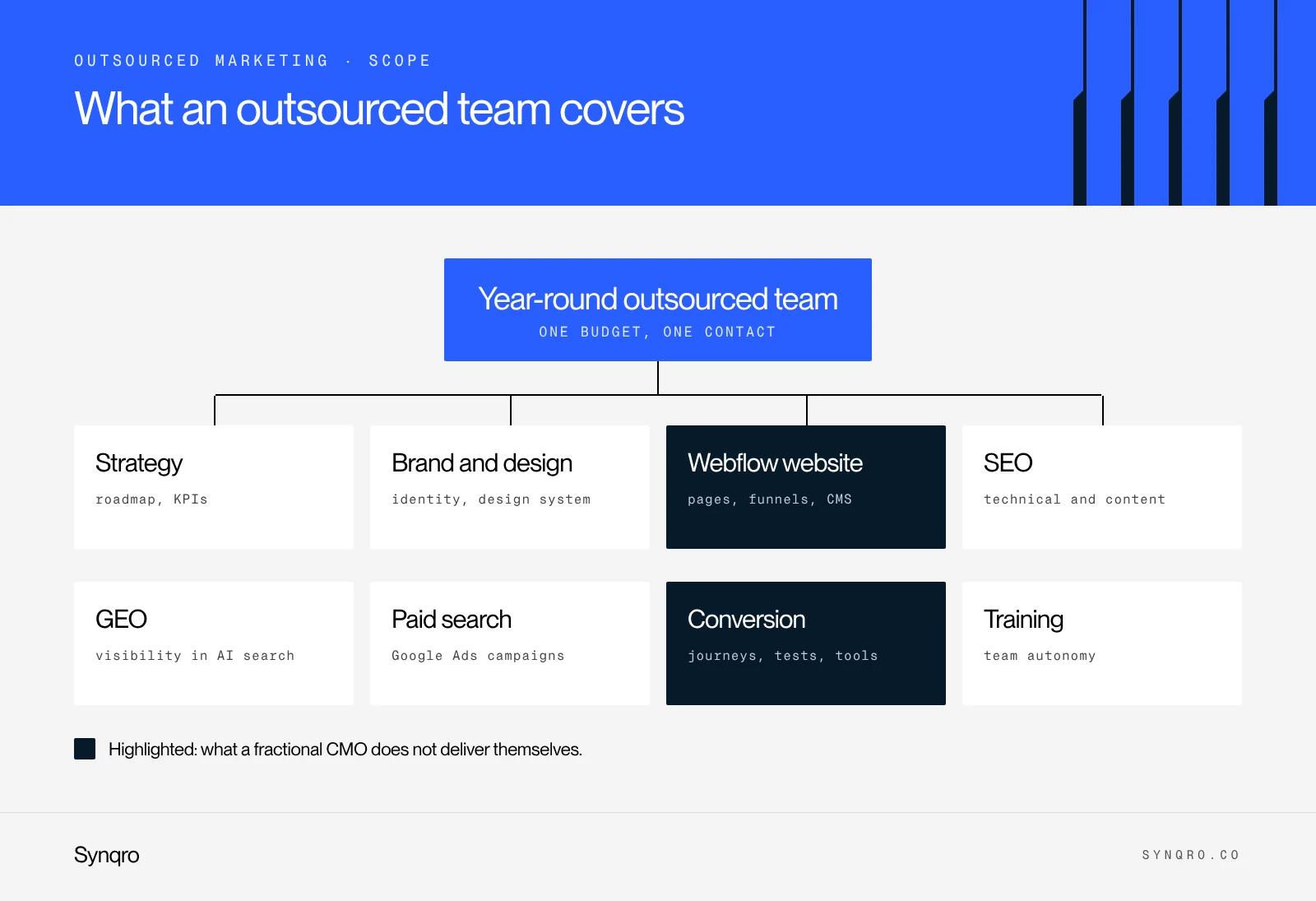
The difference shows in turnaround times. When a salesperson asks for a page aimed at a new segment, a fractional CMO writes the brief. An outsourced team ships the page. On our side, a landing page goes from brief to live in two weeks.
The two can also work together. Some companies keep a fractional CMO for direction and hire an outsourced team to execute. That works well, provided one of them clearly owns the roadmap.
What does an in-house marketing hire really cost?
Salary is only the visible part. According to the US Bureau of Labor Statistics, the median annual wage for marketing managers was $166,790 in May 2025.
Then come benefits and employer taxes. The BLS Employer Costs for Employee Compensation release shows that in June 2026, wages and salaries accounted for 70.0% of employer compensation costs in private industry, with benefits making up the other 30.0%. Applied to the median salary, that puts the full cost of a marketing manager at roughly $238,000 a year, before recruitment fees, software and management time.
The picture is similar in Europe, at a lower level. Michael Page's 2027 salary grid puts a marketing manager in the Paris region at €40,000 to €80,000 in fixed gross salary, with an average of €56,500 (checked in October 2026). Eurostat reports that non-wage costs made up 32.3% of total labour costs in France in 2025, the highest share in the EU. Using that national average, the €56,500 manager costs the company about €83,500 a year.
The real issue is scope. For that budget you hire one person with one set of skills. A strong marketing manager can lead. They can rarely also build a website, design a component library, run a technical SEO audit and manage Google Ads. So they end up buying those skills from outside, on top of their own salary.
Hire, fractional, freelance or agency: the comparison
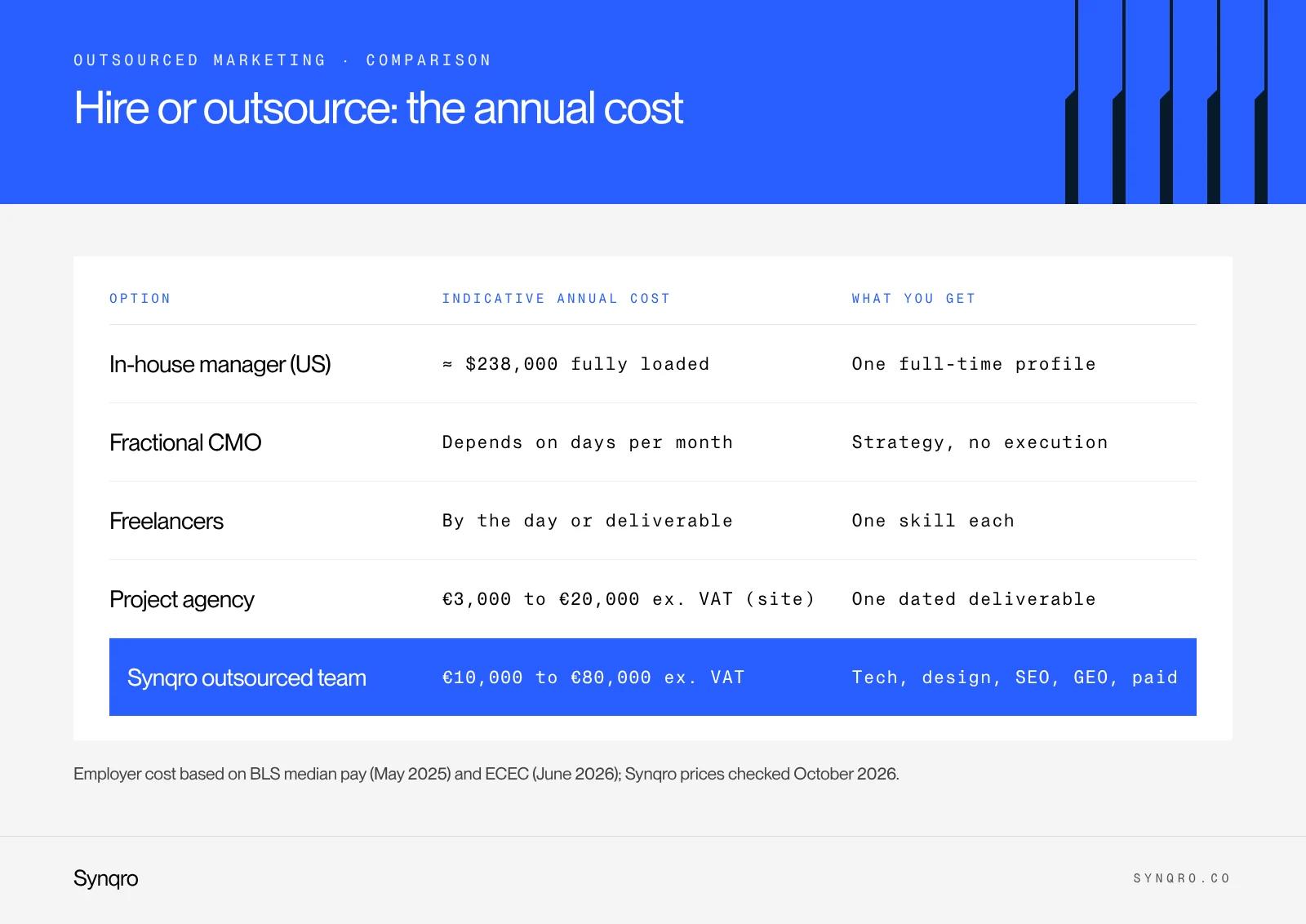
These are the five options our clients weigh before signing, with what each one costs and what it leaves on your plate.
| Option | Indicative annual cost | What it covers | Main risk |
|---|---|---|---|
| In-house marketing manager (US) | About $238,000 fully loaded at the median | One profile, full time | One skill set; a resignation resets everything |
| Fractional CMO | Depends on days per month | Strategy and leadership | Nobody to execute the plan |
| Freelancers | By the day or by deliverable | One skill per freelancer | Coordination falls on you |
| Project agency | €3,000 to €20,000 excluding VAT for a Synqro website | One dated deliverable | The site freezes after launch |
| Year-round outsourced team | €10,000 to €80,000 excluding VAT a year at Synqro | Tech, design, SEO, GEO, paid search, conversion | Needs an internal owner who decides |
The market is moving towards fewer, better-coordinated partners. In its 2025 CMO Spend Survey, Gartner found that 39% of CMOs planned to cut agency budgets, mainly by dropping unproductive relationships and streamlining their agency rosters. One team covering several disciplines is the logical end point of that trend.
A year with an outsourced marketing team, month by month
Few pages on this topic show what a year actually contains. Here is how ours runs. The logic never changes: understand, fix, produce, convert, expand, hand over. What changes with budget is the pace. At €10,000 a year, we tackle one priority per quarter. At €80,000 a year, several workstreams run side by side.
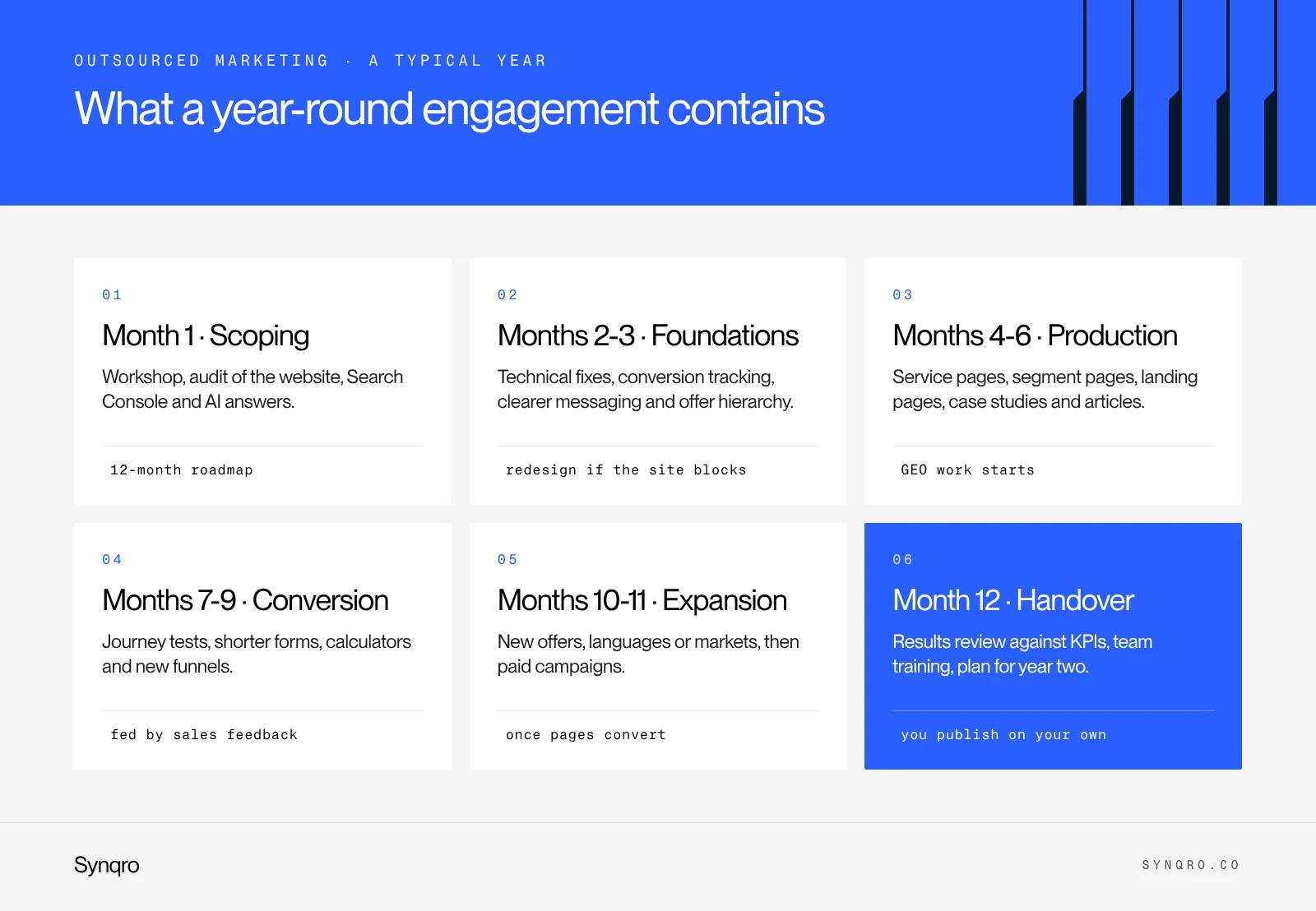
- Month 1, scoping. Workshop with leadership and sales, audit of the website, Search Console data, conversion paths and the answers AI assistants give about your market. The output is a twelve-month roadmap, a quarterly budget and baseline KPIs.
- Months 2 and 3, foundations. Technical fixes, conversion tracking, clearer messaging and offer hierarchy. If the website is the blocker, this is when the redesign happens, delivered in 8 to 12 weeks with a fixed price agreed before the first mock-up.
- Months 4 to 6, production. Service pages, pages by segment or industry, landing pages, case studies and articles. GEO work starts here: content that AI assistants can quote, and presence on the sources they read.
- Months 7 to 9, conversion. Journey tests, shorter forms, interactive tools such as an ROI calculator, and new funnels built from what sales hears in meetings.
- Months 10 and 11, expansion. New offers, new languages or new markets, and paid campaigns once the pages convert.
- Month 12, review and handover. A results review against the baseline KPIs, training so your team can publish on its own, and the plan for year two.
This order is a guide. A funding round, a product launch or a traffic drop reshuffles priorities. That flexibility is the main advantage of a team committed for the year: it can move budget between workstreams without a new proposal every time.
Three long-term engagements, three formats
The three clients below have worked with Synqro over the long term. None of them buys the same thing, which shows how an outsourced team adapts to what the in-house side already does well.
Qobra: a website that keeps pace with the product
Qobra, a sales commission management platform, first asked Synqro to build its Webflow website for its rebrand, with the brand itself created by the agency Bruno. The work carried on for two years: an ROI calculator, dedicated funnels for each new audience, then in 2026 a funnel built around its AI features. Over that period, inbound requests tripled and organic traffic grew sixteenfold. The full story is in the Qobra case study.
Growth Opportunity: SEO, GEO and acquisition on a rolling basis
Growth Opportunity, an online advertising agency, had a one-page website that brought in no leads. We modernised the brand, set the SEO and CRO strategy before designing a single screen, then designed and built the site on Webflow. The team has since extended it to new offers on its own, and we keep working together on acquisition, SEO and GEO. Revenue has doubled since the relaunch, as described in the Growth Opportunity project.
Circul'R: ongoing SEO and GEO coaching
Circul'R, a circular economy consultancy, was often seen as a business club. We redesigned the logo and identity, reorganised the offer around consulting, built the conversion journeys and the SEO and GEO strategy, developed the site and trained the team. Qualified leads came in soon after launch, and the engagement continues as SEO and GEO coaching. Sara Bonnet, Head of Communication, says Synqro “allowed us to double our conversion rate” (translated from French). See the Circul'R case study.
What the three have in common: an in-house team that decides quickly, and a partner who knows the site and the brand well enough to deliver without a fresh briefing each time.
How to run an outsourced marketing team: KPIs and rituals
You run an outsourced team the way you run an in-house one: written goals, short rituals and a single point of contact on each side. Pick the KPIs during scoping and keep them for the year, otherwise nothing can be compared.
| KPI | Frequency | What it tells you |
|---|---|---|
| Qualified enquiries (forms, booked calls) | Monthly | Whether marketing actually feeds sales |
| Conversion rate of key pages | Monthly | Whether the site turns its traffic into leads |
| Non-brand organic clicks | Monthly | Whether new prospects find you in Google |
| Presence in AI answers | Monthly | Whether ChatGPT, Gemini or Perplexity cite you on your topics |
| Time from request to live | Ongoing | Whether the external team is genuinely responsive |
| Influenced pipeline or revenue | Quarterly | Whether the investment pays for itself |
Three rituals are enough. A thirty-minute weekly call to unblock approvals. A monthly report that explains the numbers instead of piling them up. A quarterly review that moves budget towards what works. If conversion is your weakest number, our guide to conversion rate optimisation explains where to start.
One rule matters more than the others: the external team needs access to what sales hears. The best pages we have written started from objections raised in sales meetings.
When outsourcing your marketing is the wrong call
Outsourcing does not fix everything. In these six situations we recommend something else, even when that means not signing with us.
- Nobody in-house can make decisions. Without a founder or manager who signs off within days, the external team produces drafts that sit in a queue. You need at least one internal owner.
- The product is still looking for its market. While the offer changes every month, a first marketer sitting next to customers is worth more.
- The work is mostly physical. Trade shows, events and field sales enablement still benefit from someone in your office every day.
- Search is the only problem. Dedicated SEO support costs less than a full team and is often enough.
- You need an occasional expert view. An SEO consultant or a scoped audit is a better fit than an annual contract.
- The budget is under €10,000 a year. At that level, a well-chosen freelancer or coaching for your in-house marketer will do more than a stretched team.
How to choose the agency that becomes your marketing team
An agency can act as your outsourced marketing team if it covers the whole chain, from brand to website to acquisition, and can show clients it has worked with for several years. An agency that only delivers websites leaves you alone after launch. The website is usually the first workstream: our guide to B2B website design covers the pages and calls to action that produce enquiries.
Check these six points before you choose:
- Clients retained for more than a year, with published, verifiable results.
- Tech and design in-house, so pages ship without layers of subcontracting.
- SEO and GEO in the same team, because AI assistants read the same pages as Google.
- A website you can edit yourselves, on a CMS your team is trained to use.
- A written scope per quarter and an annual budget known from day one.
- Training built in, so you never need the agency to publish a news item.
Synqro is a Dubai-based agency, with a presence in Downtown Dubai and Dubai Creek Harbour, whose French-speaking team works with companies in Paris, across France and internationally, remotely or on site. A Webflow Premium Partner, the highest tier of the partner programme, it has worked with more than 150 companies since 2019 and holds 52 Google reviews rated 5.0 out of 5 (October 2026). Its annual engagement, from €10,000 to €80,000 excluding VAT a year, makes the Synqro team the client's tech, design and marketing team: branding, website, SEO, visibility in AI search, paid search and training. If you only need a website, our Webflow agency page covers the project offer.
Contract terms to settle before you sign
A contract for an outsourced team reads differently from a website quote. What matters is what happens during the year and what you keep at the end.
- Ownership. The website, domain name and the Webflow, Google Analytics, Search Console and ad accounts should all be in your name. The agency only gets access.
- Term and notice. An annual commitment is justified by the roadmap. A clear notice period protects both sides if the relationship does not work.
- Reallocatable scope. The contract should let you move budget between workstreams each quarter without a new amendment every time.
- Documentation. Design system, site components, access and an action log should all be transferable to another team.
- Reporting. Frequency, format and KPIs written into the contract, with the data sources named.
Our own migration from agence-synqro.fr to synqro.co in October 2026 required 485 redirects, written and tested before the switch. That is the kind of project an outsourced team should be able to carry end to end, and document so you stay in control.
Frequently asked questions
An outsourced marketing team is an external group of specialists that runs part or all of your marketing on a retainer, covering both strategy and execution: website, content, SEO, paid campaigns and reporting. It differs from a fractional CMO, who provides strategy and leadership but leaves execution to others.