Article
What is copywriting? Definition and keys to effective content
Webflow17 min read

James BrunettoCo-fondateur & CEO
Good copy can change everything. Learn the fundamentals of copywriting to write content that hits the mark. Your words have power.
Explore this post with…
Have you ever wondered how words can influence buying decisions? Copywriting holds the key to creating compelling, persuasive content that captures the audience and moves it to act.
In this article written by our agency specializing in Webflow website design, we take an in-depth look at what copywriting means and share the essential keys to writing content that resonates with your target audience.
Copywriting goes far beyond simply writing ads. It is a subtle craft that combines psychology, persuasion and creativity to convince readers and get them to take the step of buying. Whether you are an entrepreneur looking to improve your online sales or a budding writer keen to explore persuasive writing, this guide gives you the tools you need to excel at copywriting.
What is copywriting? A definition
Copywriting is the craft of writing text in order to persuade and prompt action. The term covers the creation of many kinds of content, such as ads, blog posts, marketing emails and sales pages.
Unlike other forms of writing, copywriting focuses on the emotional and psychological impact of words, seeking to build a strong connection between the message and the reader. The goal is to turn interest into action: a purchase, a sign-up, a download.
The fundamental principles of copywriting
Copywriting relies on well-established psychological principles, such as social proof, which shows that other people have enjoyed a product or service, or a sense of urgency, which prompts consumers to act quickly thanks to a time-limited offer.
Beyond being a conversion tool, copywriting is a key part of branding. The way a brand speaks shapes its identity. A friendly, approachable tone attracts a young audience, while a more formal approach suits a professional clientele. That is why a branding agency works on tone at the same time as visual identity.
Why copywriting matters in marketing
In a saturated digital environment, standing out has become a challenge. Good copywriting lets you capture consumers' attention quickly, improve organic search rankings (SEO) by including relevant keywords, and tell a strong story that creates an emotional connection with the audience.
Good copy can turn a simple visit into a conversion.
Copywriting does more than sell: it creates an experience and strengthens the relationship between the brand and its customers.

Effective copywriting techniques
- Use attention-grabbing headlines: a good headline should be punchy and intriguing. Questions or bold statements can increase the click-through rate.
- Include strong calls to action (CTAs): CTAs should be clear and compelling. Examples: "Download now", "Take advantage of the offer today".
- Personalize the message: using "you" and "your" creates a stronger connection with the reader.
The differences between copywriting and traditional content
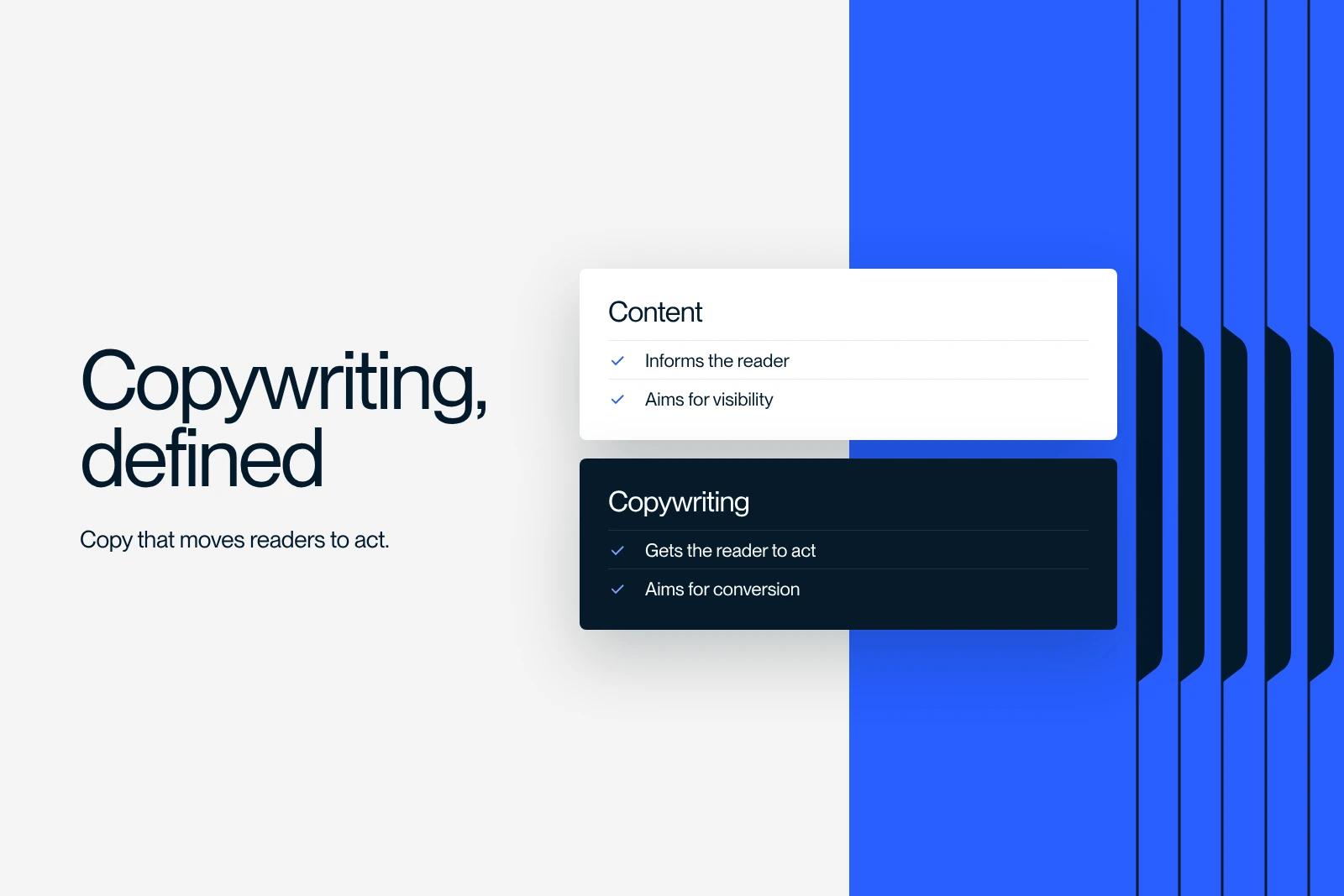
It is important to distinguish copywriting from traditional content, even though the two often overlap in marketing. Traditional content, such as blog posts or social media posts, mainly aims to inform, educate or entertain the audience. Its main purpose is to bring value to the reader without necessarily trying to sell right away. Copywriting, on the other hand, has persuasion as its primary mission, prompting the reader to take a specific action.
Another notable difference lies in structure and writing style. Copywriting is generally more concise and direct, using short, punchy sentences to catch the reader's attention quickly. Traditional content, by contrast, can afford deeper explorations and longer narratives, because its aim is to hold interest over a longer period. This means copywriting has to be more strategic in its choice of words and phrasing to achieve an immediate impact.
Finally, success is measured differently. For copywriting, success is often measured in conversions, sales or link clicks. Writers analyze key performance indicators (KPIs) to assess how effective their copy is. The success of traditional content, on the other hand, can be measured by engagement, shares and comments, which indicate the value the audience perceives. This distinction is essential for marketers who want to define their goals and strategies.
The 3 essential elements of good copywriting
- Clarity: a simple, understandable message.
- Relevance: tailoring the content to what the target audience expects.
- Storytelling: stories stick in people's minds and create emotional engagement.
Good copywriting tells a story that resonates with its audience.
How to improve your copywriting skills
- Read and analyze the best ads, sales pages and compelling articles.
- Practice regularly by writing a variety of content.
- Ask for feedback from experts or people around you.
Learning copywriting is an ongoing process that improves with time and experience.
The 5 levels of prospect awareness and how they shape copywriting
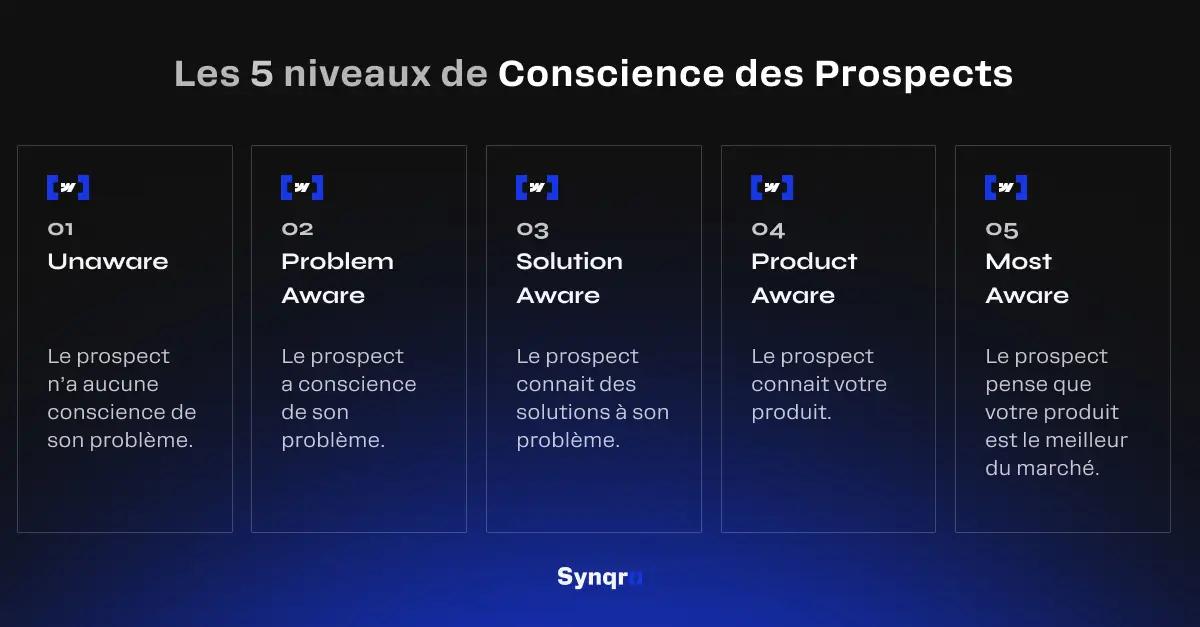
In digital marketing, not all prospects relate to an offer in the same way. Some are completely unaware that they have a problem, while others are actively looking for the best solution to meet their need. This is where the concept of the 5 levels of prospect awareness comes in, a fundamental principle for effective copywriting and an optimized conversion strategy.
Good copywriting is not simply about writing well, but about speaking to the right person with the right message at the right time. Using the wrong tone or presenting an offer too early in the prospect's journey can lead to a lack of engagement, or even outright rejection of the message.
Let's look at each level of awareness in detail and how to adapt copywriting to it.
1. Unaware: the prospect has no awareness of their problem
👉 Prospect profile: they do not even know they have a problem. So they are not looking for any solution and have no intention to buy.
🔹 Example: someone who sleeps badly at night but simply thinks it is "normal" and is not looking for a solution.
✍ Copywriting strategy:
- The goal here is to educate the prospect without selling them a product directly.
- Use blog posts, videos or social media posts that shed light on the problem.
- An informative, non-commercial tone, with facts, statistics and testimonials.
💡 Content example:
"Did you know that 35% of adults have sleep disorders without realizing it? Learn how to spot the signs of unrefreshing sleep."
2. Problem aware: the prospect is aware of their problem
👉 Prospect profile: they know they have a problem, but do not yet know the available solutions.
🔹 Example: the person starts to think: "I sleep badly and I am often tired during the day. Maybe I should look for a solution?"
✍ Copywriting strategy:
- Show that solutions exist and spark curiosity.
- Use case studies, customer testimonials and educational content.
- Ask engaging questions to spark interest.
💡 Content example:
"Do you struggle to fall asleep and wake up tired? Discover the 5 most common causes of sleep disorders and how to fix them."
3. Solution aware: the prospect knows solutions to their problem
👉 Prospect profile: they know solutions exist, but do not yet know your specific product or service.
🔹 Example: they start looking for natural remedies, ergonomic pillows or suitable mattresses to improve their sleep.
✍ Copywriting strategy:
- Compare different solutions to help the prospect choose.
- Highlight the pros and cons of the available options.
- Offer comparison content and buying guides.
💡 Content example:
"Ergonomic pillow or memory foam mattress: which solution works best for better sleep?"
4. Product aware: the prospect knows your product
👉 Prospect profile: they know your product exists and are starting to take an interest, but are not yet convinced it is the right choice.
🔹 Example: they have heard of your brand and visited your website, but are still hesitating between several options.
✍ Copywriting strategy:
- Reassure with customer testimonials, demos and guarantees.
- Highlight the specific benefits that set your product apart from the others.
- Offer special deals or a free trial.
💡 Content example:
"Our ergonomic pillow has already helped more than 10,000 people sleep better. Try it for 30 nights, satisfaction guaranteed or your money back."
5. Most aware: the prospect thinks your product is the best
👉 Prospect profile: they are ready to buy, but may still hesitate about the timing or wait for a final trigger.
🔹 Example: they are convinced by your ergonomic pillow, but may be waiting for a promotion or an extra bonus to complete the purchase.
✍ Copywriting strategy:
- Create a sense of urgency (time-limited offer).
- Add strong social proof (recent customer reviews, certification badges).
- Make it easy to take action (installment payments, money-back guarantee).
💡 Content example:
"Last chance: our ergonomic pillow is on sale for 24 hours only. Order now and get 20% off."
Why copywriting matched to the level of awareness is essential
Effective copywriting is not simply about selling right away, but about guiding the prospect throughout their buying journey.
- If you try to sell directly to an "Unaware" person, they will pay no attention to your offer.
- If you do not give a "Solution Aware" prospect points of comparison, they will look elsewhere.
- If you do not provide social proof to a "Product Aware" prospect, they may have doubts and not complete the purchase.
Each level of awareness requires a different message and a specific approach to capture attention, hold interest and turn the prospect into a customer.
By understanding these 5 levels and adapting your copywriting, you maximize your chances of reaching the right prospects, at the right time, with the right message.
Useful copywriting tools
- Grammarly: grammar correction and improvement.
- CoSchedule Headline Analyzer: headline analysis and optimization.
- Google Analytics: measures the impact of your copy on the audience.
These tools help you refine your writing and increase the impact of your content.
Examples of successful copywriting
To better understand how effective copywriting can be, let's look at a few iconic examples. One of the most famous campaigns is Nike's, which uses powerful, inspiring slogans such as "Just Do It". This simple but impactful message encourages people to take action, whatever their skill level. The strength of Nike's copywriting lies in its ability to build an emotional connection with the audience while conveying an image of determination and pushing past one's limits.
Another striking example is Dollar Shave Club, which shook up the shaving industry with its humorous ad video. By combining a clear message about the value of its products with a relaxed, entertaining tone, the brand managed to capture the attention of a wide audience. This unique approach not only generated viral buzz, but also led to a significant increase in subscriptions, proving the impact of good copywriting.
Finally, Airbnb has made the most of storytelling in its communication. By sharing stories of travelers who have had unique experiences thanks to its services, the brand creates a strong emotional bond with its audience. This kind of copywriting highlights not only the products but also human experiences, reinforcing the brand's identity and its relevance in the market.

Training to sharpen your copywriting skills
For those who want to deepen their copywriting skills, several training options are available. Many online courses are offered by platforms such as Udemy, Coursera and LinkedIn Learning. These courses vary in length and cost, and cover topics ranging from copywriting basics to advanced persuasion techniques. By taking them, you can gain new practical and theoretical skills.
In-person workshops are also an excellent way to learn. Many organizations offer training sessions led by industry experts. These workshops often provide networking opportunities and hands-on learning, allowing participants to exchange ideas and feedback. These interactive settings also encourage creativity and engagement, which can greatly enrich your learning.
Finally, it can be useful to join online groups or forums dedicated to copywriting. These communities let members share advice, tips and feedback on each other's work. Taking part in discussions and constructive critiques can help you progress quickly and keep up with the industry's trends and best practices.
- Online courses: Udemy, Coursera, LinkedIn Learning.
- In-person workshops: ideal for interactive learning.
- Online communities: specialized groups and forums.
Investing in continuous learning is essential to improve as a copywriter.
Conclusion
In 2025, copywriting remains a key skill for success in digital marketing. By mastering persuasion techniques, optimizing their messages and adapting their tone to their audience, a copywriter can turn a simple text into a powerful conversion lever.
Never underestimate the power of words: they can influence, sell and build a lasting relationship with your audience.
Copywriting is a craft that can be learned and perfected.
Frequently asked questions
Copywriting focuses on persuasion and prompting action (purchase, sign-up, link click). It is centered on commercial and marketing effectiveness. Web writing, on the other hand, aims to inform, educate or entertain. It includes blog posts, informational pages and guides.