Article
ChatGPT SEO: how to get cited by AI in 2026
IA7 min read

Guillaume SchluppConsultant SEO
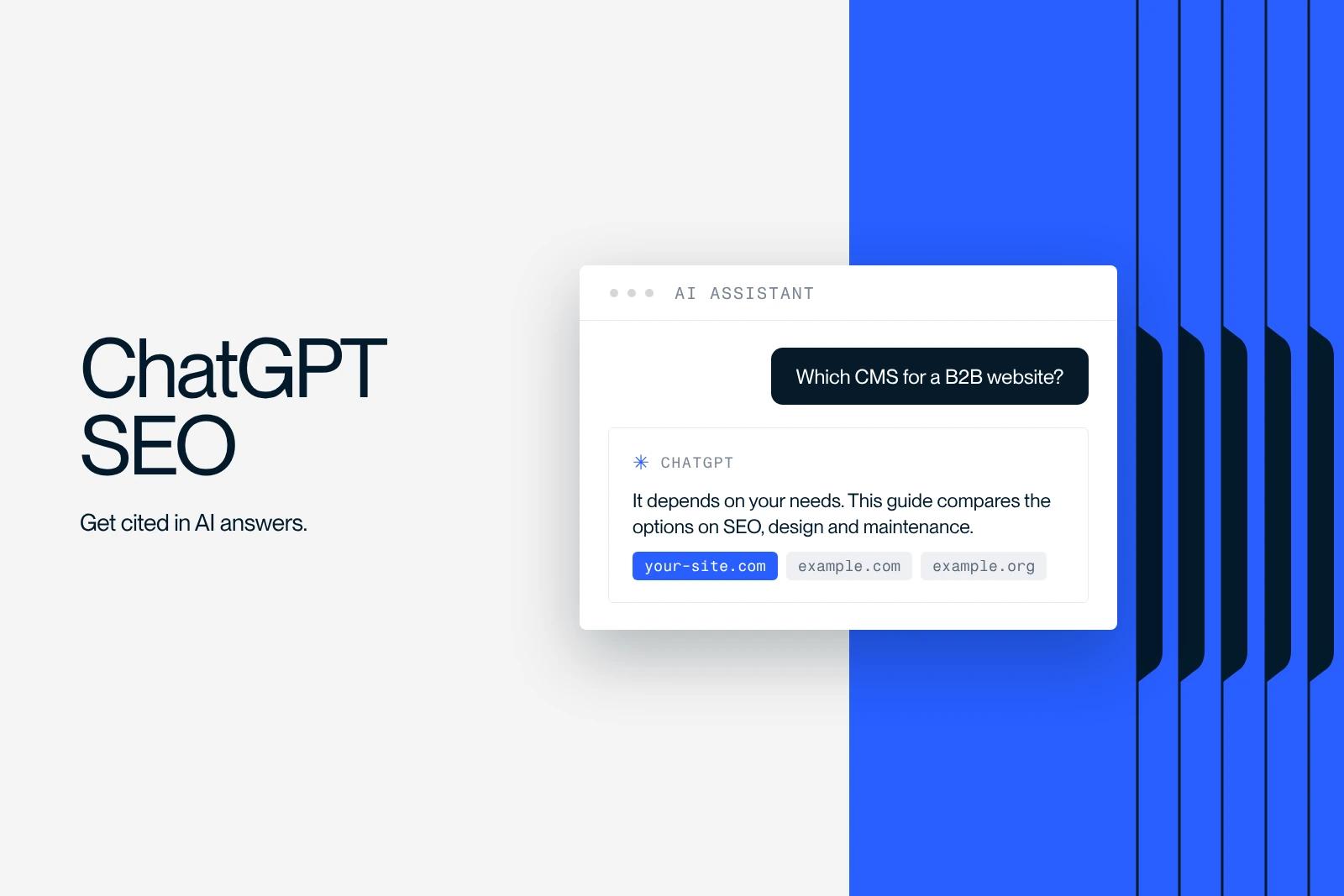
ChatGPT SEO, also called GEO (Generative Engine Optimization), covers all the techniques that get your brand cited as a source in answers generated by ChatGPT and other AI tools. Classic SEO aims for a position in a list of links. ChatGPT SEO aims to become the answer itself. This guide explains how ChatGPT picks its sources, the pillars to activate to get cited, a step-by-step method, realistic timelines and the mistakes to avoid in 2026.
Explore this post with…
What is ChatGPT SEO (GEO)?
ChatGPT SEO is the practice of optimizing a website and a brand's wider ecosystem so that generative answer engines cite it as a source: ChatGPT, but also Perplexity, Gemini, Claude and Google's AI Overviews. It is also called GEO, for Generative Engine Optimization.
The underlying shift is easy to grasp. More and more users ask their question directly to an AI, which writes a summary answer based on a handful of sources it cites. If your brand is not one of those sources, it becomes invisible in this new search journey, even if it ranks well on Google. ChatGPT SEO aims to turn your content into the reference answer, the one the AI picks up and credits.
ChatGPT SEO vs classic SEO: what are the differences?
Classic SEO and ChatGPT SEO share common foundations, but their goal is different. SEO aims for a click from a list of results. GEO aims for a citation inside a single, synthesized answer. The table below sums up the key differences.
| Criterion | Classic SEO | ChatGPT SEO (GEO) |
|---|---|---|
| Goal | A position in a list of links | A citation in a synthesized answer |
| Target result | A click to your page | Your brand mentioned as a source |
| Main index | Bing for ChatGPT Search, plus AI-specific signals | |
| Key lever | Keywords and backlinks | Authority, Q&A structure and third-party mentions |
| Measurement | Rankings and traffic | How often you are cited in AI answers |
How does ChatGPT choose its sources?
ChatGPT chooses its sources by combining an index of web pages with an assessment of how reliable each source is. For its search feature, ChatGPT Search relies heavily on Bing's index. Being properly indexed in Bing is therefore a prerequisite that is often underestimated.
Beyond indexing, the AI favors three families of signals. First, source reliability, assessed through domain authority and E-E-A-T markers. Second, content clarity: a passage that directly answers a question is easier to extract and cite. Third, recognition of the brand as an entity, meaning your company is identified and associated with an area of expertise across the web. A mention in a recognized publication or a trusted third-party source carries far more weight here than self-promotion on your own site.
The pillars of getting cited by ChatGPT
ChatGPT SEO rests on a few pillars that reinforce each other. Activating them together is what makes the difference.
- Structure content as questions and answers: each section answers a specific question in plain language, which makes it easier for AI to extract.
- Strengthen E-E-A-T: experience, expertise, authoritativeness and trustworthiness, shown through named authors, cited sources and concrete proof.
- Earn mentions on trusted third-party sources: press, serious directories and recognized industry sites, which validate your brand in the eyes of the models.
- Link the brand to recognized entities: Schema.org structured data, a presence in databases such as Wikidata, and consistent information across the web.
- Use the inverted pyramid: give the key point in the first sentence, then expand. This is the format AI tools pick up most readily.
Step-by-step method to optimize your ChatGPT SEO
Here is a concrete sequence to move from theory to action, in the right order.
- Take care of Bing indexing: set up Bing Webmaster Tools, submit your sitemap and use IndexNow to get new pages picked up faster.
- Answer the intent directly: structure each page as an inverted pyramid, with a clear answer in the introduction and an FAQ that covers real questions.
- Implement structured data: mark up your pages with Schema.org (Organization, Article, FAQPage) and keep your brand consistent as an entity.
- Build off-site authority: aim for mentions and citations on reliable sources, because that is where the models' trust is won.
- Measure and iterate: regularly ask AI tools about your target queries, note when you are cited and adjust your content accordingly.
In practice at Synqro: for Kohorte (consulting), which needed lasting SEO foundations, we provided SEO consulting and training to set up sustainable acquisition foundations. Those foundations are exactly what a GEO strategy builds on: a clear, structured and reliable site is much easier for an AI to cite than a messy one.
How long does it take to appear in ChatGPT?
ChatGPT SEO does not deliver instant results, but it is faster than SEO on highly competitive queries. The first citations on a targeted query can appear within 4 to 8 weeks when the work is done well. Building a strong, recurring presence on commercially relevant queries usually takes 3 to 6 months. These ranges vary depending on your starting authority and the competition on the topic.
ChatGPT SEO mistakes to avoid
Some mistakes come up often and slow down results. Knowing them saves you time.
- Neglecting Bing: focusing only on Google when ChatGPT Search relies heavily on Bing's index.
- Publishing unstructured content: walls of text with no clear answer that AI cannot easily extract.
- Ignoring E-E-A-T: no named author, no sources, no proof, and therefore little trust.
- Relying only on your own site: without third-party mentions, your authority stays fragile in the eyes of the models.
- Expecting immediate results: GEO is long-term work, not an on/off switch.
Conclusion
ChatGPT SEO is not a fad. It is the natural extension of SEO to a search journey where AI answers instead of lists of links. The path is clear: take care of Bing indexing, structure your content as answers, strengthen your E-E-A-T and build off-site authority. Want AI to cite you in your market? Our SEO and GEO team can build your strategy, from classic SEO to visibility in ChatGPT. To go further, read our article on using ChatGPT for SEO and our guide to the llms.txt file on Webflow. Let's talk about your AI visibility.
Frequently asked questions
ChatGPT SEO, or GEO, groups the techniques that aim to get your brand cited as a source in answers generated by ChatGPT and other AI tools. The goal is not a click from a list of links, but to be the answer the model picks up and credits when a user asks a question about your area of expertise.