Article
GEO Audit: How to Measure Your Brand's Visibility in AI Search
IA10 min read

James BrunettoCo-fondateur & CEO
A GEO audit measures whether your brand shows up, gets cited and is described accurately in answers from ChatGPT, Perplexity, Gemini, Google AI Overviews and AI Mode. It starts from the questions your buyers actually ask, records who the AI recommends instead of you, and ends with a prioritized action plan. Unlike the free "GEO audit tools" that crawl your site and hand you a score, a real audit looks at the answers themselves. Here is what to measure, how we run one at Synqro, which tools help, and what a serious audit will never promise.
Explore this post with…
What is a GEO audit?
A GEO audit is a baseline of your visibility in AI answer engines. It answers three questions: do AI tools mention you, do they link to your pages, and is what they say true?
GEO stands for Generative Engine Optimization, the work that helps a brand get picked up by those engines. If the term is new to you, start with our guide to generative engine optimization. The audit is step one, because you cannot improve what you have not measured.
Most results ranking for "GEO audit" today are free tools that scan your site for crawlability and structure. That is useful, but it is only one fifth of the job. A site scan tells you whether an AI bot can read your page. It does not tell you whether ChatGPT recommends your competitor when a buyer asks for a shortlist.
| Criterion | Site scan tool | Full GEO audit |
|---|---|---|
| Starting point | Your URL | Your buyers' real questions |
| What it checks | Crawlability, structure, content format | Mentions, citations, accuracy, competitors |
| AI answers reviewed | None or a few | Every question, every platform |
| Competitors | Rarely | Who wins which question, and why |
| Output | A score and a checklist | A visibility map and a dated plan |
What a GEO audit measures
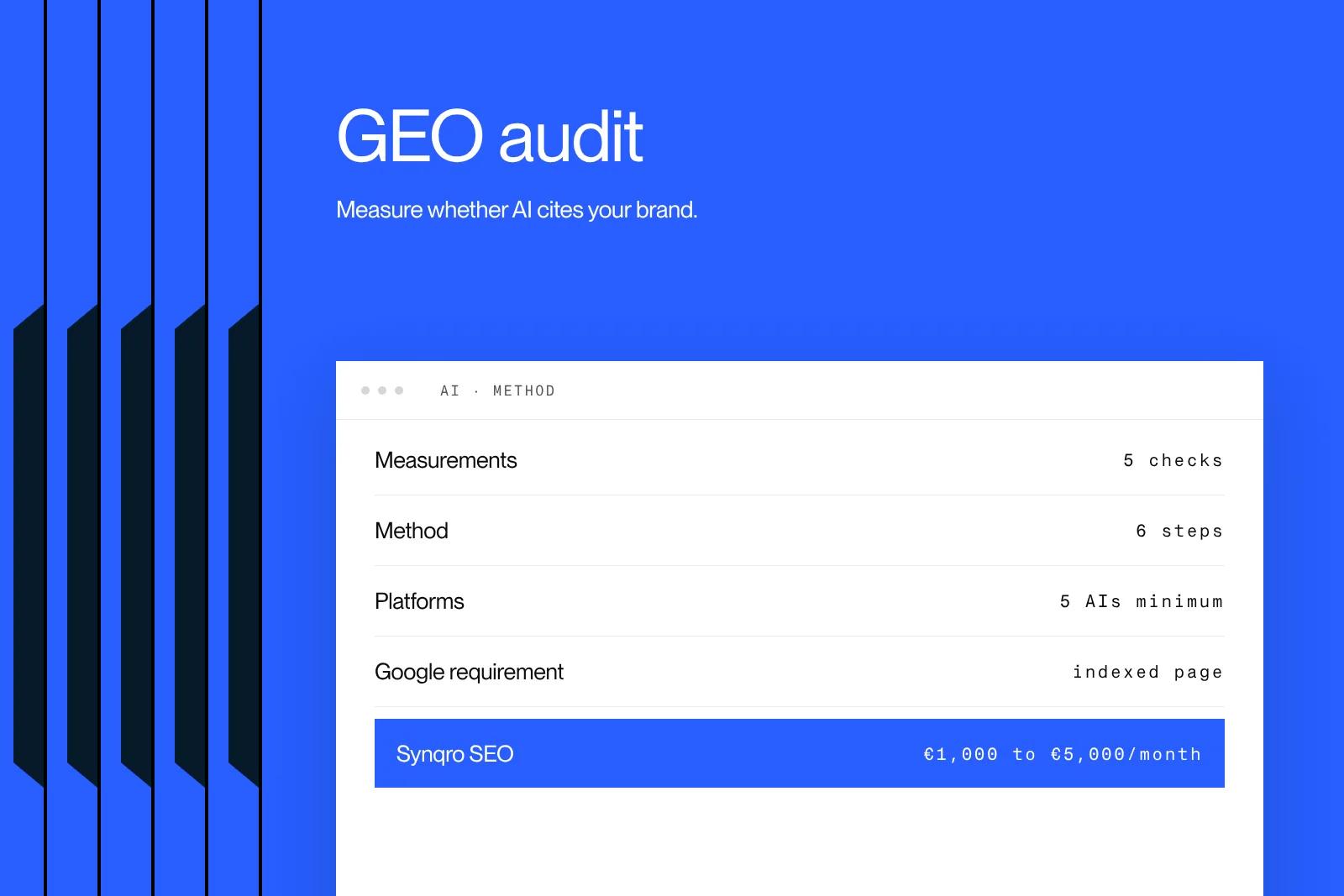
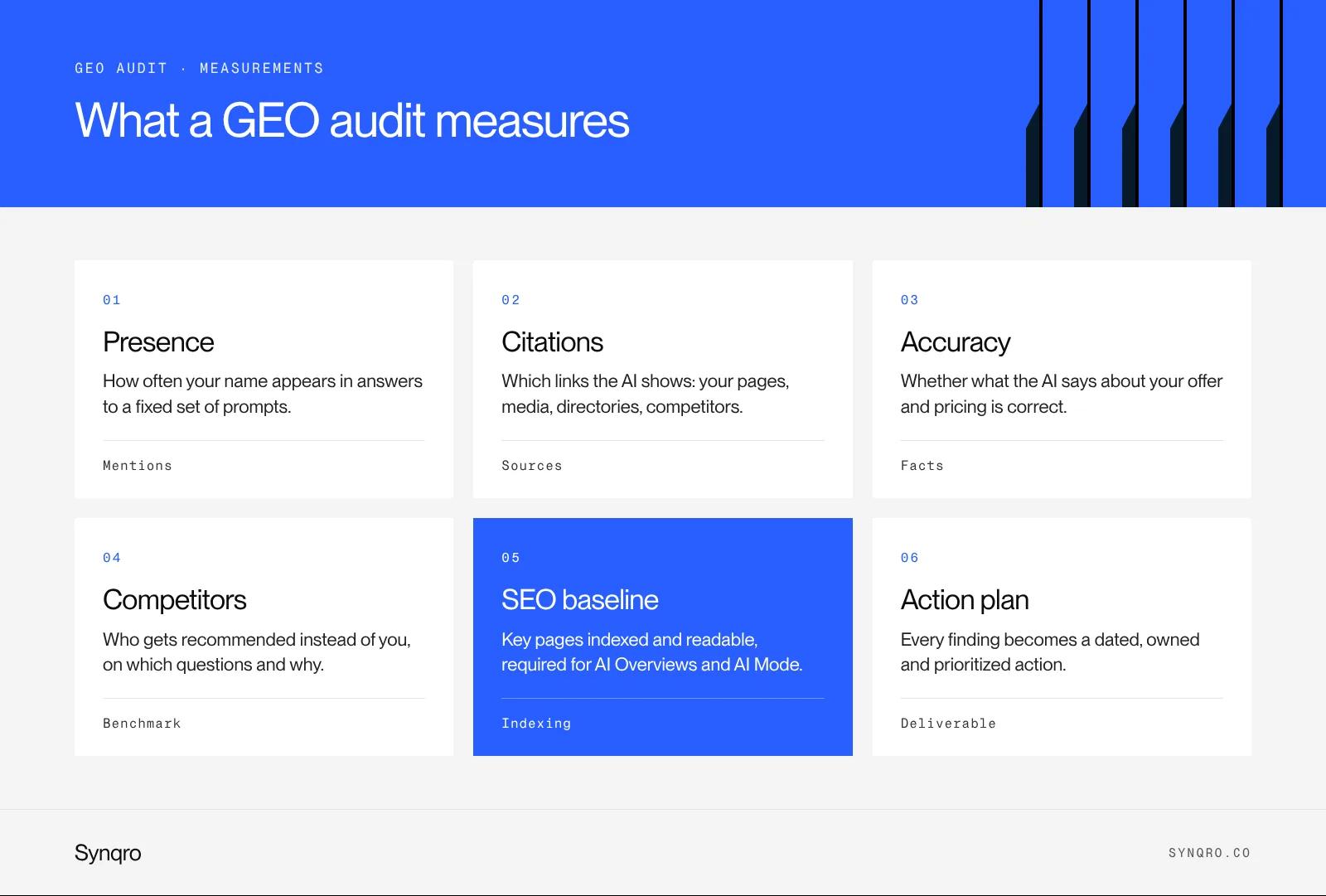
A good audit comes down to five measurements. Each one answers a specific question and leads to different actions.
- Brand presence. Across a fixed set of prompts, how often does your name appear in the answer?
- Citations and sources. When the AI shows links, which ones? Your pages, a directory, a trade publication, a competitor, a forum?
- Answer accuracy. Is what the AI says about you correct: offer, pricing, markets, clients, founding date?
- Competitors cited. Who gets recommended instead of you, on which questions, with what arguments?
- SEO baseline. Are your key pages indexed, crawlable and readable by Google?
The last one matters more than people expect. Google's own guidance on AI features and your website says that to appear as a supporting link in AI Overviews or AI Mode, a page must be indexed and eligible to show in Search with a snippet. Google adds that there are no additional technical requirements, no special files and no special schema.org markup.
So a poorly indexed site starts behind on Google's AI surfaces, whatever else you do. That is why every Synqro GEO audit opens with a quick indexing check drawn from our technical SEO audit process.
Why run a GEO audit now
Because your buyers already ask an AI before they visit your site. They type "best commission management software for a 40-person sales team" or "which agency should rebuild our B2B website". The answer names three or four companies. If you are not one of them, you are not on the shortlist.
An audit also saves you from two expensive mistakes:
- publishing dozens of "AI-ready" articles without knowing which questions you are missing;
- paying for a tracking tool with a poor prompt list, then watching a chart that means nothing.
How to run a GEO audit, step by step
This is the method we use at Synqro. Six steps, in this order.
- List the questions buyers really ask. We start from sales calls, inbound requests, objections and the comparisons prospects make. Not from a generic keyword list. A few dozen questions is usually enough, split across discovery, comparison and decision.
- Pick the platforms. ChatGPT, Perplexity, Gemini, AI Overviews and AI Mode at minimum, depending on your market and language. An audit for the US and one for France will not return the same answers.
- Record the answers. For each question and each AI, we note whether the brand is cited, in what position, with which sources and what message. We repeat runs, because answers change between sessions.
- Benchmark competitors. We measure each competitor's share of answers, and above all the sources that earn them those mentions: listicles, review sites, category pages, trade media.
- Check the SEO and content base. Indexing of key pages, pages that truly answer the recorded questions, and key facts available as text (pricing, timelines, references).
- Write the action plan. Every finding becomes a dated, owned action: page to create, page to fix, third-party source to earn, factual error to correct.
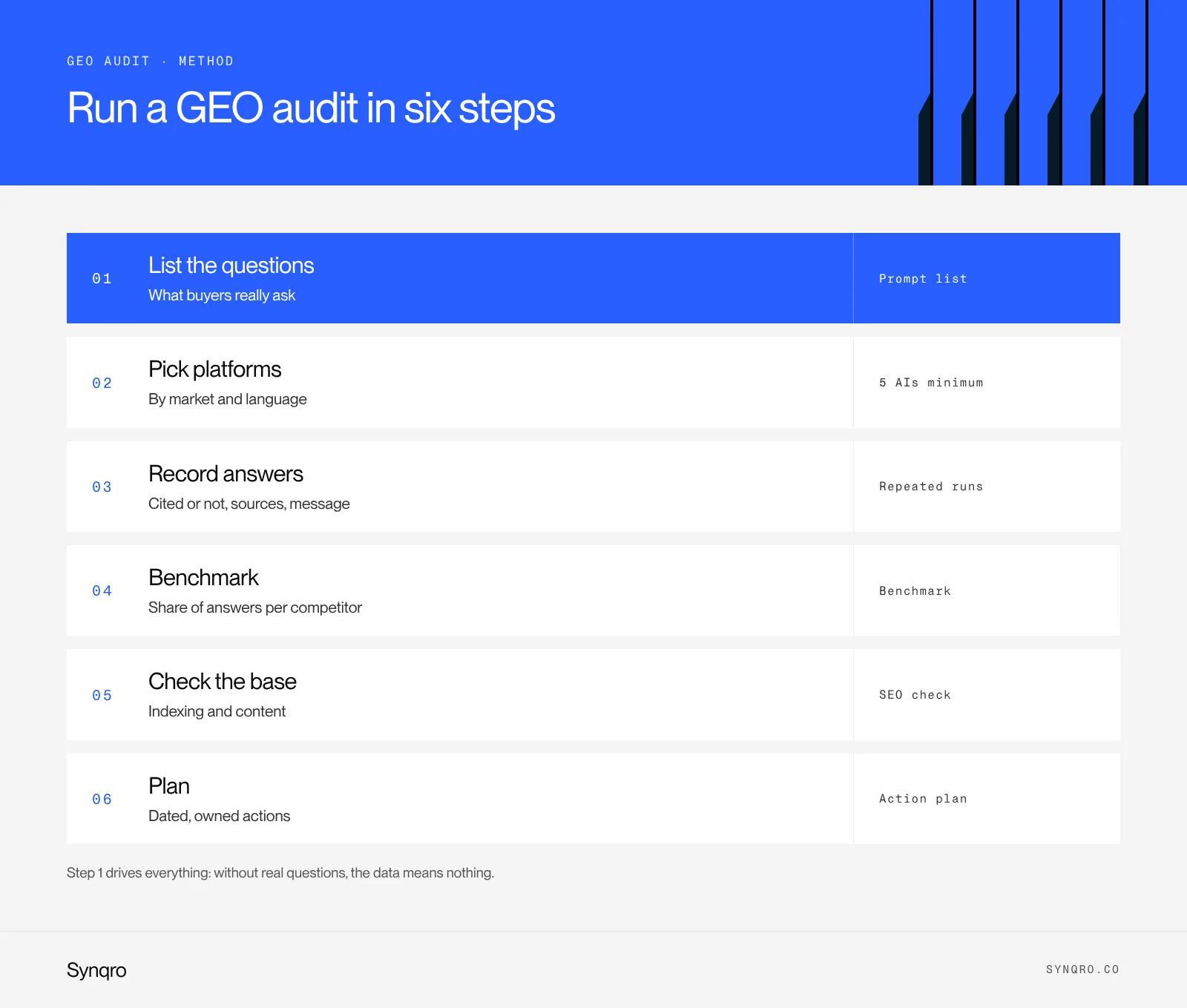
Step 1 is where most audits cut corners. An AI does not answer "commission software". It answers "what can replace our commission spreadsheets for 40 reps". At Synqro, we collect the client's own material (sales decks, brochures, real figures) before writing a single prompt. Same rule as for our content: without real material, the output is generic.
Tools for a GEO audit
Tools speed up data collection. They do not replace the prompt list or the analysis. Here are the ones we know, with their coverage checked on their own sites in October 2026.
| Tool | What it does | Platforms covered |
|---|---|---|
| Otterly.ai | Prompt tracking, brand reports, a technical audit module | ChatGPT, AI Overviews, AI Mode, Gemini, Perplexity, Copilot |
| Ahrefs Brand Radar | Ready-made AI visibility index plus custom prompt tracking | AI Overviews, AI Mode, ChatGPT, Perplexity, Gemini, Copilot |
| Semrush AI Visibility Toolkit | Visibility, competitor and prompt research, tracking | ChatGPT and AI Mode named in its docs |
| Manual checks | Questions asked by hand in a private window | Any, case by case |
| Google Search Console | Clicks and impressions, AI features included under Web | Google only |
Two caveats. First, coverage changes fast, so check the platform list when you subscribe. Otterly's own audit module, for instance, focuses on crawlability, content and query fan-out, not on every dimension of a full audit.
Second, Search Console does not break out AI traffic. Google counts clicks from AI Overviews and AI Mode in overall search traffic, under the Web search type. You will not find an "AI Mode" row in your reports. For more on that surface, read our guide to Google AI Mode.
At Synqro, we track our own AI citations, not only our clients'. It forces us to test on ourselves what we recommend, and to see in real time what moves after a new page or a new mention in an industry comparison.
GEO audit deliverables
A useful audit fits in a few documents, and each one should drive a decision.
- The final prompt list, grouped by buying stage.
- The visibility map: for each question and each AI, present or absent, cited or not, with sources.
- The accuracy log: what AI tools get wrong about you, and where it comes from.
- The competitor benchmark: who wins which questions, thanks to which sources.
- The prioritized action plan, with estimated effort and expected impact.
After the audit, we produce monthly GEO reports for the clients we support. We keep the same prompt list month to month so we compare like with like. Changing prompts every month makes the trend unreadable.
What a serious GEO audit does not promise
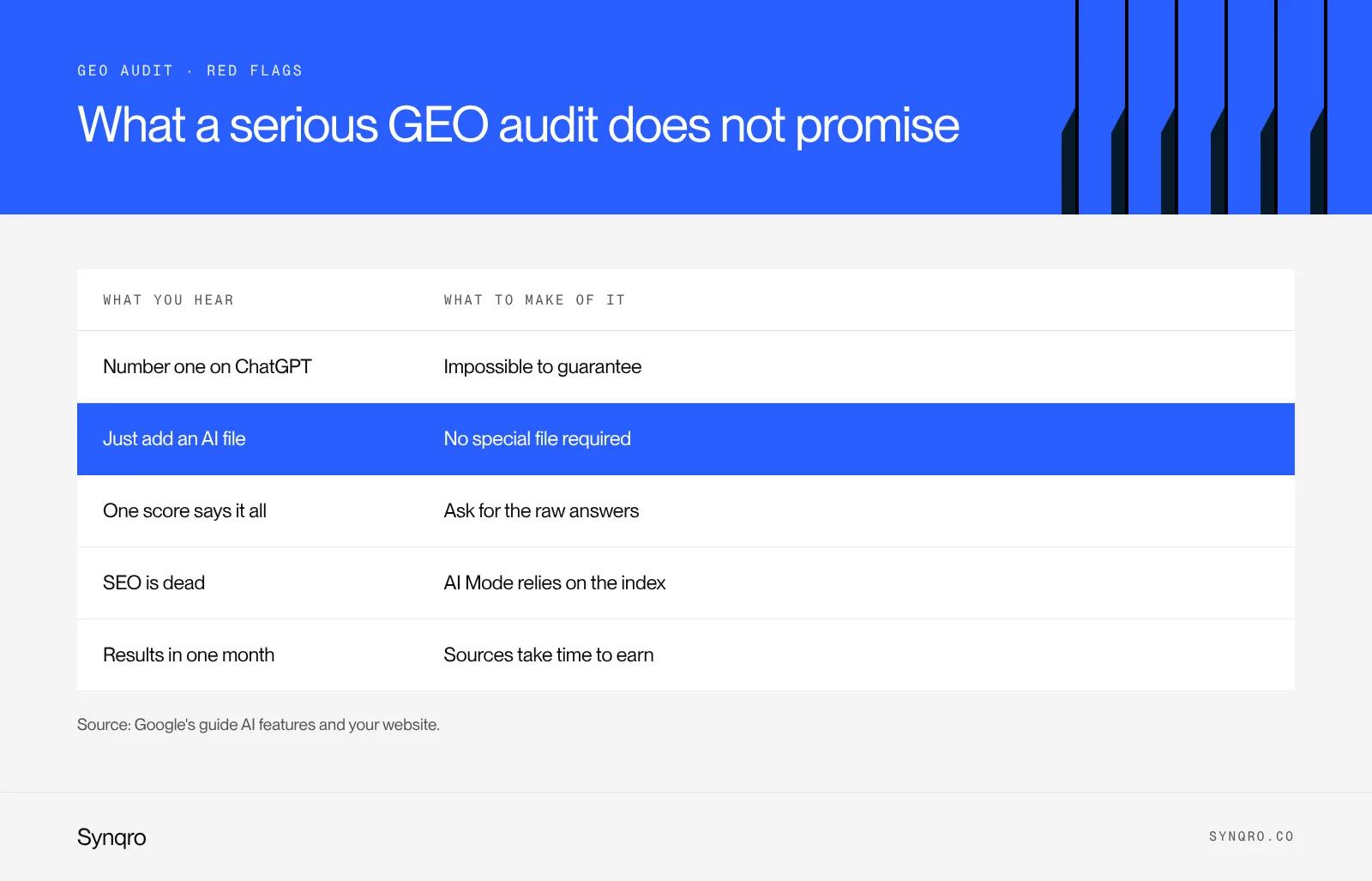
This is the best filter for choosing a provider. Be wary of any audit that promises:
- A guaranteed spot in ChatGPT or AI Mode. Nobody controls a model's answer. Google itself states that indexing and serving are not guaranteed.
- A magic file or markup. Google writes that you do not need new machine-readable files, AI text files or special markup to appear in its AI features.
- One score that sums it all up. A grade out of 100 without the underlying questions does not tell you what to do on Monday.
- Results in a few days. The sources AI tools read are built over weeks and months.
| What you hear | What to make of it |
|---|---|
| "You will be number one on ChatGPT" | Impossible to guarantee, answers vary |
| "Just add an AI file to your site" | Google says no special file is required |
| "Our GEO score says it all" | Ask for the prompt list and raw answers |
| "SEO is dead now" | AI Overviews and AI Mode rely on Google's index |
| "Guaranteed results in one month" | Third-party sources take time to earn |
How long does a GEO audit take, and what does it cost?
Think weeks, not months. Duration depends mostly on the number of questions, platforms and markets. A single-market, single-language audit is faster than a multilingual one, where each language has its own competitors and sources.
Market prices range widely, from free automated scans to fully custom studies. A report generated by a tool in five minutes is not worth the same as an audit built on your real buyer questions and ending with a dated plan.
At Synqro, the GEO audit is part of an SEO and GEO engagement priced from €1,000 to €5,000 per month, excluding VAT, depending on scope. We prefer that to a one-off audit: an audit nobody acts on changes nothing about your visibility. You will find the full offer on our page about getting your brand cited by AI search.
What to do after the audit
An audit is only worth what follows. Most actions fall into three groups:
- Your pages: create pages that answer the questions where you are missing, and make key facts readable as text (offer, pricing, timelines, references).
- Third-party sources: be present in the comparisons, quality directories and trade media AI tools cite in your market.
- The SEO base: fix indexing and crawling, because that is the entry point to Google's AI features.
If ChatGPT is your main target, our guide on how to rank on ChatGPT covers the levers specific to it. To compare providers, see our list of the best GEO agencies.
A concrete example: for Lumera, an influence agency working between China and Europe, we built a site in Chinese, English and French, with an SEO and GEO strategy covering more than 150 keywords and a six-month content plan. Within weeks of launch, Lumera received its first leads from SEO and GEO. At Qobra, the commission management platform, long-term work on the site tripled inbound requests and grew organic traffic 16 times. Both started the same way: measure first, act second, and revisit priorities every quarter.
Frequently asked questions
A GEO audit measures the presence, citations and accuracy of your brand in answers from ChatGPT, Perplexity, Gemini, AI Overviews and AI Mode. It also benchmarks your visibility against competitors and ends with a prioritized action plan.