Article
Transition words for SEO: the complete list by category
SEO9 min read

James BrunettoCo-fondateur & CEO
A transition word is a connector that sets up a logical relationship between two ideas: addition, cause, consequence, contrast. In SEO, it serves less to please an algorithm than to make a text readable, and readability shows up in the signals Google observes.
This article gives the complete list of 120+ connectors sorted into twelve categories, the threshold Yoast expects, and above all the method for adding them without it showing.
At Synqro, a Webflow and SEO agency, we run this review on every piece of content we deliver. What follows is the actual protocol, including the mistakes we have learned to avoid.
Explore this post with…
What is a transition word in SEO?
A transition word is a linguistic connector that sets up a logical relationship between two sentences, two paragraphs or two ideas.
It does three jobs. It guides the reader from one idea to the next. It makes the structure of the reasoning explicit. And it signals to search engines and language models alike how your arguments connect.
That last point has grown in importance. A generative engine that extracts a passage to answer a question needs to understand where an idea starts and where it ends. Explicit connectors give it those boundaries.
One important point up front: transition words are not a ranking factor. No one at Google has ever said otherwise. They work indirectly, by making the text more readable, and readability influences time on page, reading depth and the likelihood that a passage gets picked up elsewhere.
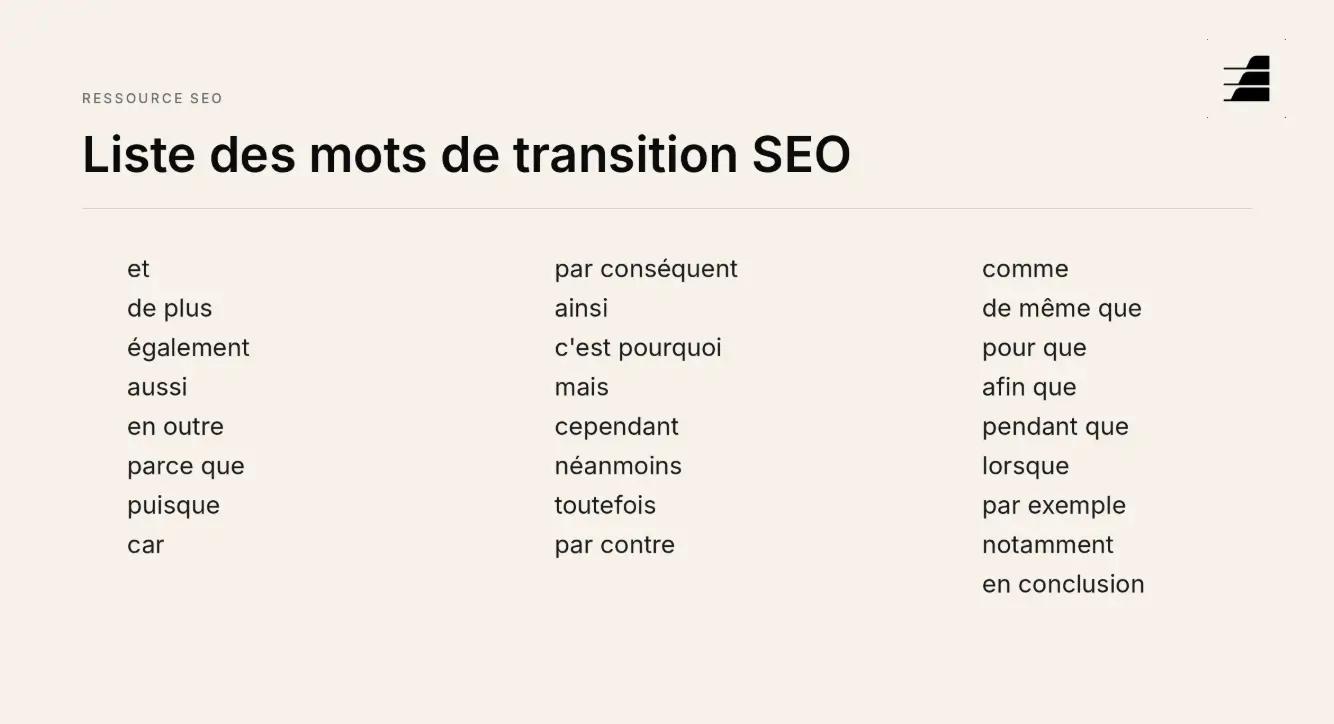
The complete list of transition words by category
More than 120 connectors, sorted by the logical relationship they express. That relationship should guide your choice, not how the word sounds.
Addition and continuity
To add an idea that goes in the same direction as the previous one.
and · also · in addition · furthermore · moreover · besides · as well · what's more · all the more so as · not only… but also · additionally · equally important · on top of that · along the same lines
Cause and justification
To explain the reason for a fact.
because · since · as · due to · owing to the fact that · given that · in view of · thanks to · because of · on the pretext that
Consequence and result
To show the logical effect of a situation.
so · therefore · thus · that is why · as a result · consequently · it follows that · hence · this is why · so much so that · so that · in such a way that
Contrast and opposition
To mark a difference or a contradiction.
but · however · nevertheless · nonetheless · on the other hand · whereas · in contrast · on the contrary · despite · although · even though · while · conversely · yet · still
Condition and hypothesis
To introduce a necessary condition.
if · provided that · as long as · in the event that · assuming that · unless · in case · to the extent that · if only
Comparison and similarity
To draw a parallel between two elements.
like · just as · as well as · similarly · in the same way · in the image of · just like · such as · as much as · following the example of
Purpose and goal
To express the purpose of an action.
so that · in order that · with the aim of · with a view to · so as to · in such a way as to · to · in order to
Time and sequence
To place ideas in relation to one another.
while · when · before · after · as soon as · ever since · first of all · next · then · lastly · beforehand · afterward · simultaneously · meanwhile · first · finally
Example and illustration
To introduce a concrete case.
for example · notably · in particular · as an example · for instance · among others · in this case · such as · this is the case with · to illustrate
Clarification and rephrasing
To clarify or say something another way.
that is · in other words · put differently · more precisely · namely · in fact · actually · to put it plainly · in practice
Emphasis and reinforcement
To support a statement.
indeed · incidentally · for that matter · above all · all the more · especially since · admittedly · certainly · it is true that
Conclusion and summary
To introduce a wrap-up.
to conclude · in short · ultimately · in summary · in the end · in brief · to finish · all things considered · in the final analysis
Why it matters for SEO
The effect is indirect, and it is important to say so clearly rather than promise a gain in rankings.
Readability
The Flesch reading ease score rates a text from 0 to 100: the higher the score, the easier the text is to read. Connectors mechanically improve this score by reducing the effort needed to move from one idea to the next.
A text that reads effortlessly is a text people read to the end. That is the whole benefit, and it is more than enough to justify the exercise.
Behavioral signals
Google indirectly observes user satisfaction: do people return to the search results right away, or keep reading? A smooth text holds attention longer than a choppy one.
Google's official position, repeated by its spokespeople, is that readability is not a ranking factor as such. It does, however, influence everything users do once they land on the page.
Extraction by generative engines
ChatGPT, Perplexity and Google's AI Overviews extract passages to build their answers. An explicit connector such as "as a result" shows where the conclusion of a line of reasoning sits, which makes the passage easier to isolate cleanly.
It is the only area where the effect of connectors has clearly grown in importance over the past two years.
How Yoast evaluates your transitions
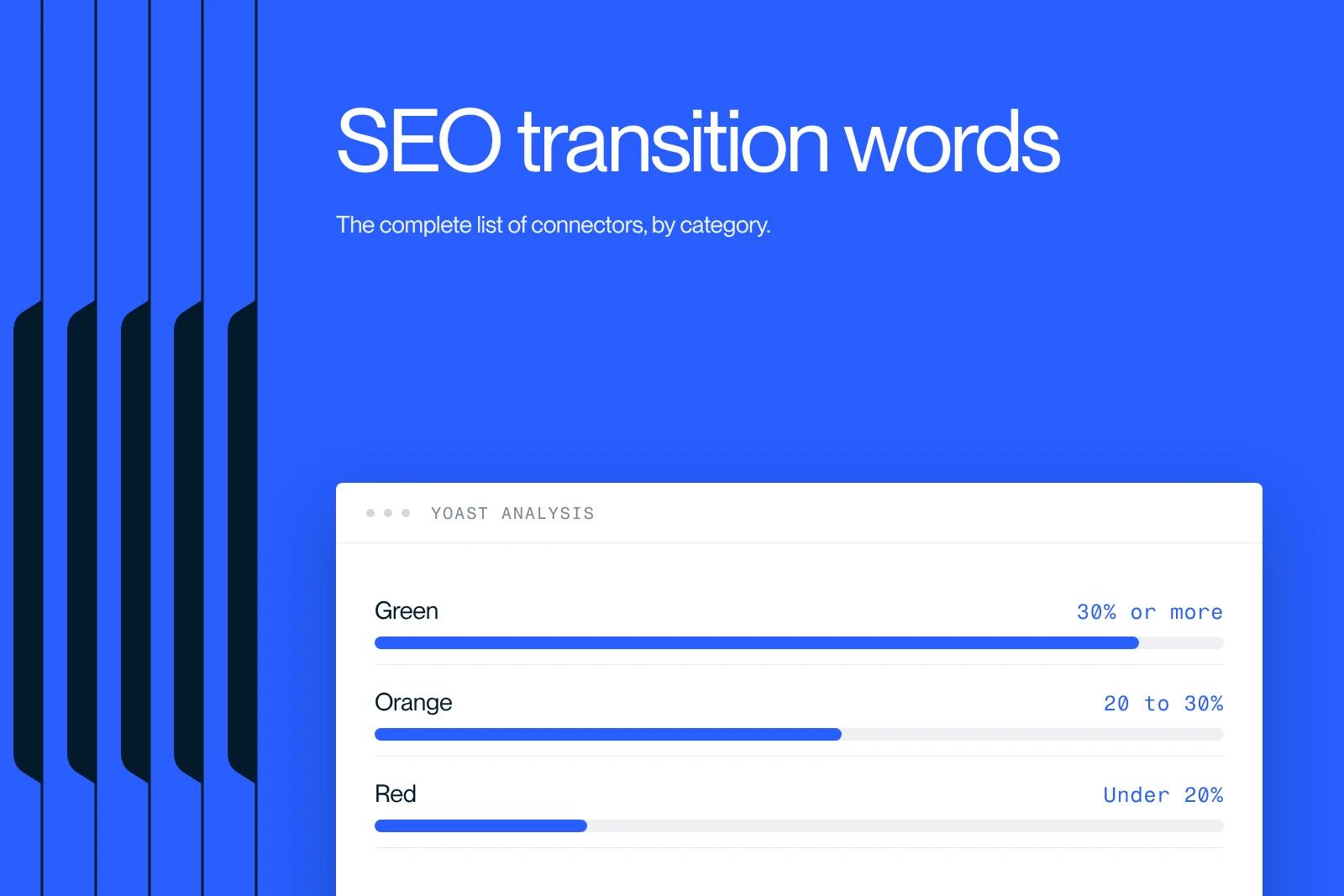
Yoast SEO calculates the percentage of sentences that contain at least one connector from its database. The traffic-light system is simple:
- Green: 30% of sentences or more contain a transition word.
- Orange: between 20% and 30%.
- Red: less than 20%.
Yoast also evaluates other readability criteria: sentence length, the share of passive voice, paragraph length, repeated sentence openings and heading hierarchy.
A useful warning: this threshold is a convention of the tool, not a Google rule. Aiming for green is a good safeguard; making it an absolute goal produces mechanical text.
Other tools
- Hemingway Editor: flags sentences that are too long or too complex, beyond connectors alone.
- Antidote: a writing assistant that is the most relevant for French-language text when checking how sentences flow.
- Surfer SEO: compares your structure with that of pages that already rank well.
The three-step method
The worst way to go about it is to think about transitions while writing: the text becomes rigid and you can hear the effort. Here is the order that works.
- Write without thinking about it. Lay out the ideas, in order, without worrying about the links between them.
- Reread looking for breaks. Every place where the reading snags signals a missing link.
- Add the connector that matches the actual relationship: addition, cause, consequence, contrast. Not the one that sounds good: the one that is accurate.
This third step is the one people rush. A "however" placed where there is no contrast confuses the reader, and signals to the model a contradiction that does not exist.
Where to place them first
- At the start of a paragraph: to connect it to the previous paragraph.
- Before an example: "for example", "in practice".
- Before the conclusion of a section: "as a result", "that is why".
- Before a data point: naming its source in the same sentence.
Adjusting density to the format
The 30% threshold applies to an in-depth article. Elsewhere, it works against the text:
- Blog post: around 30%.
- Product page: much less, because the text is descriptive, not argumentative.
- Landing page: the minimum, because short messages live on their rhythm.
- FAQ: somewhere in between, since each answer must stand on its own.
The five most common mistakes
- Overuse: a connector in every sentence weighs the text down as much as having none. If a sentence works without one, leave it without.
- The inconsistent connector: "as a result" with no cause-and-effect link is worse than nothing: it misrepresents the structure of the reasoning.
- Repetition: the same word three times in ten lines creates a reading tic. Alternate between "so", "that is why" and "as a result".
- The decorative connector: added afterward to turn a tool green. You can hear it, and the reader tunes out.
- Forgetting headings: transitions also matter between sections, not just between sentences.
An example of both
Avoid: "Furthermore, SEO is important. In addition, content needs to be optimized. Moreover, keywords matter." Three connectors, no progression.
Better: "SEO rests on three pillars: content, technical work and authority. Each one calls for a distinct approach. For example, content work starts with choosing topics before choosing keywords." A single connector, and the reasoning moves forward.
Frequently asked questions
Yoast turns green at 30% of sentences. It is a useful benchmark for an in-depth article, not a universal rule: a product page or a landing page works very well well below that.