Article
Web design: the complete guide for web designers
Branding14 min read

James BrunettoCo-fondateur & CEO
Web design: explore the job, the tools and the trends. Create engaging web interfaces, and find web design inspiration for your website.
Explore this post with…
Web design is the visual and functional soul of the web. In the digital ecosystem of 2026, it is no longer just about arranging graphic elements on a web page, but about building an emotional and technical architecture that can turn a casual visitor into a loyal user. Whether we are talking about ergonomics, cognitive psychology or technical optimization, web design has therefore become the central pillar of any successful communication strategy.
Designing interfaces today requires a fine understanding of human behavior combined with flawless technical command. The goal of web design is no longer only aesthetic; it is to make every website or app perfectly smooth, accessible and memorable.
The web designer's job: role, skills and career path
The web designer's job has changed. Once seen as someone who simply executed graphics, the web designer is now an interaction strategist. Within a digital project, the web designer has to master the mechanics of visual communication while anticipating the needs of the business.
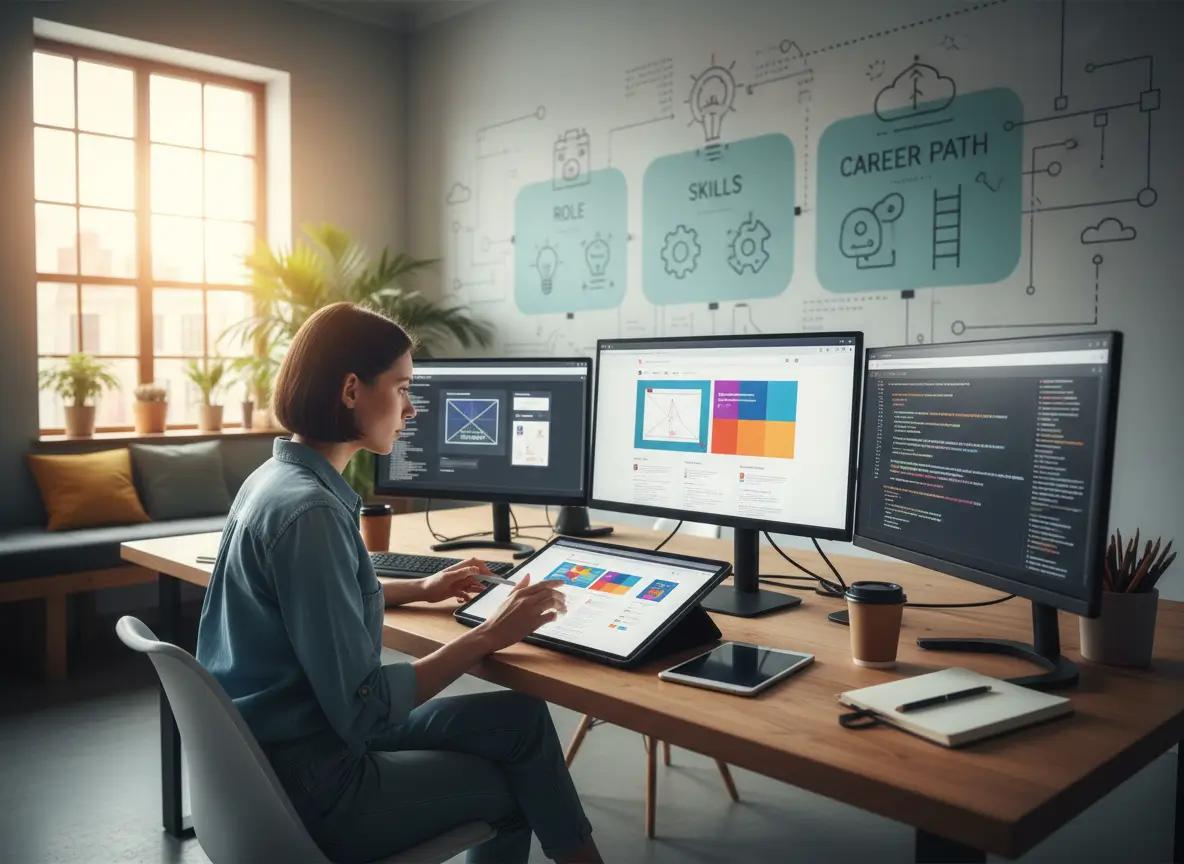
The web designer's role and responsibilities
The web designer is responsible for translating a brand's identity into the digital world. The work starts well before any design software is opened. They first need to immerse themselves in the company's strategy to understand who the end users are. As a web designer, they guarantee harmony between the marketing message and usability.
The web designer's mission is to create web interfaces that capture attention. Whether it is the structure of a website for a brochure site or the complexity of a SaaS platform, they must make sure every feature is intuitive. Their role is to be the bridge between pure creativity and web development.
Essential technical and creative skills
In the field of design, versatility is key. The web designer has to master a range of skills, from the fundamentals of graphic design to an understanding of code.
- Design fundamentals: command of color theory, visual hierarchy and the balance of white space.
- User interface (UI) and UX design: knowing how to create interfaces that guide the user effortlessly. The design has to be easy to use to reduce the visitor's cognitive load.
- Technical culture: it is essential to understand the technical constraints of the browser. A designer who ignores the basics of the web (how elements stack and behave) will produce mockups that cannot be built.
Training and paths to becoming a web designer
The path into this exciting profession has become more professional. Today, companies favor candidates who have followed a structured program:
- Bachelor's in web design: a 3-year program that allows students to learn how to build websites from A to Z.
- RNCP level 6 certification: this French state-recognized qualification, equivalent to a bachelor's degree, certifies a level of skill and is essential to prove your credibility on the market.
- Master's in art direction: for those aiming for management positions after 5 years of study, this program prepares you to oversee website creation at a strategic level.
Students learn not only to design, but also to manage a web project as a whole, from the brief to final delivery.
Essential web design tools and software
Today's digital craftsperson relies on increasingly collaborative and powerful tools to design web interfaces that perform.

Visual design and UI design software
The days of building your first website in Photoshop are over. Today, visual design tools are vector-based and built for digital design.
- Figma: the leading tool to create interfaces collaboratively.
- Adobe Creative Cloud: essential for working on illustrations and complex images that will enrich the website.
- Sketch and Adobe XD: less dominant, but still major players for producing a high-precision functional mockup.
Inspiration and design watch platforms
To stay at the top, web designers need to feed their web design inspiration every day.
- Dribbble and Behance: to see the best websites created by the global community.
- Awwwards: the reference for analyzing websites that push the limits of innovation.
- Pinterest and Muzli: to discover many designs and a wide range of visual content.
Digital creation and no-code tools
The web is moving toward greater autonomy for designers. Webflow Showcase and platforms such as Commerce Cream show that it is possible to build sophisticated websites without hand-coding every line. Using a CMS (content management system) makes it possible to deliver a working website that the client can update on their own. In some cases, a logo generator can serve as a quick starting point for a prototype, even though custom design remains essential.
Design and usability: the pillars of the interface
The success of a website or app rests on timeless usability principles.
User experience and responsive design
UX design is the heart of the engine. Web design takes into account browsing habits. The web designer can therefore anticipate friction points. Responsive design is no longer optional: web design takes into account the constraints of smartphone screens. A web page has to be as readable on a small screen as on a 4K monitor.
Typography and grids in web design
Typography and the grid play a crucial role in readability. Every design element has to be aligned to build a sense of trust. A well-planned grid gives the graphics room to breathe. The web designer uses line and space to prioritize information, because every site has to tell a clear story.
Animation and illustration
Illustrations and animation bring life to the site, as well as a unique personality. Motion guides the eye and confirms the user's actions. These elements, in their various forms, are not just decorative; they serve overall usability.
Strategy, marketing and technical implementation
Web design does not exist in a vacuum; it is the engine of a brand's online presence.
Brand guidelines and digital marketing
Design helps strengthen brand identity. Consistent brand guidelines ensure that the logo and colors are used correctly everywhere. Digital marketing relies on web design to optimize conversions. Effective web design turns interest into action, improving the overall performance of a website. If your identity needs to be defined first, a branding agency can set the guidelines before the site design.
The link between design and web development
For a web project to succeed, the designer has to talk with the web developers. Understanding HTML and CSS lets the designer know what is feasible. Web design has to be conceived so it can actually be built. A good designer makes life easier for the other web professions by delivering clean, organized files.
Evolution, trends and the future of web design
History and evolution of digital design
In 30 years, the web has come a remarkable way. From the austerity of the early days to the richness of today's digital design, each stage has been marked by technical change. The past 5 years have seen accessibility rise to top priority.
Current trends: one-page sites and smartphones
The one-page style is particularly popular for its linear storytelling. With smartphones everywhere, mobile-first design has become the norm. Interfaces are getting darker (dark mode), more immersive and more respectful of the user's attention.
The creation process and professional collaboration
The stages of website design
Website design follows a rigorous process to guarantee quality:
- Requirements document: defining the needs.
- Zoning and wireframing: the structure of the web page.
- Visual design: creating the graphic universe.
- Prototyping: making the site functional virtually.
- Testing: making sure the site can handle every use case.

Collaboration between web professions
The web designer works with the project manager, SEO specialists and developers. This synergy is vital because the web has to account for constraints of budget, time and technology. Together, they make sure the website meets the most demanding expectations.
Pay and career prospects
The sector is growing and offers strong prospects for those who keep reinventing themselves.
Salary and moving into art direction
A web designer's salary depends on experience and location.
- Junior (3 years): between €30k and €38k.
- Senior (5 years or more): up to €55k and beyond.
- The natural next step is often art direction, where the professional oversees the overall image of several projects and manages other creatives.
Comparison of tools and methods
UI design and web interface mockups
- Main tool: Figma
- Key advantage: it is the absolute reference for real-time collaborative work. It lets the web designer build libraries of reusable components, which makes it possible to update every complex site in a single click and ensures visual consistency across all web interfaces.
Creative watch and web design inspiration
- Reference sources: Behance, Dribbble and Awwwards
- Key advantage: these platforms give access to the world's best websites. They are the essential pool for drawing innovative web design inspiration, spotting trending design elements and staying competitive in the digital design field.
Content management and website creation
- Solutions: CMS (WordPress, Webflow, Strapi) or custom development
- Key advantage: it offers great speed to build websites (whether a brochure website or e-commerce) while guaranteeing a working site. The client can then run the interface independently after the website design phase.
Structure and alignment of design elements
- Method: 12-column grids and auto layout
- Key advantage: this method guarantees mathematical alignment of every block. It is a pillar of digital design for ensuring a clear hierarchy, smooth reading and an interface that is easy to use overall.
Technical implementation and web development
- Core languages: HTML and CSS
- Key advantage: technical understanding is essential to design web interfaces that are realistic. It lets the designer respect the basics of the web and limit friction during the web development phase.
Digital creation often raises many questions, whether you are a student choosing a path or a professional looking to take your business online. Here are answers to the most frequently asked questions.
Conclusion: the future of web design without borders
Web design is a constant journey between creativity and technical rigor. Today, designing interfaces requires constant humility in the face of AI developments and new uses. Web design is therefore a field where you never stop learning. Whether you are building your first website or you are a seasoned expert, keep in mind that every site is an opportunity to make someone's life easier.
The future of a web without limits will run through interfaces that are even more human, more inclusive and more sustainable. As a future player in the web professions, your role will be to shape this window onto the world.
More than a creative agency, Synqro sees itself as a growth partner. Our philosophy: create a perfect synergy between bold design and robust technology. Whether you need an elegant brochure site or a complex e-commerce platform, we turn your ideas into digital experiences that are memorable and, above all, effective. For the technical side, our Webflow agency designs and maintains your sites.
Because a beautiful website is good, but a tool that genuinely grows your business is the commitment we make every day at Synqro.
Frequently asked questions
Although both disciplines share the same fundamentals of graphic design (typography, color, composition), web design introduces a major variable: interactivity. Unlike a paper poster, a web page is alive. It has to adapt to an infinite range of screen sizes and respond to the user's actions.
The web designer does not just create a fixed image; they imagine a dynamic system where usability (UX) comes first. Web design therefore requires you to understand the technical constraints such as load time or browser compatibility, which print design generally ignores.