Article
Brand Architecture: the 4 models and how to choose
Branding6 min read

James BrunettoCo-fondateur & CEO
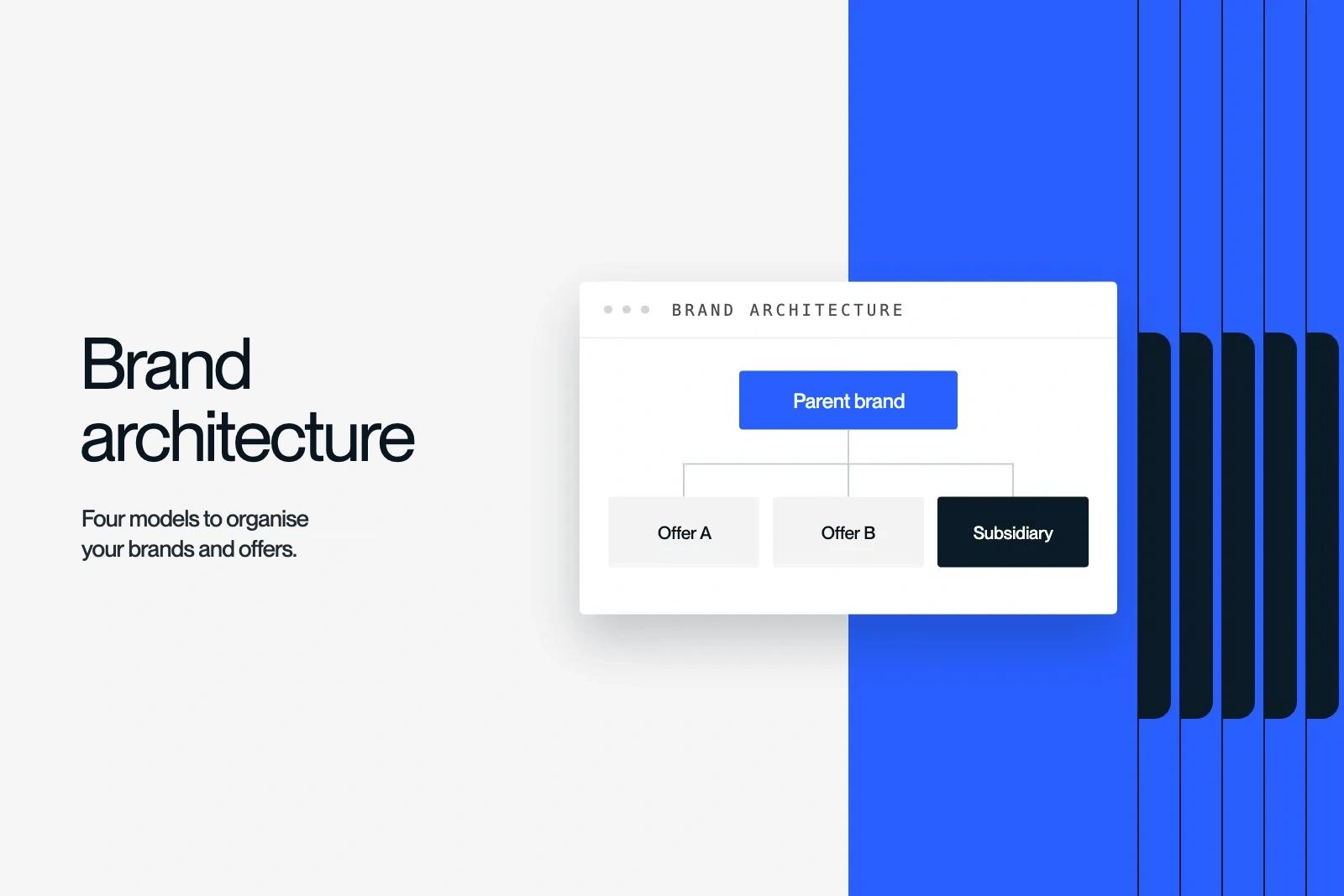
Brand architecture is how a company organises its brands, offers and subsidiaries in relation to each other. It answers two questions: how many brands do you need, and what link should you show between them?
Here are the four models, a table to compare them, our view for a B2B company, three real cases and five questions to help you choose.
Explore this post with…
In short: there are four main models: the branded house, sub-brands, endorsed brands and the house of brands. The more brands you run, the more you split your budget and your awareness. Our view: for a B2B SME or mid-sized company, a single brand is almost always the right choice. Architecture is decided before naming, logo and website, not after.
Brand architecture: the definition
Brand architecture sets the role of every name in a portfolio: the company brand, the brands of its offers, the brands of its subsidiaries. It says who signs what, and what the client should understand about how they relate.
The question rarely comes up at launch. It arrives with growth: a new offer, an acquisition, a subsidiary abroad, a new target, a name change. Four signs show it is time to deal with it.
- Your clients do not know that one of your entities belongs to you.
- Every team creates its own logo for its offer.
- Two of your websites compete for the same Google searches.
- Your sales team needs three slides to explain who does what.

The 4 brand architecture models
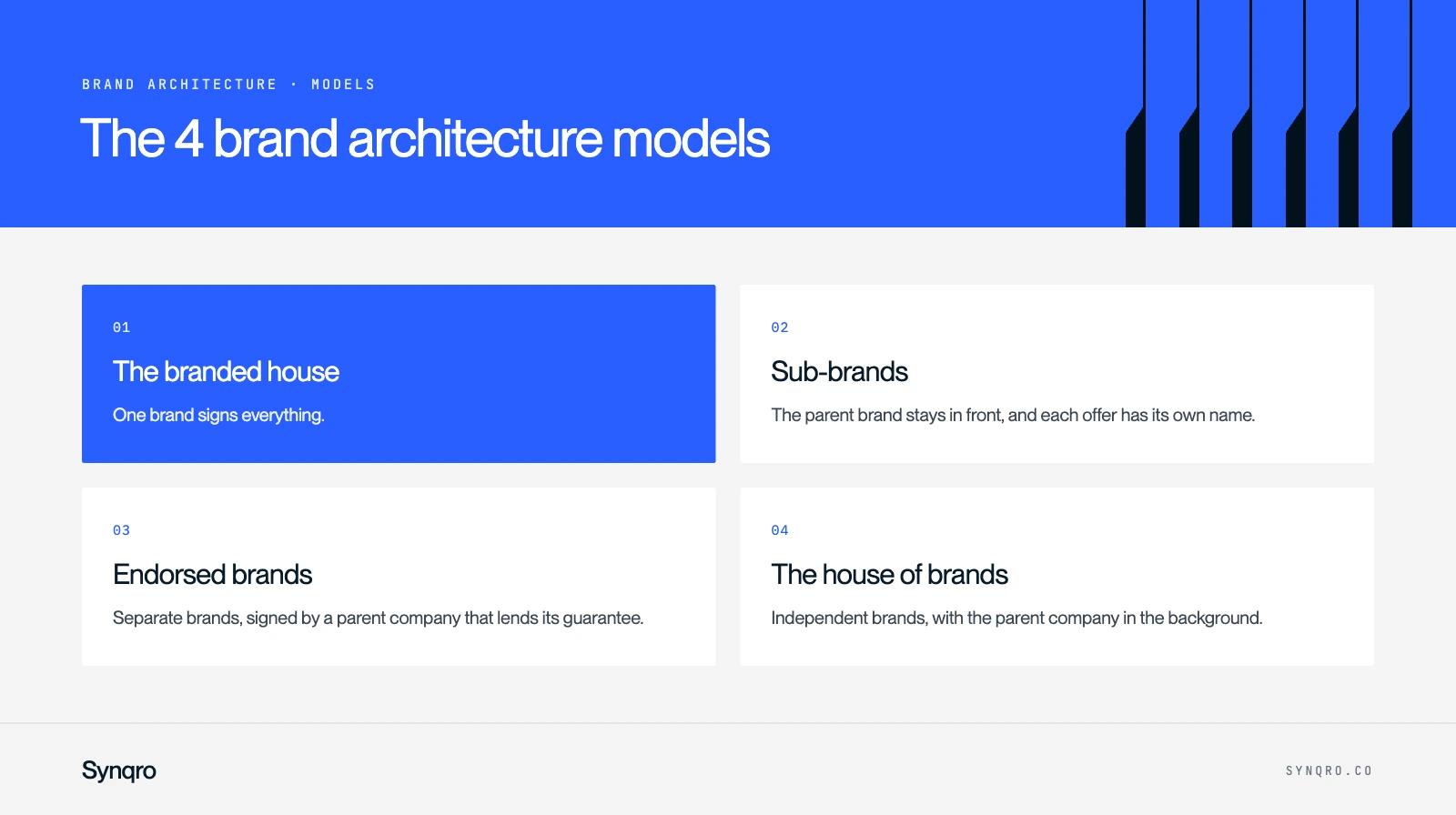
1. The branded house
One brand signs everything. Offers carry descriptive names. Google is the usual example: Google Maps, Google Drive, Google Calendar. It is also called an umbrella brand.
2. Sub-brands
The parent brand stays in front, and each offer has its own name. Apple works this way with the iPhone, the iPad and the Mac.
3. Endorsed brands
Separate brands, signed by a parent company that lends its guarantee. "Courtyard by Marriott" is a classic example.
4. The house of brands
Independent brands, with the parent company in the background. Procter & Gamble owns Ariel, Pampers and Gillette. LVMH brings together Louis Vuitton, Dior and Sephora. The client buys the brand, not the group.
| Model | Principle | Strength | Limit | Best for |
|---|---|---|---|---|
| Branded house | One name for everything | Every euro invested benefits every offer | One incident affects everyone | SMEs, mid-sized companies, B2B |
| Sub-brands | Parent brand and named offers | Clear product ranges | Each name needs its own effort | Distinct product ranges |
| Endorsed brands | Separate brands, shared signature | Autonomy and trust | Two brands to run every time | Diversified groups, acquisitions |
| House of brands | Independent brands | Very different audiences and prices, risks kept apart | Everything multiplies: budgets, sites, teams | Large groups |
Which model for a B2B company?
Our view is clear: a single brand, by default. For three reasons.
- Budget. Building awareness for one brand takes years. Building it for three takes three times the effort.
- Commercial clarity. A B2B buyer wants to know who they are dealing with. One name makes selling simpler.
- Online visibility. One website concentrates content, links and SEO effort.
Three situations justify an exception.
- Your offers target incompatible audiences, for example premium and entry-level.
- You acquire a brand that is better known than yours in its market.
- One business line carries a reputational risk you want to isolate.
3 real cases
BMA: one group, two subsidiaries, two countries
BMA is a general contractor specialised in design & build, founded in 2006, with teams in Paris and Portugal. In 2025, the group renewed its identity to assert that approach. Synqro redesigned the websites of its two subsidiaries, from design to development, and the project received an Honorable Mention at the Awwwards. The lesson: when a group carries several entities, its architecture shows first on its websites. See the BMA case study.
Circul'R: putting offers in the right order
Architecture is not only about logos. It also sets the order in which you present your offers. Circul'R was often seen as a business club, while consulting generates most of its revenue. We reorganised the service hierarchy: consulting first, the club in support. See the Circul'R case study.
Diametral: changing name rather than adding a brand
Founded in 2018 as LittleBigCode, the company redefined its positioning when AI moved from experimentation to core business infrastructure. It did not create one more brand. It changed its name. Diametral carries a clear idea: a line that cuts through complexity and sets a direction. See the Diametral case study.
When ambition changes, the right answer is sometimes a rebrand, not an extra brand.
Brand architecture and your website
Your architecture choice translates straight into domain names.
| Model | Website organisation |
|---|---|
| Branded house | One domain, one section per offer |
| Sub-brands | One domain, strong offer pages |
| Endorsed brands | Separate domains possible, with a visible link to the parent company |
| House of brands | One website per brand |
Every extra domain is one more website to write, maintain and promote. Before opening one, check whether a section of the main site would do the job. Our domain name guide helps you decide.
Merging two websites also takes preparation: a redirect plan, a change of address in Search Console, and position tracking for several weeks.
How to choose: 5 questions
- Do your offers target the same buyer?
- Do they carry the same promise?
- Do you have the budget to run more than one brand?
- Should an incident in one business line stay contained?
- Is an acquired brand better known than yours in its market?
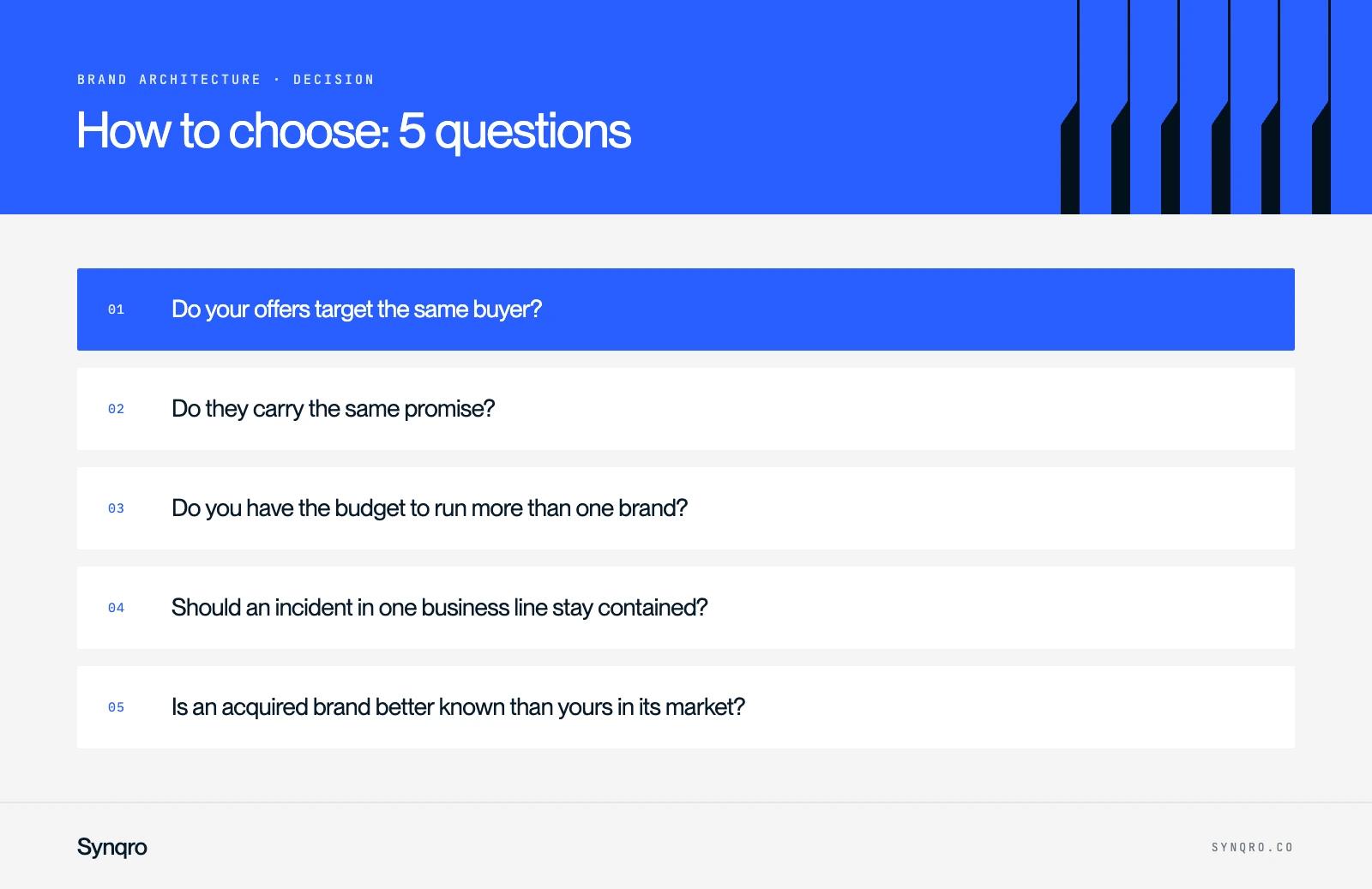
Two "yes" answers to the first two questions: keep a single brand. A "no" to the third: keep it too. Questions 4 and 5 are the only ones that justify a separate brand.
This work builds on your positioning and your brand platform. Without them, you end up debating logos instead of strategy.
The most common mistakes
- Creating one brand per offer. Every launch dilutes the main brand a little more.
- Deciding architecture after the logo. The visual system depends on how many brands have to live together.
- Keeping an acquired brand with no plan. Either it has a role, or it has an end date.
- Forgetting the website. Two domains targeting the same searches compete with each other.
- Copying the org chart. Clients do not care about your legal entities.
Once the architecture is set, you still need to name what needs naming. Our brand naming guide details the method, and our branding agency can run it with you.
Frequently asked questions
It is how a company organises its brands: the main brand, the brands of its offers and those of its subsidiaries, with the link shown between them.