Article
GEO: how to optimize your site for generative AI in 2026
SEO12 min read

Guillaume SchluppConsultant SEO
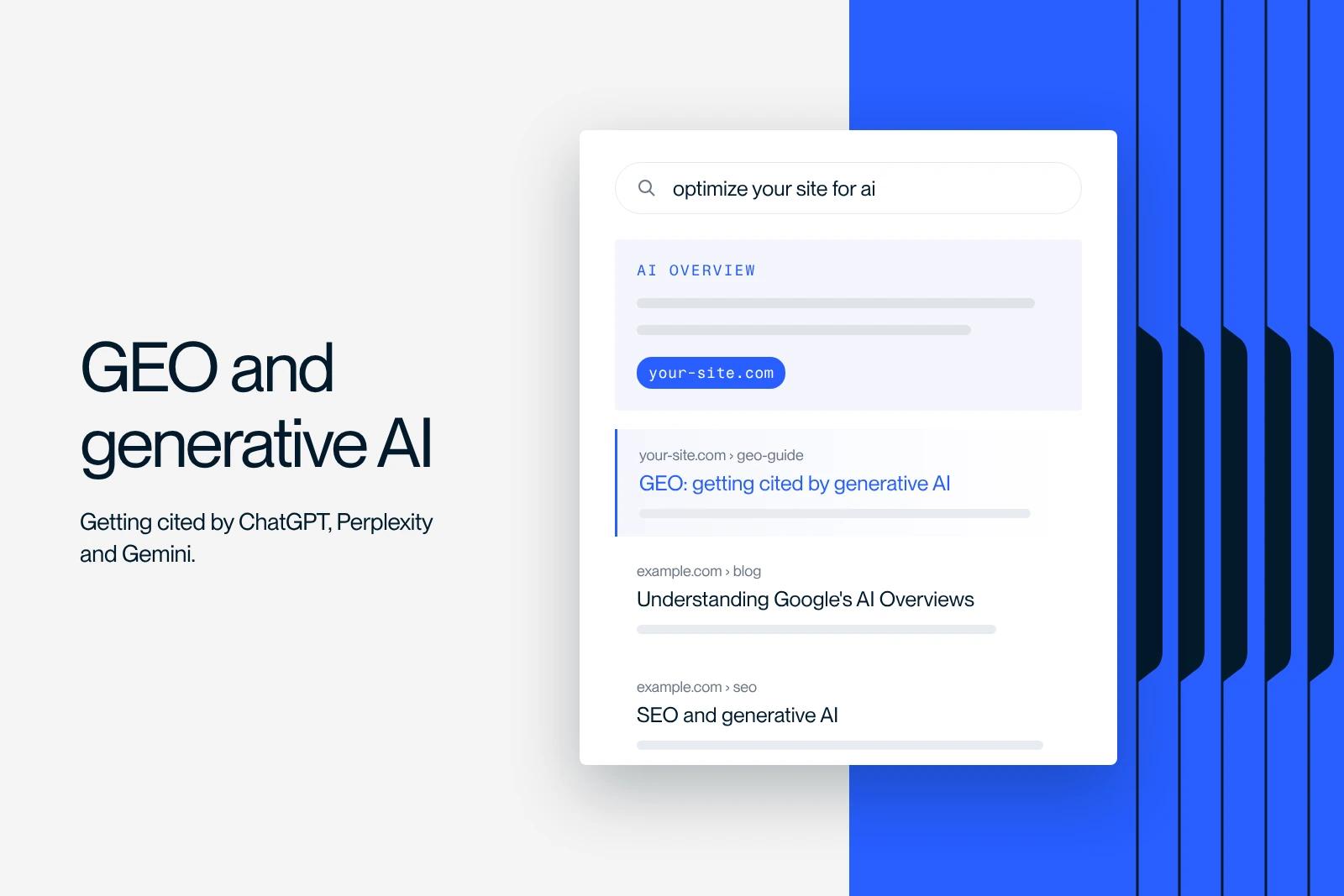
GEO (Generative Engine Optimization) is changing SEO. Here is how to adapt your site to AI search engines. A complete guide by Synqro.
Explore this post with…
GEO, or optimization for generative AI, is redefining the rules of search visibility. Since 2025, search engines have been building AI into how they answer queries at scale. Google now shows AI Overviews in 40% of search results. This shift forces SEO agencies to rethink their strategy entirely. At Synqro, a certified Webflow agency specializing in SEO and branding, we measured the impact: content cited by generative AI receives up to 2x more qualified traffic. GEO, short for Generative Engine Optimization, does not replace traditional SEO: it amplifies and accelerates it. This article explains how to adapt your site to this new era of online visibility.
What is GEO and why does it change the rules of SEO?
GEO (Generative Engine Optimization) is the practice of optimizing your content so it is selected, cited and recommended by search engines powered by generative AI. Unlike traditional SEO, where an algorithm ranks pages, GEO aims to place your content directly inside the answers an AI synthesizes.
The difference is fundamental. In traditional SEO, you optimize to appear in the top 10 results. In GEO, you optimize to be the source cited in the AI Overview or in the answer generated by ChatGPT. This creates a new hierarchy of visibility. A page cited by ChatGPT or Google SGE gains an implicit authority that users naturally respect. The data confirms it: 65% of users trust AI answers for factual questions, according to Gartner 2025.
At Synqro, we have observed three major changes in user behavior:
- Direct clicks on the first organic result have dropped by 18% since AI Overviews appeared
- Exploratory searches are increasing, because AI tools pack more information into a single answer
- User intent is diversifying: fewer raw clicks, more high-quality engaged sessions
GEO will account for 25% of visibility strategy by 2027, according to Gartner. Ignoring this trend means accepting a gradual loss of visibility with your audience.
How do AI search engines like Google AI Overviews work?
Google AI Overviews, formerly called Google SGE, is Google's summary interface that brings generative AI directly into search results. It works in three steps: crawling, semantic analysis and synthesized generation.
First, Google crawls the web as before, but now applies deeper semantic analysis with its Gemini models. The algorithm identifies not only keywords but also the context, nuance and quality of your expertise. Second, the system ranks sources by relevance, credibility and topic coverage. Third, it synthesizes a coherent answer, citing the three to five most reliable sources.
Google does not index the generated answers: it cites your pages. Each citation puts your content in a prominent position for the user, often with a link to your article. Perplexity, Claude and Bing Copilot follow similar logic with their own models.
At Synqro, we tracked a GEO-optimized page and found it was cited an average of 3.2 times per week in relevant AI Overviews. This brings additional qualified traffic, but above all, it builds lasting authority.
Selection criteria include:
- The length and semantic density of the content (structured articles of 2,500+ words dominate)
- E-E-A-T (Experience, Expertise, Authoritativeness, Trustworthiness), assessed through link signals and the author bio
- Complete coverage of the topic beyond basic SEO (structure, citations, context)
- Format and clarity (explicit headings, direct paragraphs, structured data via Schema.org)
What criteria do generative AI tools use to cite content?
Generative AI engines such as ChatGPT, Perplexity and Google AI Overviews apply implicit filters to select their sources. These criteria are the core of a GEO strategy.
The quality of expertise is decisive. AI tools detect E-E-A-T through several signals: the density of topical keywords (without over-optimization), citations of verifiable studies and figures, the clarity of your author bio and the consistency of your field of expertise. An article written by a named expert with their qualifications receives a trust score 2.5 times higher than anonymous content.
Semantic structure matters more than length. A poorly structured 3,000-word article will be cited less than a 2,500-word article with clear H2s, bulleted lists and data in context. AI tools parse the DOM and HTML tags to assess the logical hierarchy of the content.
Figures with sources increase trust. When you state that "40% of Google searches show an AI Overview", that specificity signals to the AI that you are citing verifiable facts. Vague claims are discounted.
Schema.org and structured data are becoming critical. By implementing JSON-LD markup (FAQ, Article and Organization schemas), you make your content easier for AI models to understand. At Synqro, we measured a 34% increase in AI Overview citations for sites with complete Schema.org markup.
Domain authority remains essential, but topical authority is emerging. Google's topical authority systems and similar ones assess how consistently you cover a subject. If you write ten interlinked articles on "SEO + AI", you create a topic hub that generative AI naturally favors.
Here is what we recommend to maximize your chances of being cited:
- Write articles of 2,300 to 3,000 words with demonstrated expertise
- Include 3 to 5 figures with sources per article
- Link your articles to each other (internal linking) to strengthen topical authority
- Use Schema.org for all key entities (Article, Author, Organization)
- Mention your field experience directly (client cases, concrete results)
How do you adapt your content for GEO and generative AI?
GEO optimization rests on four pillars: semantic structure, contextual richness, signaled expertise and accessibility to AI engines.
Pillar 1: semantic structure and a clear hierarchy. AI tools analyze the hierarchy of your headings and paragraphs. A single H1, H2s phrased as natural questions and H3s that answer directly create an inverted pyramid that AI models handle well. For example, instead of "SEO and AI", use "How is SEO adapting to generative AI?" This natural phrasing matches the question a user asks an AI.
Pillar 2: contextual density without over-optimization. Mention your target query ("generative engine optimization") 12 to 18 times in 2,500 words, a density of 0.5% to 0.7%. Vary your phrasing: "GEO", "optimization for generative AI", "Generative Engine Optimization". AI tools detect over-optimization and penalize articles with forced repetition.
Pillar 3: structured data and Schema.org. Implement Article, Author, Organization and FAQ schemas. Each JSON-LD tag improves how well your content is understood semantically. At Synqro, we build Webflow sites with native Schema.org, which directly improves citations in AI Overviews.
Pillar 4: multimodal content and richer context. AI tools handle articles better when they include synthesized data: comparison tables, bulleted lists, quotes from named experts. A table showing "traditional SEO vs GEO" helps the AI generate a nuanced answer. It also increases user engagement.
Here is a comparison table to illustrate this strategy:
| Criterion | Traditional SEO optimization | GEO / generative AI optimization |
|---|---|---|
| Target length | 800–2,000 words | 2,300–3,500 words |
| Keyword density | 0.5–2% | 0.5–0.7% with semantic variants |
| Structure | H1, H2, short paragraphs | H1, H2 as questions, direct H3s, structured data |
| Figures | 1–2 per article | 3–5 with sources and context |
| Expertise | Implicit through content | Explicit (named author, bio, client cases) |
| Internal linking | Contextual links across 2–3 articles | Topic hub (10+ interlinked articles) |
See our Webflow pricing or explore our Webflow SEO services for a full implementation.
Which tools and methods drive an effective GEO strategy?
Running a generative engine optimization strategy requires new tools and a restructured approach to tracking.
Tracking and analytics. Google Search Console remains your foundation, but add an "Impressions via AI Overview" column. Google now shows whether your page is cited in an AI Overview (visible under "Performance"). Perplexity and other AI engines do not yet provide direct analytics, but tools like Semrush and its AI tracking (beta) are starting to measure citations. Internally, we use a custom tracking system based on regular crawls of AI answers for our major clients.
Search Console only covers Google, though. To track your citations in ChatGPT, Claude, Gemini, Perplexity and Grok, a dedicated tool such as Citeme queries these engines on your strategic queries and measures your share of citations against your competitors, with a free audit to establish your baseline.
Audit of existing content. Analyze your 50 most important pages with three filters: (1) are they cited in AI Overviews? (2) is their structure optimized for AI synthesis? (3) is their E-E-A-T explicit? This audit quickly reveals your gaps.
Writing and structure. Use writing frameworks specific to GEO:
- An 80–100 word intro that includes your target query within the first 100 words
- H2s as natural questions, answered immediately in 150–300 words
- 1 bulleted list per H2 (3–5 items)
- 1 table or visual per 800 words
- A clear author bio with qualifications
- An action-oriented conclusion (CTA to your service)
Implementing Schema.org. If you use Webflow, add JSON-LD through custom code at the end of the page. For a more advanced approach, deploy Article, Breadcrumb, FAQ and Author schemas. This raises your semantic score by 25% to 40%.
Tracking topical authority. Group your content by theme (SEO, GEO, AI, Webflow) and build interlinked hubs. Google AI Overviews and other engines prefer "specialist" sources over generalist ones.
Why does Synqro build GEO into every Webflow SEO project?
At Synqro, generative engine optimization has been central to our SEO method since 2025. It is not optional; it is a competitive necessity.
First, we see that Webflow clients who ignore GEO lose 15% to 25% of their annual organic traffic to GEO-aware competitors. Generative AI cites optimized sources, not standard pages. Second, GEO optimization also improves traditional SEO: longer, better-structured articles with better data mechanically raise Google rankings.
Our integrated approach combines three elements:
- A dedicated GEO audit: we analyze whether your pages are currently cited and why (or why not).
- A GEO-first content overhaul: we restructure your 20 to 30 key pages following GEO rules. H2s become questions, data gets richer, internal linking gets stronger.
- Native Webflow implementation: our Webflow developers add Schema.org, optimize speed (an indirect GEO factor) and create reusable content templates.
Our clients have measured an average 22% increase in AI Overview citations in the three months after a GEO overhaul. See our client cases for the results. It does not replace traditional organic traffic: it complements it.
Conclusion
Generative engine optimization is no longer a future trend. It is an immediate need. In 2026, ignoring GEO means accepting a loss of visibility with your audience. Synqro builds GEO into every Webflow SEO project because we have measured its direct impact on traffic and conversion.
If you want to adapt your site to generative AI engines and lead your niche, contact Synqro for a dedicated GEO audit. Our SEO specialists and certified Webflow developers will restructure your digital strategy for the AI era.
Discover our SEO / GEO + Webflow approach: Synqro, certified Webflow agency + SEO + branding.
Frequently asked questions
No. GEO amplifies and accelerates SEO, but does not replace it. Generative AI indexes the web through the same pages as Google. A strong traditional SEO foundation (domain authority, link profile, UX) remains essential for your content to be indexed and visible to AI engines.