Article
Link building training: curriculum, resources and how to choose
SEO6 min read

Guillaume SchluppConsultant SEO
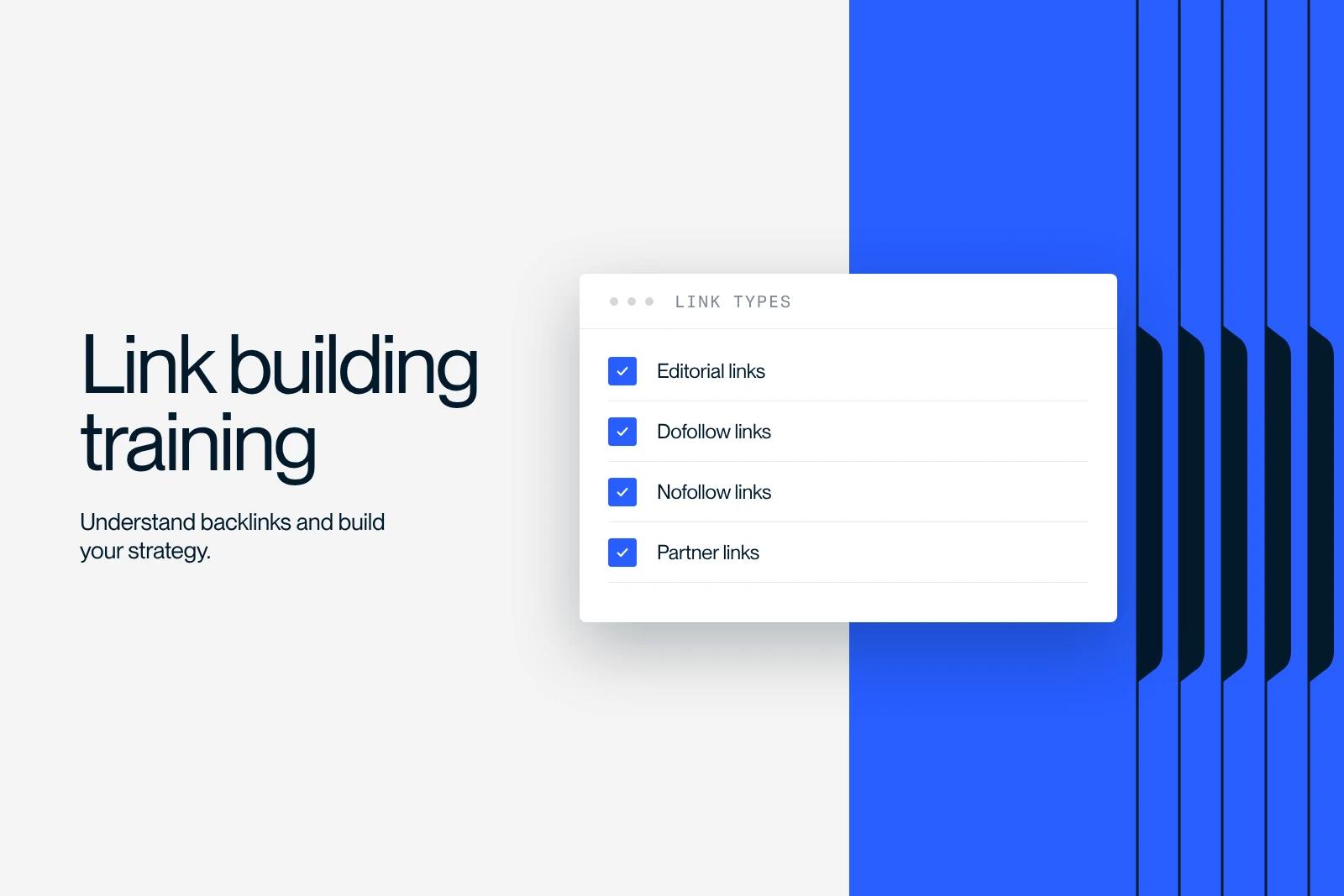
Link building training teaches you how to earn useful, low-risk external links: understanding how Google treats links, auditing a backlink profile, finding opportunities, reaching out to sites and measuring results. You can learn on your own with free official resources, or take a paid course, which in France can be funded through the CPF (the personal training account) if it is eligible.
This guide covers the curriculum a good training program should include, the tools to learn, the free resources, the funding rules and the criteria for choosing without getting it wrong.
Explore this post with…
What link building training should teach you
Link building means getting other sites to link to yours. Serious training does not stop at "tips for getting backlinks": it covers the rules, analysis, execution and measurement. Here is the curriculum to expect.
| Module | What you should be able to do at the end |
|---|---|
| 1. Fundamentals | Explain how Google uses links and why a topically relevant link is worth more than a generic one |
| 2. Google's rules | Tell editorial, sponsored, ugc and nofollow links apart, and recognize link spam |
| 3. Profile audit | Read the Search Console Links report and a third-party tool, and spot anchor text anomalies |
| 4. Strategy | Choose target pages, analyze the gap with competitors, plan anchors and budget |
| 5. Execution | Produce citable content, pitch a media outlet, reclaim an unlinked mention |
| 6. Measurement | Track referring domains, rankings and conversions of target pages |

Google's rules to know first
The Google ranking systems guide (updated in December 2025) confirms that PageRank is still part of its core ranking systems, even though how it works has changed a lot since the beginning. Links still count, but Google reads them through increasingly refined anti-spam systems.
Three historical milestones to know. Penguin, launched in 2012 to fight link spam, was built into the core algorithm in September 2016: there is no longer a "Penguin update" to wait for.
In September 2019, Google added the sponsored and ugc attributes, and started treating nofollow as a hint rather than a directive.
Finally, Google's spam policies (updated in August 2026) list what counts as link spam and describe site reputation abuse. A course that does not cite them is probably out of date.
The tools to learn
A tool does not measure what Google does with your links: it measures what its own crawler found. Trust Flow (Majestic), Domain Authority (Moz), Domain Rating (Ahrefs) and Authority Score (Semrush) are proprietary metrics. Useful for comparing, misleading for drawing conclusions.
| Tool | Entry price (checked on October 12, 2026) | What you learn there |
|---|---|---|
| Google Search Console | Free | Your links as Google sees them: linking sites, linked pages, anchors. A sample, with no competitor data |
| Ahrefs | $29 per month (Starter) | Link profile, lost links, Link Intersect for competitive analysis (higher plans) |
| Semrush | $139 per month (SEO plan, billed monthly) | Backlink Analytics, Backlink Gap, campaign tracking |
| Majestic | $49.99 per month (Lite) | Trust Flow and Topical Trust Flow to judge a domain's topic |
Learning link building for free
Primary sources are enough to cover modules 1 and 2. Read them before paying for anything:
- Google's link best practices: anchors, crawlable links, outbound links.
- Qualifying outbound links: when to use sponsored, ugc or nofollow.
- The Search Console help page on the Links report: what the report shows and its limits.
- Ahrefs Academy: free video courses, including an SEO course for beginners. Semrush Academy also offers free courses.
On our blog, continue with the definition of a backlink and its types, then our method to build a link building strategy in 7 steps.
Paid training and the CPF: what to know
In France, the CPF (compte personnel de formation, the personal training account) can fund link building or SEO training if the course is eligible. According to Service-Public.gouv.fr (page checked on June 27, 2026), a €150 contribution remains payable by you in most cases, unless your employer or another funder tops it up. The amount is indexed and the 2027 budget bill could raise it: check when you sign up.
Two simple checks: does the course appear on moncompteformation.gouv.fr, and is the provider Qualiopi certified (France's quality label for training providers), which has been mandatory since January 1, 2022 to receive public or pooled funding.
How to choose good link building training
- The trainer practices: they run campaigns today and can show verifiable results.
- The curriculum is up to date: it cites the current spam policies, the rel attributes and the limited use of the disavow tool.
- You work on your own site: an audit of your profile, a real prospect list, your first outreach during the course.
- No numerical promises: no one can guarantee a number of links or a ranking.
- A clear position on buying links: a trainer who presents buying undisclosed links as the main method exposes you to risk.
To compare providers, formats and prices, see our comparison of SEO training, CPF funding and real prices.

A six-week learning path
| Week | Goal | Exercise |
|---|---|---|
| 1 | Understand the rules | Read the spam policies and the page on outbound links, summarize each case in one line |
| 2 | Audit your profile | Export the Search Console Links report, sort linking sites by topic |
| 3 | Analyze competitors | List the domains that cite two competitors but not you |
| 4 | Create citable content | Publish a resource based on your data or expertise |
| 5 | Reach out | Send ten personalized messages and follow up once |
| 6 | Measure | Build a tracking table: links earned, target page, anchor, rankings |
Common beginner mistakes
- Buying links in bulk on sites unrelated to the business.
- Repeating the same exact-match anchor from one link to the next.
- Steering by a third-party tool score rather than by the rankings of target pages.
- Disavowing as a precaution: Google says the disavow tool is of no use to most sites.
- Chasing links before fixing technical issues and internal linking.
Train your team or get support?
Training makes sense if someone in-house will have time to produce content and do outreach every month. Otherwise, the skill fades quickly.
At Synqro, when we support a team, we start from its real data (brochures, figures, cases) to create content worth citing, and we run a review every quarter to reprioritize. Our SEO support ranges from €1,000 to €5,000 excluding VAT per month, depending on scope.
Frequently asked questions
It is training that teaches you how to earn external links to a site effectively and in line with Google's rules: fundamentals, profile audit, strategy, outreach and measurement.