Article
Link building for SEO: definition, methods and Google's rules
SEO9 min read

James BrunettoCo-fondateur & CEO
In SEO, link building is the work of earning links from other websites to yours. Each backlink acts like a citation: it helps Google judge that a page deserves to be recommended, as long as the link was earned for the right reasons.
This guide covers the basics: what Google says about links, which attribute goes on which link, the methods that work, what puts you at risk of a penalty and the tools to track your links. To turn these methods into an action plan, see our guide to link building strategy.
Explore this post with…
Link building for SEO is the work of earning links that point to your site from other sites. Each inbound link, or backlink, works like a citation: it tells search engines that a page is worth recommending. Link building is different from internal linking, which organizes the links between your own pages. One question remains that many guides avoid: how much do these links really weigh, and how far can you go without taking a risk.
This article is the starting point: definition, official rules, methods and risks. To build the plan itself (audit, target pages, anchors, budget, schedule, tracking), see our dedicated guide to link building strategy in 7 steps.
What Google actually says about links
Two findings, drawn from public sources and not from forum rumors.
First: links are not the all-powerful lever they are still made out to be. At the Pubcon Pro conference in Austin in September 2023, Google's Gary Illyes said that people overestimate the importance of links and that they have not been among the top 3 ranking factors for a while (remarks reported by Search Engine Land). Links matter, but they do not make up for weak content.
Second: Google regulates links very precisely in its spam policies (page updated on August 28, 2026). Link spam there includes: buying or selling links for ranking purposes, exchanging money, goods or services for links, excessive link exchanges of the "link to me and I'll link to you" kind, links required by contract, low-quality directories, links hidden in widgets or footers distributed across many sites, and forum comments with optimized links.
The practical takeaway is simple. A link is worth what it brings to a reader, not a score shown in a tool. To understand what separates a good link from a useless one, our article on the backlink goes into detail on the types of links and their value.
Which link gets which attribute
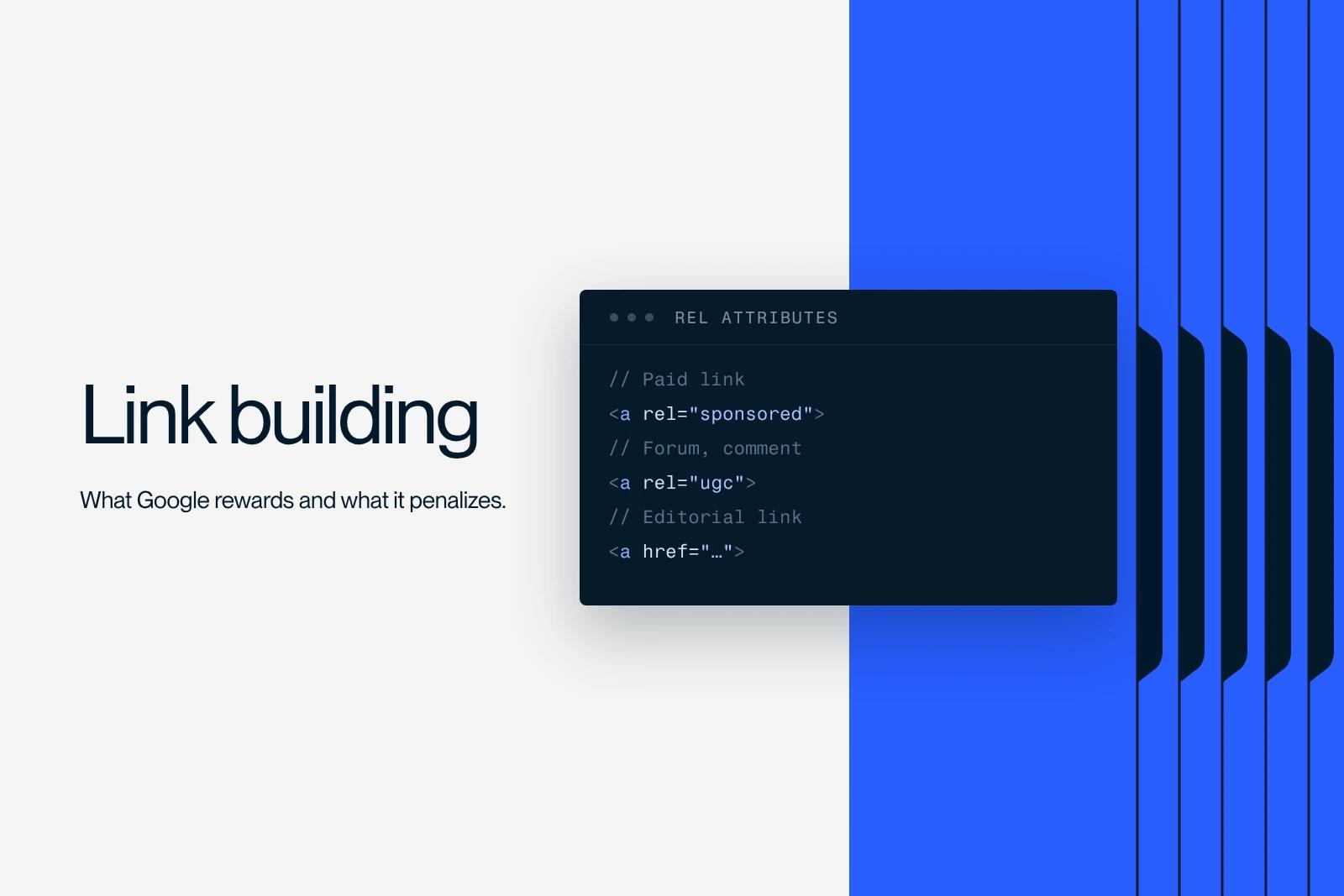
Google's documentation on qualifying outbound links defines three values for the rel attribute. Since September 2019, Google treats them as hints rather than strict directives. Mixing them up is the most common mistake, and the easiest to fix.
| Type of link | Expected rel attribute | What Google says |
|---|---|---|
| Editorial link earned with nothing in return | none | The normal case. It is the only link Google treats as a spontaneous vote. |
| Paid link, sponsored article, ad placement | sponsored | Allowed if the link is qualified. Unqualified, it counts as link spam. |
| User-posted link: comment, forum, profile | ugc | Google suggests removing the attribute for trusted contributors over time. |
| Link to a site you do not want to vouch for | nofollow | Use it when no other value applies. |
| Systematic link exchange between two sites | not applicable | Listed as spam when the exchange is excessive or a page exists only to cross-link. |
Google says that links marked with these attributes are generally not followed. The key point, often missed: it is the site publishing the link that must add the attribute. If you buy a sponsored article and the publisher leaves the link bare, the risk is shared.
Link building methods that work
No method is good or bad in itself. What matters is the reason: does your link exist because someone had a reason to cite you, or because you paid for it to appear?
Create something worth citing
Proprietary data, a free tool, a documented method, an industry study. It is slow, but it is the only lever that keeps producing links after you stop pushing.
Media relations and editorial contributions
A guest article on a media outlet in your industry is still legitimate as long as it is written for its readers. Watch out, though, for the site reputation abuse policy: Google targets third-party content published on a host site mainly to take advantage of the ranking signals that host has already earned. The official examples are telling: a page about the best casinos hosted on a medical site, or a payday loan page hosted on an educational site. An in-depth, bylined article written for the outlet's audience is not affected.
Reclaiming mentions and broken links
Your brand is mentioned without a link, or a page that linked to you has disappeared. An email is often enough. Low success rate, almost zero cost, no risk.
Communities and forums
Useful when you genuinely answer a question, disastrous when you just drop a URL. We cover the method and its limits in our guide to ninja linking.
Buying links
Our position is clear: it is an advertising expense, not an SEO strategy. If you do it anyway, insist on the sponsored attribute, and know that you are buying referral traffic and brand awareness, not ranking signals. To build a complete plan that combines these methods, see our article on link building strategy. If you would rather build the skill in-house than outsource it, our link building training covers the full path.
What really puts you at risk
Three practices account for most of the risk. Networks of sites created to link to each other. Over-optimized anchors repeated word for word, which look nothing like natural links. Links bought in bulk on domains unrelated to your business. These techniques and a few others are reviewed in our article on black hat SEO.
A word on disavowing, because the advice going around is often wrong. The Search Console help page on the disavow tool is explicit: this tool is not useful for most sites. It is meant for sites that have received a manual action, or are likely to receive one, because of a large number of artificial links, and Google asks you to try to get those links removed first. If there is no manual action in your Search Console, leave the tool alone.
Tools, with their real prices
Prices taken from the official pages on October 12, 2026, in US dollars, excluding tax, for monthly billing. They change often, so check before committing a budget.
| Tool | Listed entry price | What it brings to link building |
|---|---|---|
| Google Search Console | free | The Links report shows the domains and pages that point to you, as seen by Google. No data on your competitors. |
| Ahrefs | $29 per month, Starter plan | Link index, anchors, lost links. The Lite plan at $129 and the Standard plan at $249 unlock competitive analysis. |
| Semrush | $139 per month, SEO plan | Full suite. The plans are now called SEO, Starter, Pro+ and Advanced, no longer Pro, Guru and Business. |
| Majestic | $49.99 per month, Lite plan | Specialized in links, with Trust Flow and Topical Trust Flow to judge the topic of a referring domain. |
None of these tools measures what Google does with your links. They measure what their own crawler found. That is useful for comparing, misleading for drawing conclusions.
Before links, the foundation
The order of operations decides the outcome. Sending links to a site that is slow, poorly structured or whose pages cannibalize each other is like filling a leaky bucket.
Start with a technical SEO audit: indexing, speed, errors, duplicate pages. A link that lands on a page that is not indexed or is redirected is almost useless.
The second free project is internal linking. You alone decide where the authority you receive goes. An external link that lands on an orphan page only benefits that page.
At Synqro, we handle links in this order. We start from the client's real data (brochures, figures, case studies) to produce content worth citing, rather than generic articles. Then a quarterly review helps us reprioritize: technical, content or links, depending on what is holding things back. That is the principle behind our SEO and GEO support, billed at €1,000 to €5,000 excl. VAT per month depending on scope.
Key takeaways
Link building is still a lever, not the lever. Google itself has played down its weight and strictly regulates shortcuts. Start with the technical foundation and internal linking, then produce content people want to cite, and treat link buying for what it is: an advertising budget line. To take action, follow our method to build a link building strategy.
Frequently asked questions
Link building is the work of earning links that point to your site from other sites, in order to strengthen the credibility of your pages in the eyes of search engines. It is also called netlinking or backlink acquisition.