Article
Webflow definition: what it is and what it is used for
Webflow5 min read

James BrunettoCo-fondateur & CEO
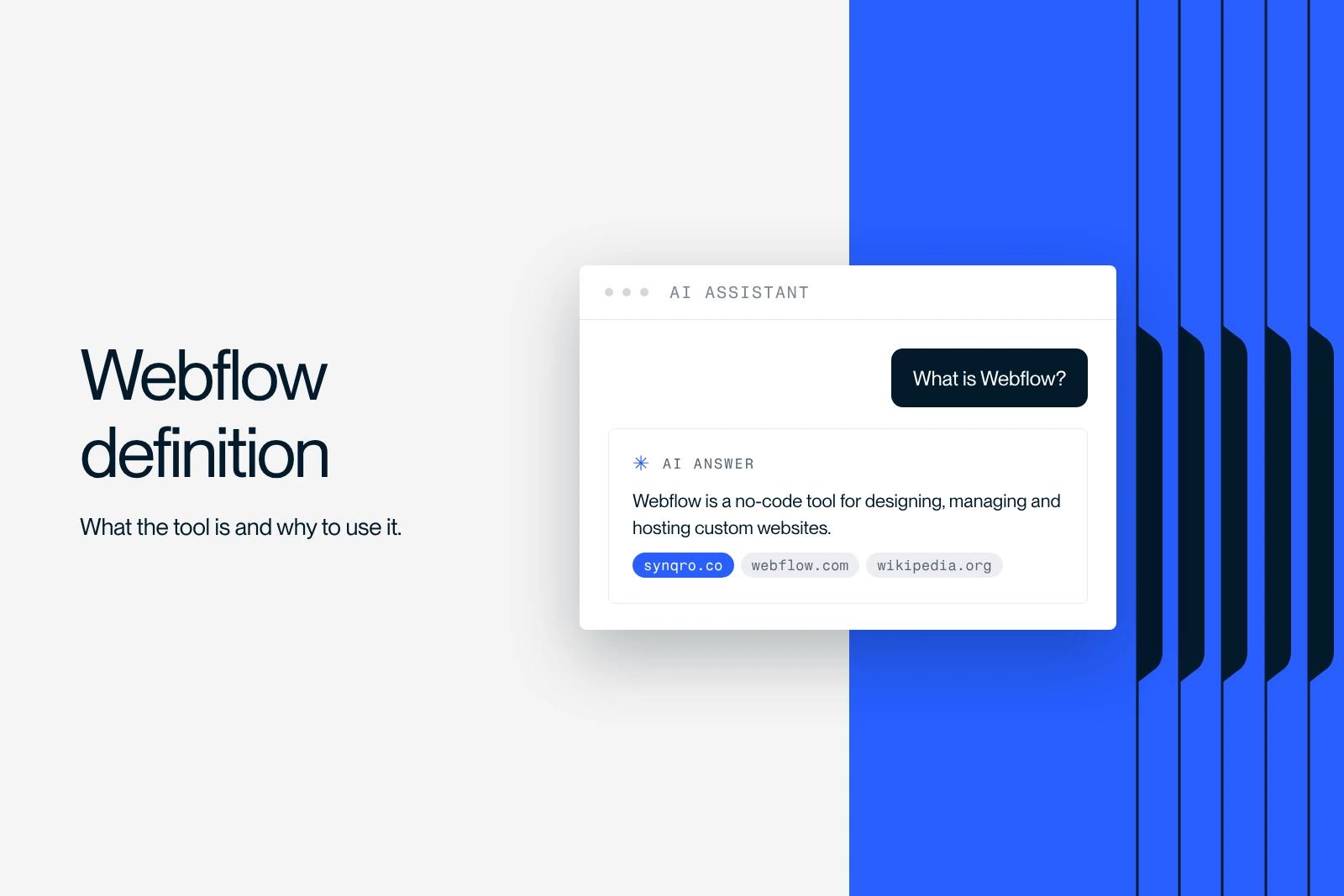
Webflow is an American website building platform, launched in 2013, that lets you design a site visually, manage its content with a built-in CMS and host it, without writing code. The editor produces standard HTML, CSS and JavaScript.
Webflow reports 3.5 million users and more than 300,000 customer brands. The free plan is for learning; a professional site costs $15 to $25 per month billed annually.
It is aimed mainly at designers, agencies and marketing teams that want a custom site they can edit on their own.
Explore this post with…
Webflow definition: Webflow is a visual website building platform that brings together a design editor, a CMS and hosting. Every visual setting maps to a real CSS property, which makes it possible to build custom sites without coding.
Webflow now presents itself as a web platform to design, build, optimize and get your site found in search, including AI answer engines. The figures quoted here come from Webflow's about page and its pricing page, checked in October 2026.
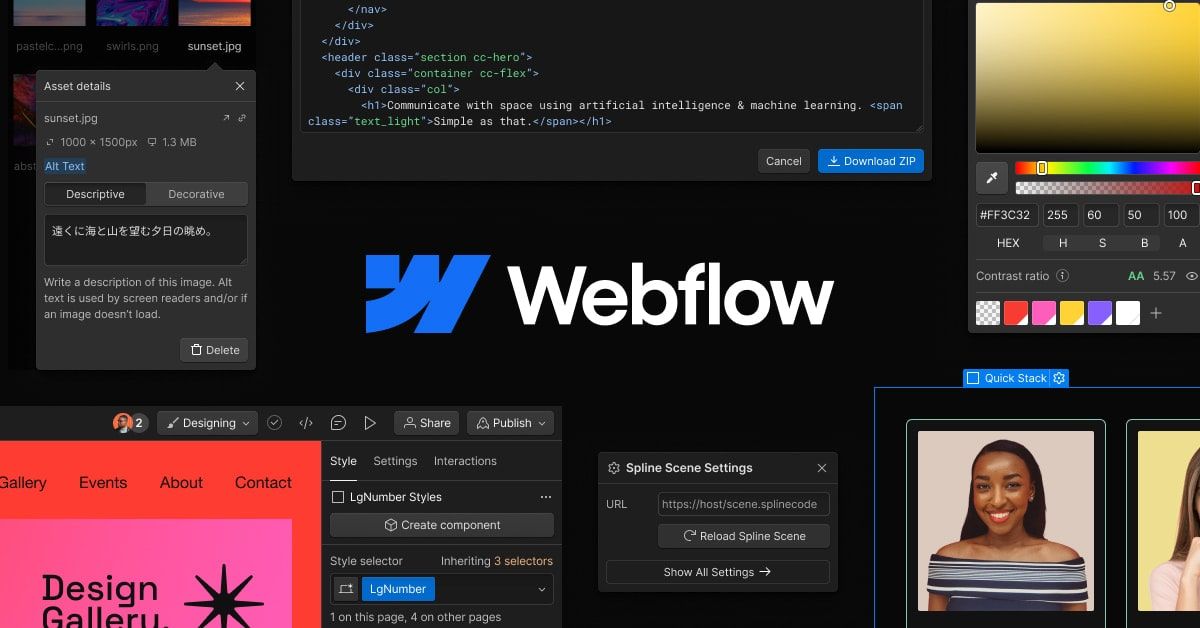
Webflow at a glance
| Item | Value |
|---|---|
| Launch | 2013 |
| Founders | Vlad Magdalin, Sergie Magdalin, Bryant Chou |
| Leadership | Linda Tong, CEO |
| Users | 3.5 million (source: Webflow) |
| Customers | More than 300,000 brands, including TED, IDEO and DocuSign (source: Webflow) |
| Funding raised | $335 million (source: Webflow) |
| Price of a site | Free to test, $15/month (Basic) or $25/month (Premium, with CMS) billed annually |
How does Webflow work?
Webflow brings together in a single tool what elsewhere takes several pieces of software. It has four building blocks:
- The visual editor (Designer): you place sections, containers, text and images, then style them with CSS classes. The code is generated as you go.
- The CMS: Collections (articles, case studies, job openings) whose fields you define, and a template page that displays each item.
- Hosting: included in Site plans, with an SSL certificate and a content delivery network (CDN). No hosting provider or updates to manage.
- Content editing: limited roles let a marketing team edit text and articles without touching the design.
What Webflow can do in 2026
Beyond design and the CMS, the platform has expanded in recent years:
- Components: reusable blocks with properties, variants and slots, shareable between sites through libraries.
- Interactions: animations on scroll, click or hover, built with GSAP.
- Localize: multilingual versions of the site, with AI translation and hreflang tags.
- E-commerce: a built-in store, suited to modest-sized catalogs.
- Analyze and Optimize: audience measurement, A/B testing and personalization, as paid add-ons.
- AI and MCP: AI assistants in the editor and an MCP server that lets AI agents read and edit a site.
- Webflow Cloud and code components: for technical teams that want to add applications or React components to the site.
How the MCP server works is covered in our article Webflow MCP: how AI reads and edits a site.
Is Webflow free?
Yes, for learning: the Starter plan is free and publishes on a webflow.io subdomain, with 2 pages. For a professional site on your own domain, expect $15 per month without CMS (Basic) or $25 per month with CMS (Premium), billed annually. Since May 2026, Premium replaces the former CMS and Business plans. All the details are in our article on Webflow pricing.
Webflow strengths and limits
| Strengths | Limits |
|---|---|
| Free-form design, no imposed theme | A real learning curve (CSS logic) |
| Hosting, SSL and updates included | An annual subscription to pay for each site |
| No plugins to maintain | Fewer extensions available than on WordPress |
| Native SEO settings (tags, sitemap, 301s) | Limited e-commerce for large catalogs |
| Marketing team autonomous on content | Code export without the CMS or forms |
Who is Webflow for?
- B2B and SaaS companies: a polished brochure site, blog and conversion pages managed by the marketing team.
- Designers and freelancers: delivering a site true to the mockup without a developer.
- Agencies: producing custom sites and handing them over to clients who can run them independently.
- Less suited: large online stores, complex business applications and projects that require hosting on their own servers.
To compare with other tools, read our comparison Webflow vs WordPress and our selection of Webflow alternatives.

Our view as an agency
Synqro has worked on Webflow since 2019 and has supported more than 150 companies as a Webflow Premium Partner. What we see: the platform is a very good fit for brand sites and B2B sites that publish regularly, as long as you plan the class structure and the CMS before the design. For a complete site, expect 8 to 12 weeks with our Webflow agency.
Frequently asked questions
Webflow is a platform that lets you design a website visually, manage its content with a CMS and host it, without writing code.