Article
Webflow vs WordPress in 2026: Verified Prices, Security, Costs
Webflow13 min read

Nathan LhommeCo-fondateur & COO
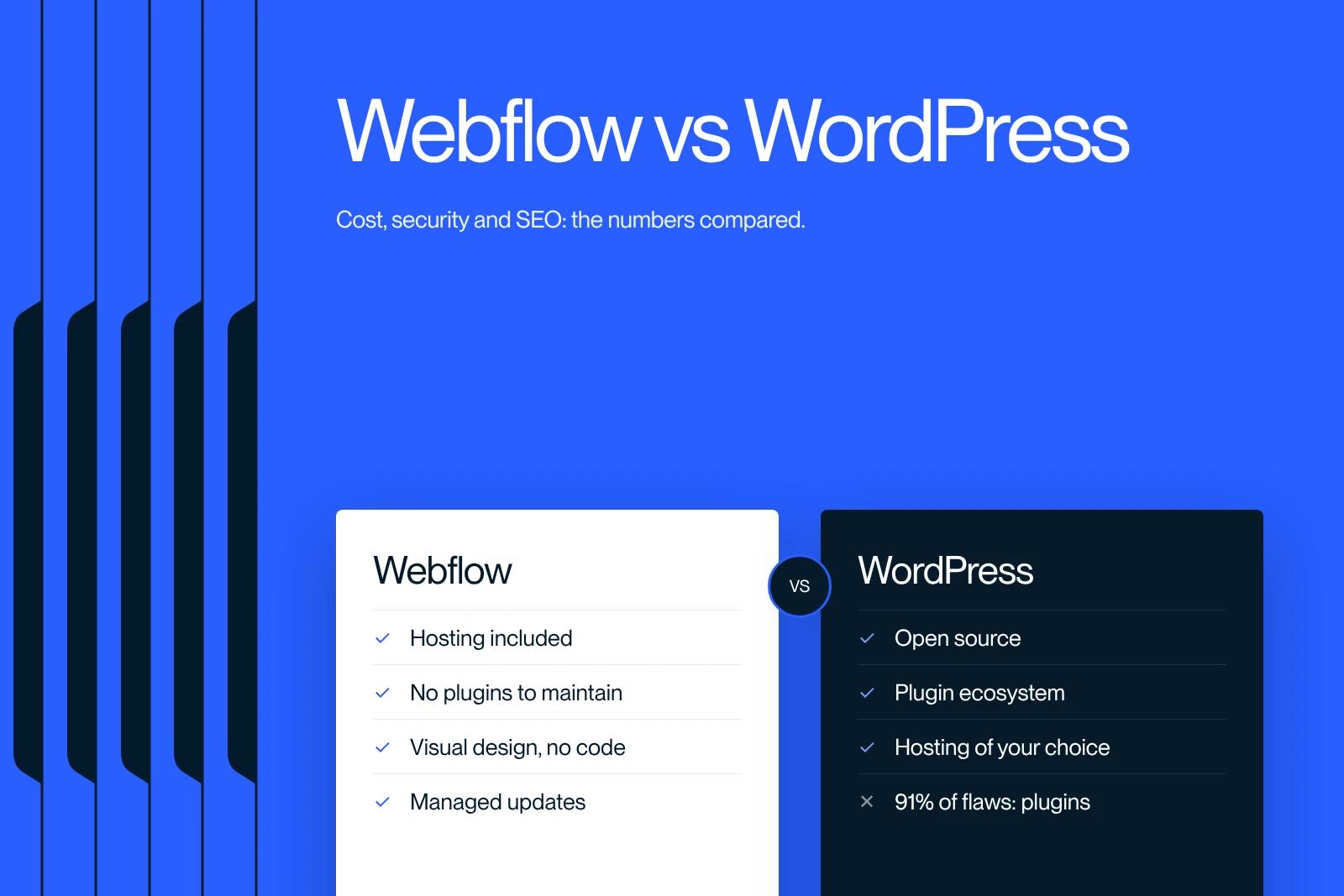
Webflow is the better choice for a marketing site that your team needs to run without a developer; WordPress is the better choice when a plugin already covers a core need (memberships, LMS, marketplace) or when hosting has to stay under your control. On numbers: Webflow Premium costs $25 per month billed yearly, WordPress shared hosting runs $4 to $10 per month at renewal, and Patchstack counted 11,334 WordPress vulnerabilities in 2025, 91% of them in plugins.
Every figure below was checked on the official pages on October 21, 2026. The comparison covers pricing, hosting, security, SEO, CMS, multilingual, ecommerce, the team you need, the three-year cost, and migration.
Explore this post with…
In short: Webflow and WordPress are a draw on SEO and design. They differ on who carries the maintenance. With WordPress, it's you (core, theme, plugins, hosting); with Webflow, it's the platform, in exchange for a smaller ecosystem and partial reversibility. If nobody on your team is named as responsible for updates, pick Webflow. If a plugin already covers a core functional need, or hosting is imposed on you, stay on WordPress.
One disclosure before anything else. Synqro is a Webflow agency and a Webflow Premium Partner, the highest tier of the Webflow partner program. We have a bias, and hiding it would be dishonest. So this article has a full section on the cases where WordPress wins, and another on the Webflow limits that comparisons leave out. Every number is dated and linked to its source, so you can check it.
Webflow vs WordPress: the full comparison table
| Criterion | Webflow | WordPress |
|---|---|---|
| Model | Closed platform: design, CMS and hosting in one place | Open-source software you install, host and extend |
| Base price (October 2026) | Basic $15 per month, Premium $25 per month, billed yearly | Free software; shared hosting from $3.99 intro to $9.99 per month at renewal |
| Hosting | Included: global CDN, automatic SSL, DDoS protection | Your choice and your bill: shared, VPS, managed or dedicated |
| Security | No third-party plugins; SOC 2 Type II and ISO 27001 on the platform side | 11,334 vulnerabilities in 2025, 91% in plugins, 6 in core (Patchstack) |
| Updates | Handled by Webflow | Yours: core, theme, plugins, PHP |
| SEO | Clean code and fast hosting by default; meta tags, redirects, sitemap, structured data | Everything is possible; depends on theme, page builder and stacked plugins |
| CMS | 20,000 items and 40 collections on Premium; display limits per page | No structural ceiling; custom post types and fields via plugins |
| Multilingual | Localize add-on from $9 per month (1 to 3 locales), included on Team | Plugins (WPML, Polylang) with yearly licenses to maintain |
| Ecommerce | Native: Standard $29, Plus $74, Advanced $212 per month billed yearly | WooCommerce, free, then paid extensions as needs grow |
| Team you need | A designer or Webflow developer at launch, then the marketing team alone | A developer or a maintenance contract, ongoing |
| Reversibility | HTML, CSS and JS export on a paid Workspace, without CMS or ecommerce | Total: you own the database and the files |
| Market share | Minority | 39.6% of all websites, 58.3% of sites with a known CMS (W3Techs, October 21, 2026) |
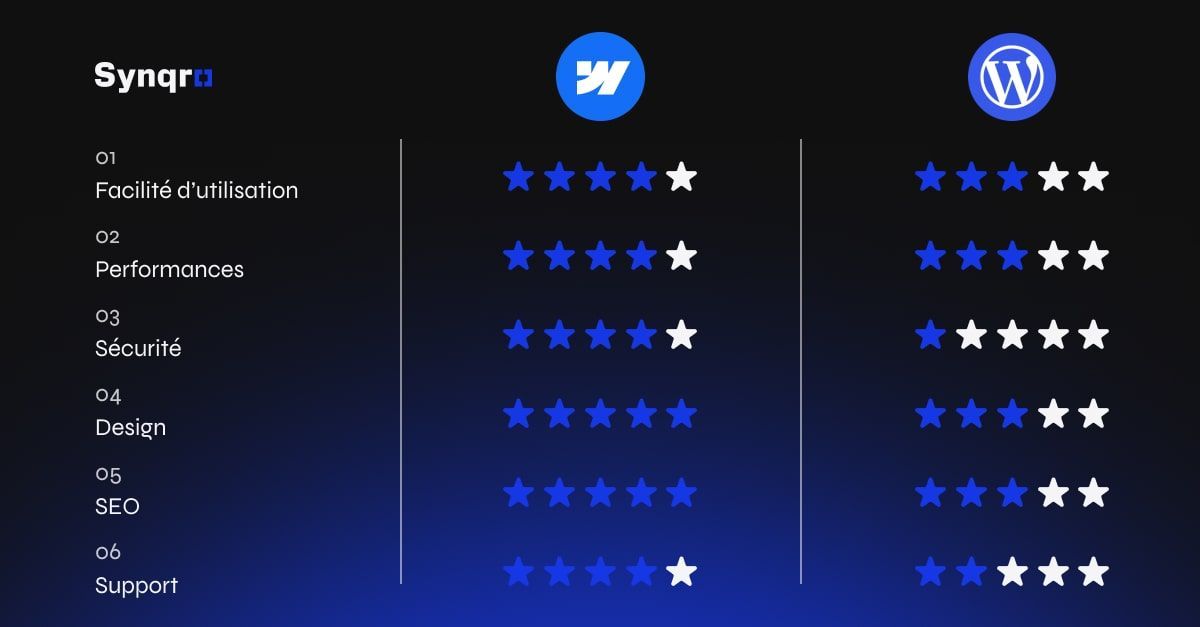
Two routes to the same goal, with constraints that are not the same.
What Webflow and WordPress really cost in 2026
Webflow simplified its plans on May 13, 2026, according to Webflow's official notice. The old CMS and Business plans merged into a single Premium plan. Any comparison still quoting a $23 CMS plan or a $39 Business plan is out of date.
Prices checked on October 21, 2026 on webflow.com/pricing:
| Webflow plan | Billed yearly | Billed monthly | What you get |
|---|---|---|---|
| Starter | Free | Free | 2 pages, webflow.io domain, for testing |
| Basic | $15 per month | $25 per month | 300 static pages, 10 GB bandwidth, no CMS |
| Premium | $25 per month | $39 per month | 300 pages, 20,000 CMS items, 40 collections, 50 GB expandable |
| Team | $2,500 per month | Annual contract only | 100 collections, 10 seats, 2 locales included, page branching |
| Ecommerce Standard | $29 per month | Not listed | 500 products, 2% transaction fee |
| Ecommerce Plus | $74 per month | Not listed | 5,000 products, 0% fee |
| Ecommerce Advanced | $212 per month | Not listed | 15,000 products, 0% fee |
Add a Workspace if several people design: Core at $19 per month billed yearly, Growth at $49. Multilingual goes through the Localize add-on, $9 per month for 1 to 3 locales or $29 for 1 to 10. Every add-on is detailed in our guide to Webflow pricing.
On the WordPress side, the software is free and everything else is paid. Prices checked on October 21, 2026:
| WordPress line item | Price checked | Note |
|---|---|---|
| Shared hosting, Bluehost Starter | $3.99 per month on a 36-month term, renews at $9.99 | The intro rate is the hook; the renewal rate is the real price |
| Managed hosting, Kinsta Single | $30 per month billed yearly ($350 per year) | Updates and backups handled |
| Page builder, Elementor Pro | From $60 per year | License renews every year |
| Cache, WP Rocket | $59.95 per year for one site | To offset a heavy theme and plugin stack |
The hosting trap is the intro price: the first term is discounted, the renewal is not. Always compare renewal prices.
The total cost over three years
The monthly price decides nothing. What decides is the line nobody puts in the quote: maintenance time. Here is the math for a small-business marketing site, 30 pages and a blog, on a low assumption.
| Line over 3 years | Webflow (Premium) | WordPress (shared hosting) |
|---|---|---|
| Subscription or hosting | $900 ($25 x 36 months) | About $144 (Bluehost 36-month term at $3.99; $360 at the renewal rate) |
| Licenses | $0 | About $360 (Elementor Pro and WP Rocket, 3 renewals) |
| Updates and backups | Included | Yours to do or to outsource |
| Maintenance time | Close to zero | Assumption of 2 hours per month, 72 hours over 3 years |
| Total without time | $900 | About $500 to $720 |
| Total with 72 hours valued at $75 | $900 | About $5,900 to $6,100 |
Without valuing time, WordPress is cheaper. Once you count the hours, Webflow comes out ahead. Adjust the hourly rate and the hours to your situation: that line is what tips the math, and it's the one comparisons leave out.
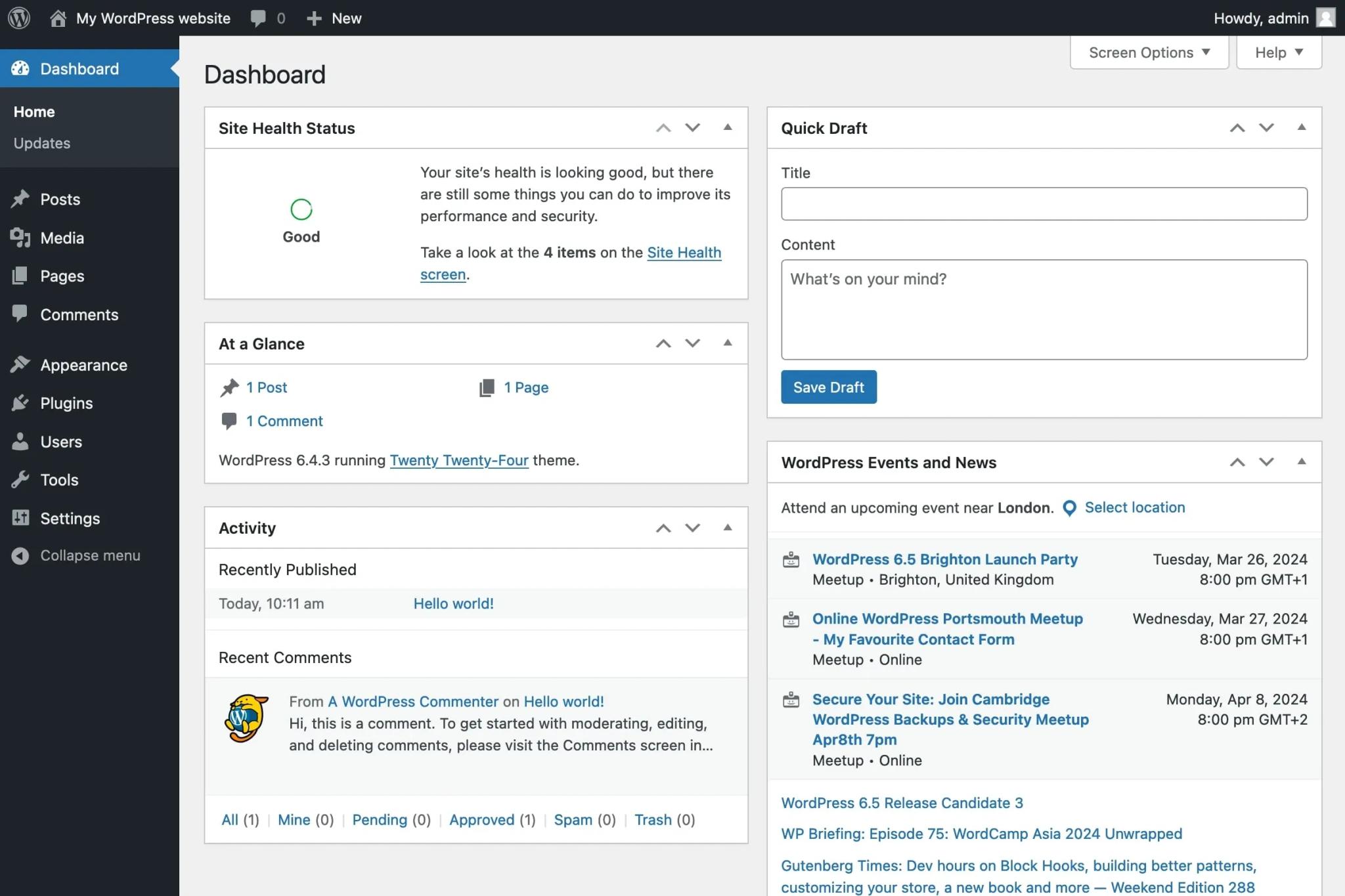
The WordPress admin is not the weak point. The plugin layer around it is.
Security: what the Patchstack numbers say
This is where the debate is worst framed. You read everywhere that WordPress is insecure, which is false, and that Webflow is unhackable, which means nothing. The data exists.
The State of WordPress Security in 2026 report by Patchstack, updated February 25, 2026, counts 11,334 new WordPress vulnerabilities discovered in 2025, up 42% year over year. The split is the decisive piece of information: 91% come from plugins, 9% from themes, and only six concern WordPress core, all low priority.
So WordPress core is solid. The ecosystem is what exposes you. The same report gives the scale of the operational risk: the weighted median time to mass exploitation for the most attacked vulnerabilities is five hours, 46% of vulnerabilities had no patch at public disclosure, and premium components account for 29% of reports.
Five hours is less than a weekend. A WordPress site updated every week by a named person is a safe site. A WordPress site nobody looks after is an exposed one. Webflow removes the problem by removing third-party plugins: the platform is SOC 2 Type II and ISO 27001 certified, with automatic SSL and DDoS protection on every site, according to its security page. You pay for that peace of mind in functional freedom.
SEO: which one ranks better?
Both. Title and meta description tags, custom URLs, 301 redirects, structured data, sitemap: all of it is doable on either side. The difference is not in the features, it's in what you have to do to get them.
On Webflow, the shipped code is clean and the hosting is fast by default, with no cache plugin to tune. On WordPress, performance depends on the theme, the page builder and the plugins stacked on top. A badly assembled site produces heavy code that cache plugins only partly offset, and that's the case we meet most often in audits.
WordPress's advantage is elsewhere, and it's real: the ecosystem's SEO tools are more numerous, more mature and often free. On Webflow, part of that work is done by hand or through external tools, which is our daily work as an agency. On either platform, what moves the needle on Google is content, internal linking and backlinks, not the CMS.
CMS, multilingual and ecommerce
The CMS. WordPress has no structural ceiling: post types, taxonomies and custom fields are added without limit through plugins. Webflow has ceilings, and they are numbered. On Premium: 20,000 items and 40 collections. For display, per Webflow's documentation: 40 collection lists per page, 10 nested lists, 3 levels of nesting, 100 items per list without pagination. A blog, case studies, a product catalog or a directory fit easily. A very deep catalog or a site with tens of thousands of pages will hit those limits.
Multilingual. Webflow Localize puts each language in a subdirectory, generates hreflang tags and the localized sitemap, and is managed from the Designer. The add-on costs $9 per month for 1 to 3 locales, $29 for 1 to 10, and the Team plan includes 2 locales. On WordPress, WPML or Polylang do the same job, with a yearly license and one more plugin to maintain.
Ecommerce. Webflow has a native offer, from $29 to $212 per month billed yearly, integrated with the CMS. It suits a catalog of a few hundred products without complex logistics. Beyond that, WooCommerce or a dedicated platform like Shopify fits better. That's a clear case where WordPress keeps the edge.
What team do you need to run the site?
This is the most underrated argument in the debate, and the one that decides most often.
With Webflow, the project needs a designer and a developer at launch. After that, the marketing team publishes alone: pages, articles, case studies, landing pages, with no ticket to a developer. In our projects, training the team at handover is part of the method, and it's what keeps the site alive six months later. For Zeliq, a sales prospecting platform, we rebuilt the site on Webflow with a component library, then trained the team to use it: the details are in the Zeliq case study.
With WordPress, you need someone on an ongoing basis: an in-house developer or a maintenance contract. That's not a flaw if that person already exists. It's a risk if they don't.
When WordPress wins, without ambiguity
A core functional need already covered by a plugin. Member areas, forums, LMS, complex booking, multi-vendor marketplaces, large ecommerce catalogs. Rebuilding that on Webflow costs more than accepting WordPress maintenance. When that's the case, we say so in the first meeting.
An in-house technical team already in place. If a PHP developer already maintains your environments, the maintenance argument falls away. The cost of freedom is already paid.
A sovereignty or hosting requirement. Some public contracts, regulated sectors and internal policies require you to control hosting, sometimes on a dedicated server in a given country. Webflow hosts on its own infrastructure and cannot meet that constraint.
A very large editorial site. Beyond tens of thousands of entries, or with a deep structure, the Webflow CMS ceilings become a real constraint.

On Webflow, the rendering is consistent by default, which cuts the time spent on fixes.
When Webflow wins
A marketing site where design is a sales argument. The ratio between what you get visually and what you spend on development has no equivalent: component-based design in Figma goes into Webflow without a theme or a page builder in between.
A marketing team that has to publish without a developer. See above. This is the typical case for the B2B companies we work with.
A project where nobody wants to manage updates. Look back at the five-hour median time to exploitation. If no one in your organization is named as responsible for updates, WordPress is a risk you carry without knowing it.
A site that has to evolve fast after launch. New landing pages, tests, interactive tools: on Webflow those iterations happen in the tool, with no redeploy.
The Webflow limits that comparisons leave out
Partial reversibility. Webflow lets you export HTML, CSS and JavaScript, but only on a paid Workspace, and the export contains neither CMS content, nor ecommerce, nor forms, nor user accounts, nor secondary locales. The CMS exports separately as CSV. In other words, you can build on Webflow and host a static site elsewhere, not a dynamic one. We go into detail in our article on exporting Webflow code.
No ecosystem. No directory of tens of thousands of plugins. Any functional need outside the box gets coded, integrated through the API, or doesn't happen. That's the exact flip side of the security advantage.
Pricing changes. Plans are billed in dollars before tax and were revised in May 2026. For a high-traffic site, bandwidth beyond 50 GB is billed.
Migrating from WordPress to Webflow
The question comes up when the WordPress site already ranks. It can be handled without loss if three things are done before the switch: an inventory of every URL that receives traffic, a complete 301 redirect map, and the preservation of the titles, meta descriptions and content that rank. We walk through the method in our guide to WordPress to Webflow migration and in our article on 301 redirects in Webflow.
We did it for our own site in October 2026, moving from agence-synqro.fr to synqro.co: 485 redirects written and tested before the switch. The rule is the same for a client: nothing goes live until every old URL has its destination.
Synqro's take, with a client case
We recommend Webflow to a B2B company whose site is an acquisition tool and that wants an autonomous marketing team. We recommend WordPress when a plugin already does the job or when hosting is imposed. We recommend neither for a store with thousands of products, where Shopify does better.
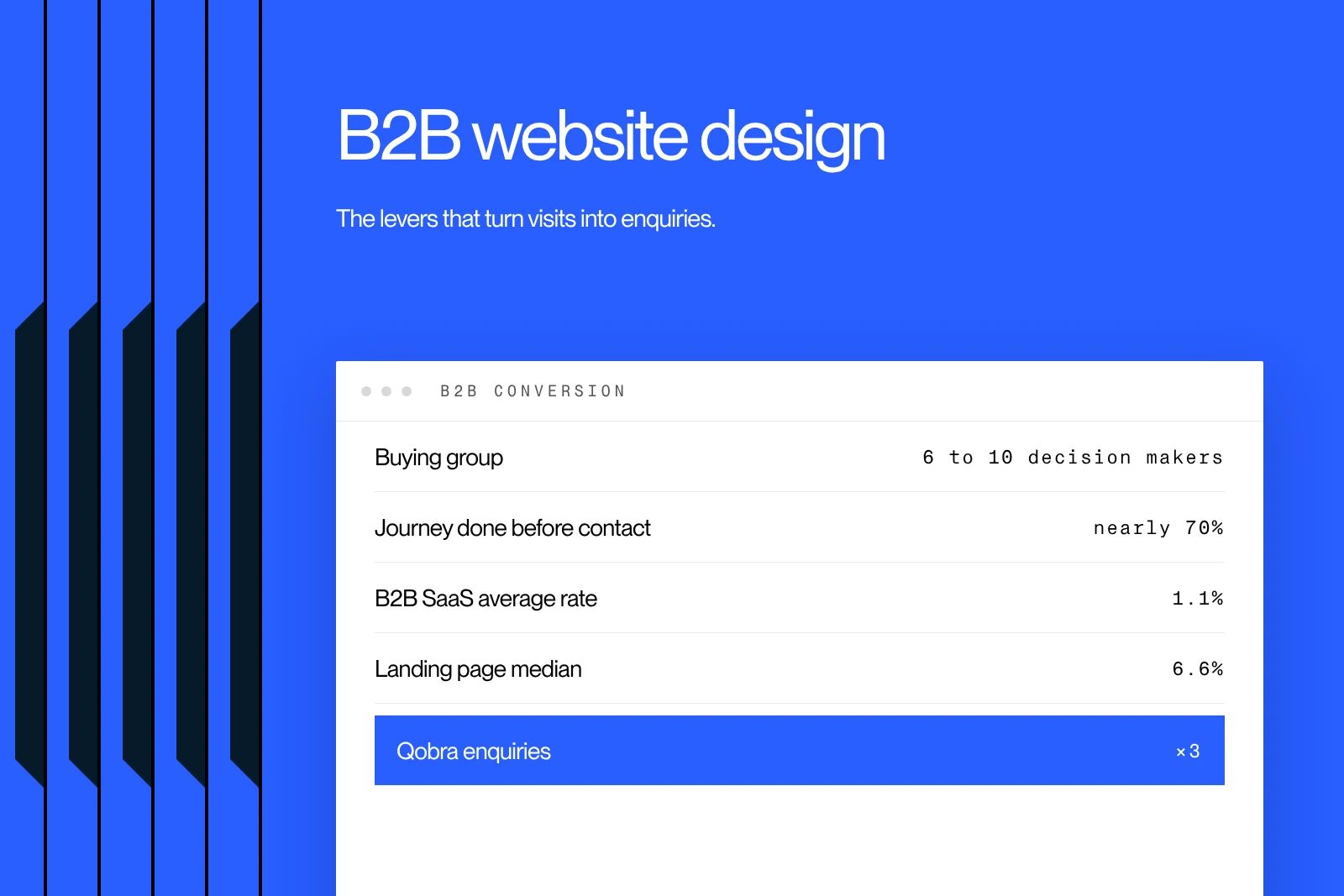
Qobra, a sales commission management SaaS, shows what Webflow allows once the site is live. We built the site to support its rebrand, then optimized it for two years: an ROI calculator, funnels per target audience, landing pages. The result: inbound requests multiplied by three and organic traffic multiplied by sixteen. The details are in the Qobra case study. That result comes from content and conversion work, not from the platform alone; but the platform made it possible to iterate without a developer.
How to decide in three questions
- Who will update this site in eighteen months, by name? If the answer is vague, rule out WordPress.
- Do I have a core functional need that an existing plugin already covers? If yes, WordPress will save you time and money.
- Does my content fit in 40 collections and a three-level structure? If not, check the Webflow CMS ceilings before committing.
Those three answers decide far better than a feature comparison. If you're still unsure, tell us about your project, even if we end up telling you to stay on WordPress.
Frequently asked questions
Webflow for a marketing site that your team needs to run without a developer. WordPress when a plugin already covers a core need (member area, LMS, marketplace) or when hosting has to stay under your control. The criterion that decides most often is who will do the updates in eighteen months.