Article
Brand platform: definition, full example and template
Branding11 min read

James BrunettoCo-fondateur & CEO
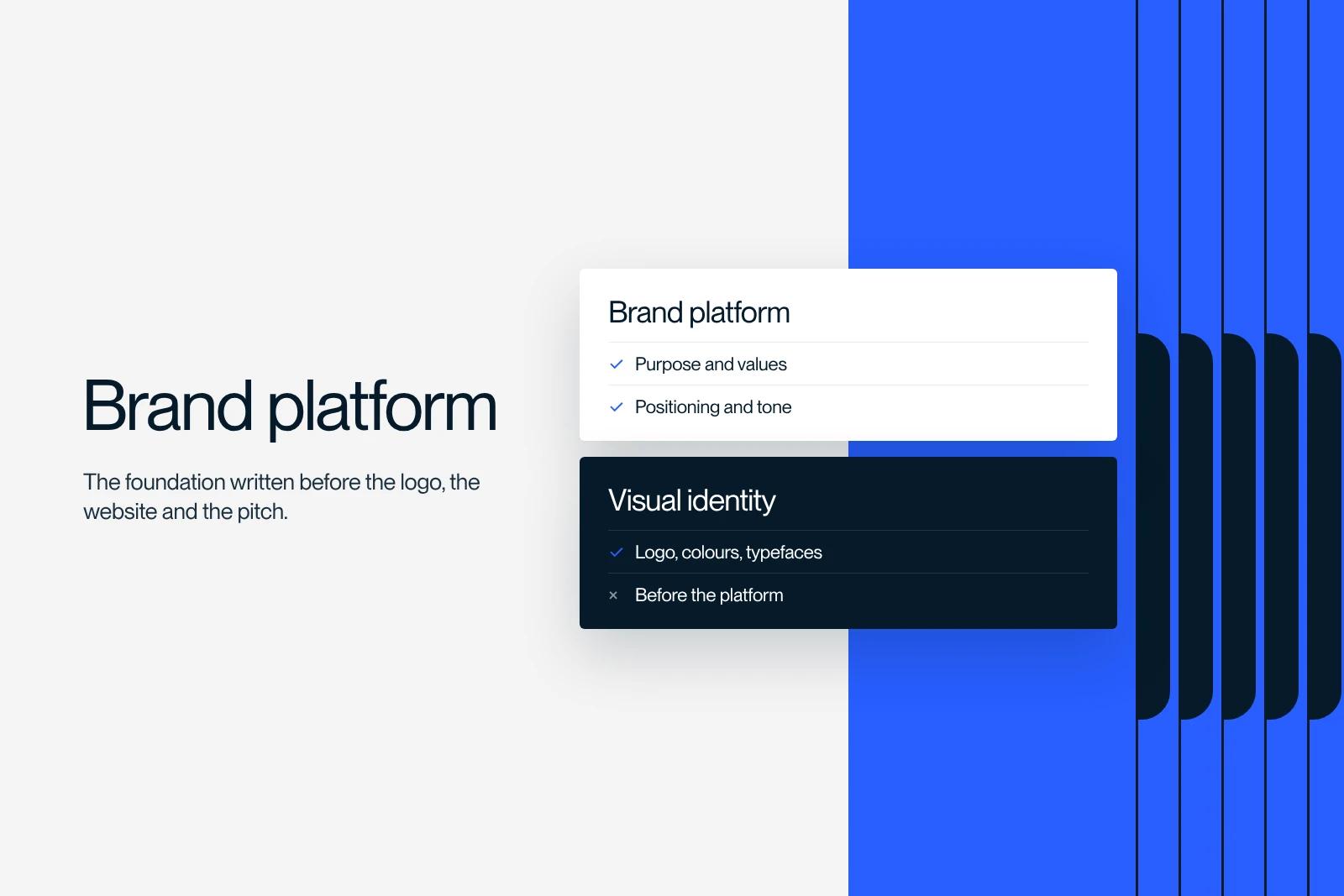
A brand platform is the strategic document that sets out what a brand is, what it promises and how it speaks: its purpose, vision, values, positioning and personality. It is the reference for everything that follows, from the logo to the website and sales materials. Here is what it contains, a complete example written for a B2B manufacturer, a template you can copy without filling in a form, what it costs, and the method we follow at Synqro.
Explore this post with…
In short: a brand platform answers three questions: who are we, who are we for, and how are we different. It fits in a few pages, is built with leadership, the sales team and a few clients, and gets reread at every change of course. In France, the median budget for one is €20,000.
Brand platform: the definition
A brand platform brings together a brand's fundamentals and key messages. It answers three questions that are easy to ask and hard to settle: who are we, who are we for, and how are we different from everyone else?
France's public agency for intangible assets (APIE), which advises public-sector brands, describes it as a strategic tool that defines the brand's core narrative. It sits where the organisation's reality meets the positioning it aims for over the next three to five years. APIE adds two points we agree with: a platform works best when it is co-created, and it should be renewed regularly.
It usually takes the form of a document of a few pages, sometimes summarised as a wheel or a pyramid. The format matters little. What matters is that each element is precise enough to settle a decision.
The 8 building blocks of a brand platform
Models vary from one agency to another, but the same blocks come up almost every time. The table gives the question each one answers.
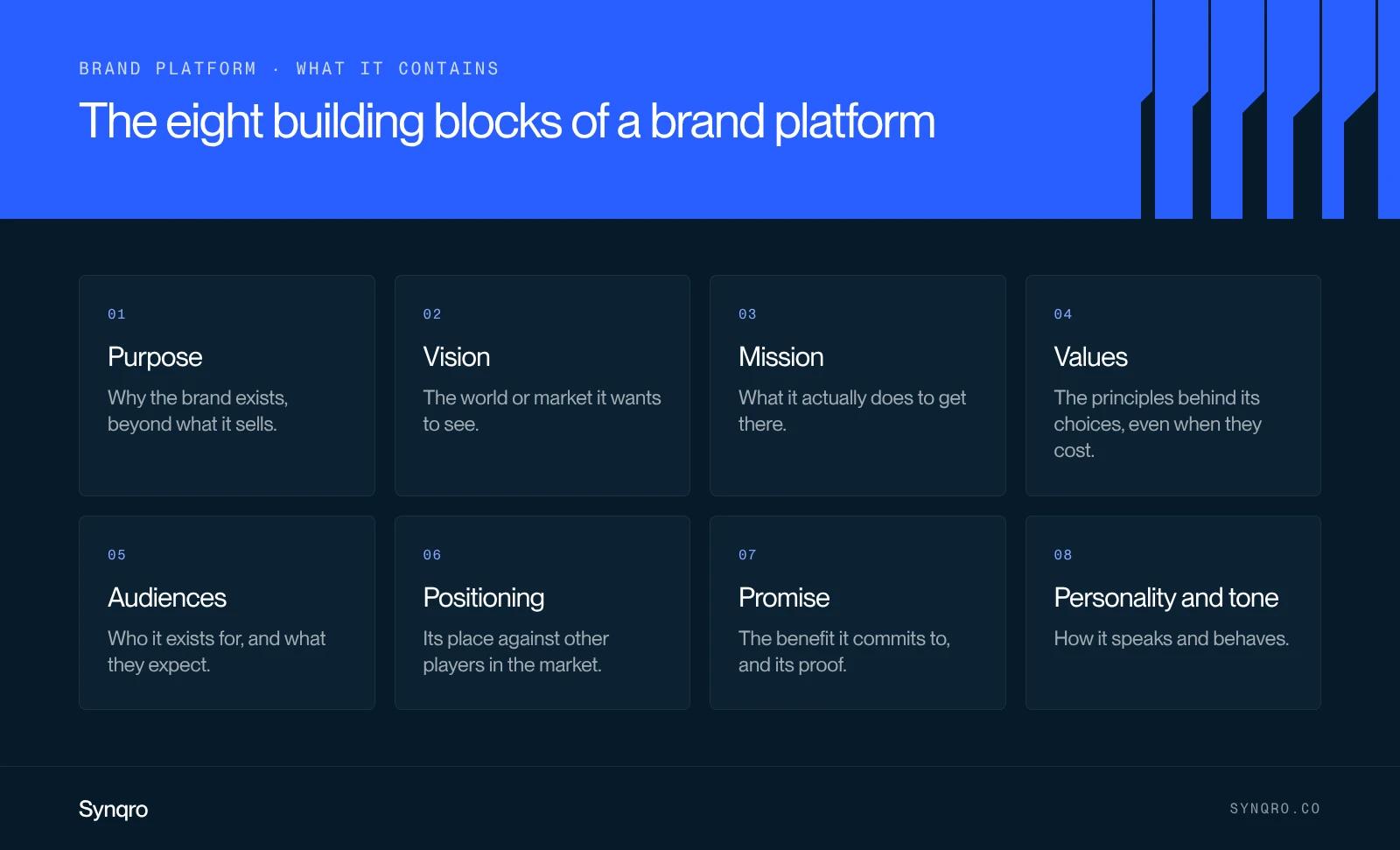
| Block | The question it answers |
|---|---|
| Purpose | Why the brand exists, beyond what it sells |
| Vision | The world or market it wants to see |
| Mission | What it actually does to get there |
| Values | The principles that guide its choices, including when they cost something |
| Audiences | Who it exists for, and what they expect |
| Positioning | The place it holds against other players in its market |
| Promise | The benefit it commits to, and its proof |
| Personality and tone | How it speaks and behaves |
A simple test shows whether a block is well written: if a competitor could copy it word for word, it says nothing. "Innovation, excellence, proximity" are not values; they are words everyone claims.
Kapferer's brand identity prism
To work on personality and relationship, many agencies use the brand identity prism created by Jean-Noël Kapferer, professor at HEC Paris. It describes a brand through six facets, arranged on two axes: what the brand sends out and what the audience receives, what is visible and what is felt from the inside.
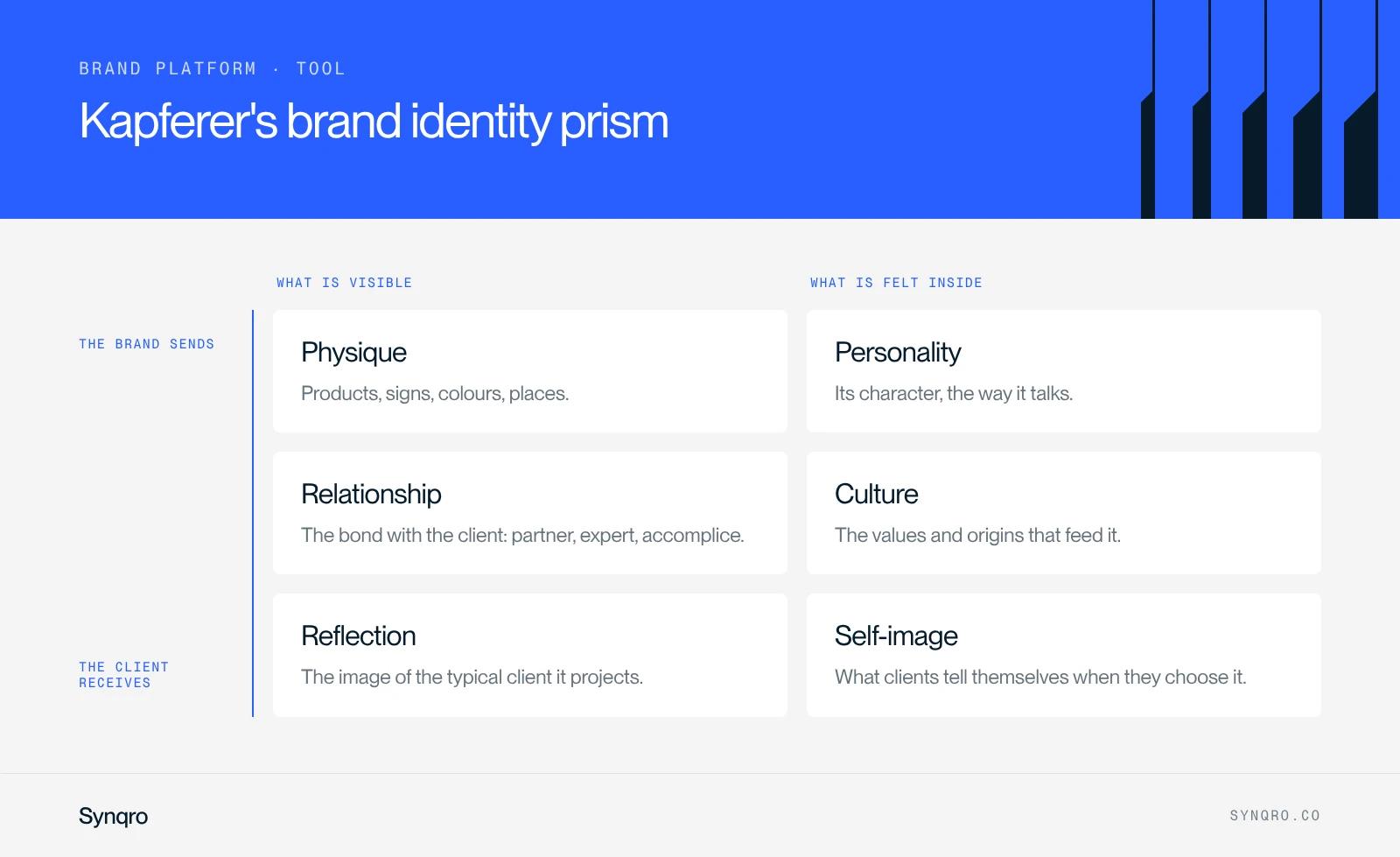
- Physique. What you can see and touch: products, signs, colours, places.
- Personality. The brand's character if it were a person, and how it talks.
- Relationship. The kind of bond with the client: partner, expert, accomplice.
- Culture. The values and origins that feed the brand.
- Reflection. The image of the typical client the brand projects outwards.
- Self-image. What clients tell themselves about themselves when they choose the brand.
The prism does not replace the platform. It helps write two of its blocks, personality and audiences, with more nuance. The twelve brand archetypes, popularised by Margaret Mark and Carol S. Pearson in 2001, play the same role: a starting point to describe a character, not a box to tick.
Brand platform, brand guidelines, purpose: who does what
These terms are often confused. Yet they fit together in a precise order.
| Document | What it sets | Who uses it | Lifespan |
|---|---|---|---|
| Brand platform | The substance: what the brand says and why | Leadership, marketing, sales, agencies | 3 to 5 years, with revisions |
| Visual identity | The translation into signs: logo, colours, typefaces | Designers, developers | As long as the platform holds |
| Brand guidelines | The rules for using those signs | Anyone who produces a material | Updated with each new medium |
| Communication platform | The messages of a campaign or a period | Marketing, communication agencies | One campaign, one year |
| Statutory purpose | A sentence written into the company's articles | Shareholders, board | Long-lasting, changed by a shareholder vote |
The statutory purpose deserves a word. Since France's PACTE law of 2019, a company can write a "raison d'être" into its articles of association, and go as far as becoming a "société à mission", a mission-driven company. At the end of 2025, France had 2,411 of them, employing more than 900,000 people in the country, according to the 9th barometer of the Observatoire des sociétés à mission. You do not need one to have a brand platform, but the sentence should be the same in both documents.
On the visual side, visual identity comes after the platform. Starting with the logo means choosing a form before knowing what it has to express. It is the most common mistake we see. Even choosing a logo colour becomes easier once the brand's personality is written down.
Two real purpose statements, and what they share
Full brand platforms are almost always confidential, so most examples online are reconstructions. Some purpose statements, however, are published by the companies themselves.
- Michelin: "We care about giving people a better way forward." It comes with five values written the same way: respect for clients, for people, for shareholders, for the environment and for facts.
- Danone: "Bringing health through food to as many people as possible", rooted in the economic and social "double project" set out by Antoine Riboud in 1972.
What they share: an action verb, a beneficiary, and no product. Michelin does not mention tyres, Danone does not mention yoghurt. That is what lets them outlast a product range.
Full example: a B2B manufacturer's brand platform
To show what a finished platform looks like, here is one written from A to Z. The company is fictional: Norvane, a maker of custom machined metal parts, 60 employees, with clients in aerospace and medical devices.
| Block | Content |
|---|---|
| Purpose | Making possible the parts others refuse to make. |
| Vision | An industry able to produce in small batches what it now buys abroad. |
| Mission | Machining complex parts in small batches, with a lead time stated before the order and kept. |
| Values | Say no early rather than deliver late. Show the measurement, not the promise. Train before hiring. |
| Audiences | Buyers and manufacturing engineers in aerospace and medical devices looking for a reliable option for runs of 10 to 500 parts. |
| Positioning | For manufacturers who need complex small batches, Norvane is the subcontractor that commits to a lead time on the quote, where the market answers "to be confirmed". |
| Promise | Your lead time is written on the quote. Proof: the on-time delivery rate, published every quarter. |
| Personality and tone | Precise, frank, technical without jargon. Short sentences, figures rather than adjectives. |
Why it holds up. Every block can settle a decision: an order that cannot be delivered on time gets turned down, in the name of the first value. The promise has measurable proof. And a competitor cannot sign the positioning without changing how it works.
Brand platform template
No form, no PDF to download: copy this table into your own document and fill it in, in order.
| Block | Question to ask yourself | Recommended format |
|---|---|---|
| Purpose | What would our clients lose if we disappeared tomorrow? | One sentence, an action verb, no product named |
| Vision | What does our market look like in ten years if we succeed? | Two sentences at most |
| Mission | What do we do every day to get there? | One concrete sentence |
| Values | Which choices have we made that cost us something? | Three values, each with a real example |
| Audiences | Who signs, who uses, who influences? | One line per profile, with its main expectation |
| Positioning | For whom, what need, how are we different, and why believe us? | One sentence, tested out loud |
| Promise | Which benefit can we prove? | One sentence and its proof in figures |
| Personality and tone | If the brand spoke in a meeting, how would it sound? | Three adjectives, three "we say", three "we don't say" |
Test your brand platform: 8 questions
Before signing it off, run each block through this test. Any "no" means the block needs rewriting.
- Could a competitor sign this sentence as it stands?
- Does the purpose hold without naming a single product?
- Is each value backed by a real choice already made?
- Can the positioning be said in one breath?
- Does the promise have proof you can show?
- Could a salesperson use it in a meeting tomorrow?
- Could a designer write a brief from it without calling you?
- Is the document under ten pages?
How much does a brand platform cost, and how long does it take?
Few pages talk about it, so here are the figures we could find. In France, La Fabrique du Net, which tracks agency quotes, reports a median of €20,000 for brand strategy across 134 projects. The middle half of projects falls between €5,000 and €40,000. Across all branding projects, three months is the most common duration.
The gap comes mainly from three factors: the number of interviews and workshops, the depth of the market study, and whether the visual identity is part of the same project. A platform written in-house costs less in budget, but it needs a facilitator from outside the debates: that is often where the decisions get lost.
For the next stage, our article on visual identity cost sets out market price ranges.
From brand platform to website, SEO and AI answers
This is the angle we see covered least, and the one we work on most. A platform that stays in a shared folder is useless. On a website, every block has a precise place.
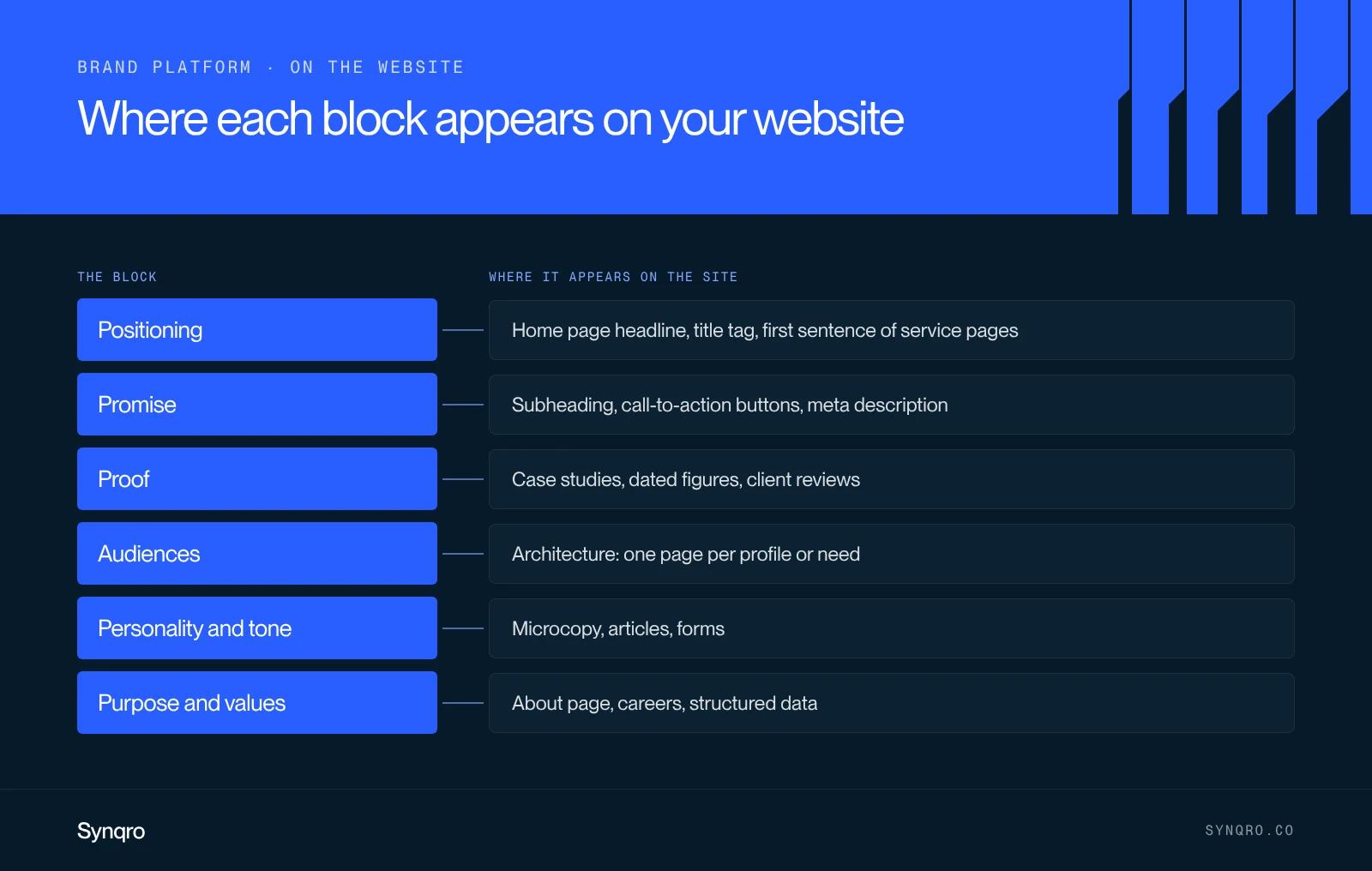
| Block | Where it appears on the website |
|---|---|
| Positioning | Home page headline, title tag, first sentence of service pages |
| Promise | Subheading, call-to-action buttons, meta description |
| Proof | Case studies, dated figures, client reviews |
| Audiences | Site architecture: one page per profile or need |
| Personality and tone | Microcopy, articles, error messages, forms |
| Purpose and values | About page, careers page, company description in structured data |
It has taken on one more role with AI assistants. These tools summarise the brands they recommend. The Semrush AI Visibility Index 2026 separates a brand's mentions in an answer from citations of its pages as sources: a brand can be named without its website being cited. A brand that describes itself the same way everywhere, on its website, its Google profile and its listings, is easier to summarise, and so easier to recommend.
We saw it when testing Google AI Mode: it reuses pages that answer plainly and recalculates figures given without context. A vague promise becomes everyone's promise. It is also where our work on visibility in AI search begins.
How to build a brand platform: our 5-step method
At Synqro, we build the platform before the first mock-up. The method comes down to five steps.
- Listen. Interviews with the leadership, the sales team and a few clients. The best wording often comes from the people who sell or buy the brand every day.
- Look at the market. An analysis of competitors and their communication territories, to see what is already taken and what is still free. We also check how Google and AI assistants already describe the brand and its competitors.
- Decide in a workshop. A working session to choose a positioning, even if it means giving up some audiences. A platform that tries to please everyone guides no one.
- Write and test. Each block is written, then run through the eight questions above.
- Roll it out. The platform becomes a visual identity, a website and sales materials, and it is revisited whenever the company changes course.
Our work with Circul'R for its tenth anniversary shows this logic. The aim was not to refresh a logo, but to turn the circular economy into a strategic advantage readable in one sentence, then carry it on an eco-designed website. At Diametral, formerly LittleBigCode, the change of name only made sense on the back of a clear positioning.
The most common mistakes
- Interchangeable values. If three competitors could sign the same list, it differentiates nothing.
- A document that is too long. A forty-page platform ends up in a shared folder nobody opens. Five pages that get used are better.
- A platform written after the logo. You end up justifying a form instead of guiding it.
- A promise without proof. Every promise needs a fact behind it: a client result, a method, a measurable commitment.
- A platform that never reaches the website. If the home page does not carry the positioning, the document only served in meetings.
- No revision. A brand launching a new offer, entering a market or changing audience should reread its platform.
If you are preparing a rebrand, our brand strategy work always starts with this step.
Sources
- APIE, What is a brand platform and what is it for? (in French)
- La Fabrique du Net, branding agency prices, data as of June 2026 (in French)
- L'Info Durable, 9th barometer of the Observatoire des sociétés à mission, 24 March 2026 (in French)
- Michelin, purpose and values
- Danone, at a glance (in French)
- Semrush, AI Visibility Index 2026, 26 June 2026
- Jean-Noël Kapferer, The New Strategic Brand Management, Kogan Page
- Margaret Mark and Carol S. Pearson, The Hero and the Outlaw, McGraw-Hill, 2001
- Synqro projects: Circul'R, Diametral
Frequently asked questions
It is the strategic document that sets out a brand's fundamentals: its purpose, vision, mission, values, positioning, promise and tone of voice. It is the reference for every communication and design decision.