Article
CRO: definition, method and tools to convert more visitors
Webflow9 min read

James BrunettoCo-fondateur & CEO
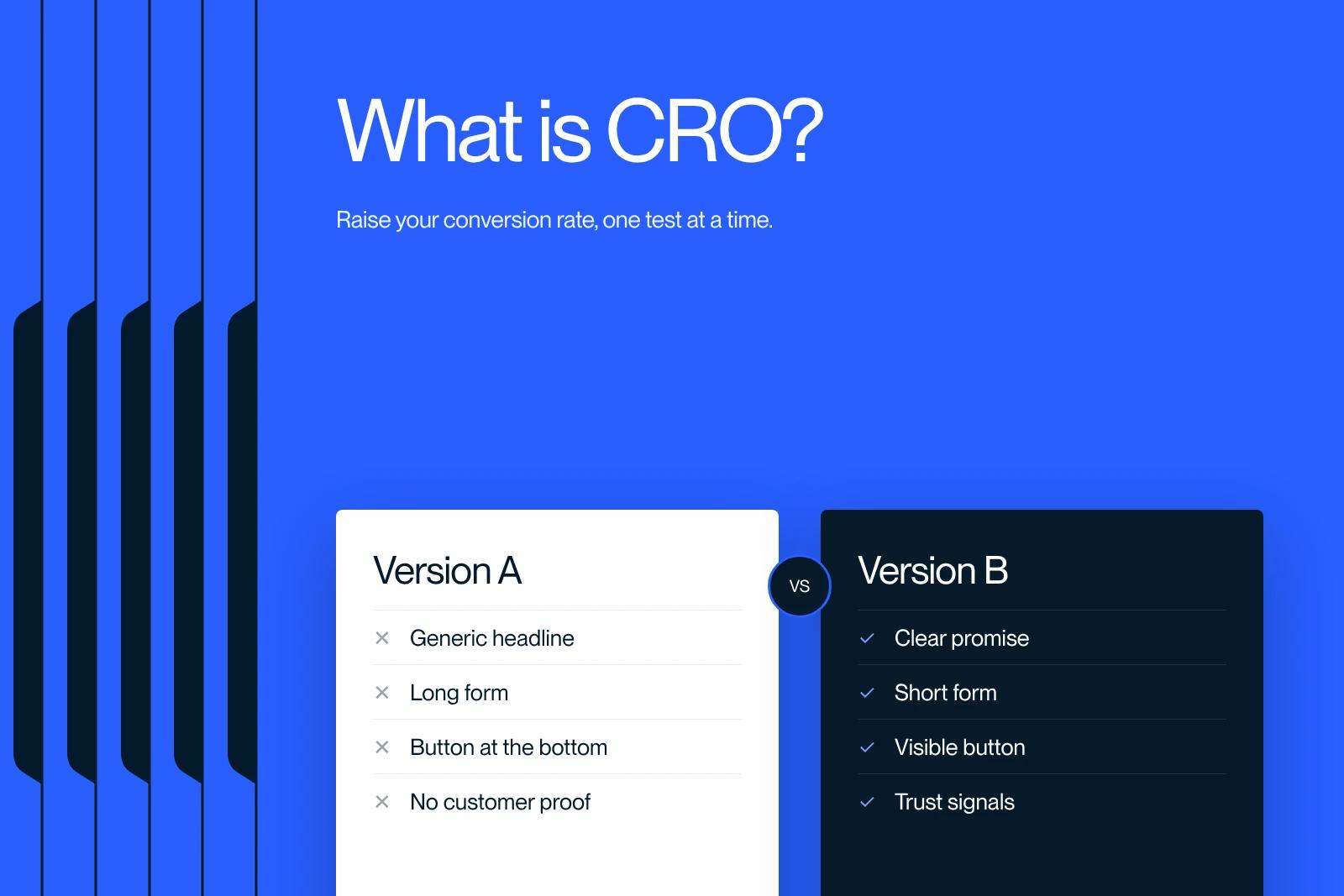
CRO (Conversion Rate Optimization) is the practice of increasing the share of a site's visitors who take a useful action: purchase, demo request, quote, sign-up. It relies on data and testing rather than intuition, and it works on the traffic you already have.
The method comes down to a loop: measure the journey, spot the friction, form a hypothesis, test a change, keep what works.
This guide walks through that loop, the tools available in 2026, the rules for reliable A/B tests and how CRO fits with SEO.
Explore this post with…
What is CRO? A simple definition
CRO, or Conversion Rate Optimization, covers all the analysis and testing aimed at getting more visitors to take action on a site or an app. The goal is not to attract more people, but to make better use of every visit.
The conversion rate is simple to calculate: number of conversions divided by the number of sessions (or users), multiplied by 100. A site that gets 2,000 sessions and 40 demo requests converts at 2%.
There are two levels of conversion:
- Macro-conversions: the main business goal (order, quote request, booked meeting).
- Micro-conversions: the steps that lead to it (CTA click, add to cart, white paper download, newsletter sign-up).
What CRO is not
- A visual redesign: a better-looking site does not necessarily convert better.
- A list of universal tricks: a button color that wins elsewhere can lose on your site.
- Manipulation: fake counters, false scarcity or pre-checked boxes lower trust and create legal risk.
Why CRO has a direct effect on revenue
The math is mechanical. With 10,000 visits a month and a 1% rate, you get 100 leads. Going to 1.3% gives you 130 leads, without spending a single extra euro on advertising. That is why CRO becomes a priority when acquisition costs rise.
In e-commerce, the room for improvement is often in the checkout. The Baymard Institute calculates an average cart abandonment rate of 70.22% based on 50 studies (page updated in September 2025). Among the US shoppers surveyed, the top reason given is extra costs that are too high, discovered at checkout (shipping, taxes, fees), cited by 40% of them.
The CRO method in 6 steps
1. Set a goal and a metric
Choose one main conversion per page or per journey. On a B2B service page, it is the qualified contact request, not time on page. Write down the current rate: this is your baseline.
2. Measure the journey
First check that conversions are properly tracked (key events in GA4, forms, CTA clicks). Then build a funnel with Google Analytics 4 funnel exploration to see at which step visitors drop off, by device and by traffic source.

3. Understand why visitors get stuck
The numbers tell you where people get stuck, rarely why. For the why, combine several sources:
- Heatmaps and session recordings: clicks on non-clickable elements, scrolling that stops before the CTA, hesitation in a form.
- On-page micro-surveys: an open question such as "What is stopping you from requesting a quote today?".
- User tests: 5 people from your target audience completing a task while thinking aloud are often enough to reveal the major blockers.
- Feedback from sales and support teams: the objections they hear on the phone are often missing from the page.

4. Prioritize the hypotheses
Write each idea as a hypothesis: "If we show shipping costs on the product page, then checkout abandonment will drop, because visitors will no longer discover an extra cost at the end." Then score each hypothesis on expected impact, confidence and effort (the ICE framework), and start with high-traffic pages.
5. Test the change
With enough traffic, an A/B test compares the current version and a variant on two randomly assigned groups of visitors. With little traffic, you make successive changes measured over comparable periods, backed up by user tests.
6. Roll out, document, repeat
Keep a record of every test: hypothesis, dates, result, decision. A losing test is information too. This log keeps you from retesting the same ideas and serves as the basis for the next quarter.
The levers with the most weight on conversion
| Lever | What we check | Test example |
|---|---|---|
| Value proposition | Visitors understand in 5 seconds what you do, for whom, and why you | Benefit-led headline vs descriptive headline |
| Forms | Number of fields, required fields, error messages | 2-step form vs single form |
| Proof and reassurance | Verifiable reviews, client logos, concrete cases, guarantees | Reviews placed near the CTA vs at the bottom of the page |
| Speed and stability | Core Web Vitals: LCP, INP, CLS | Lighter main image, deferred third-party scripts |
| Checkout | Costs shown early, guest checkout, payment methods | Shipping costs shown on the product page |
| Calls to action | One main CTA per page, explicit label | "Get a quote within 48 hours" vs "Send" |
For speed, our guide to Core Web Vitals details the thresholds and fixes. For campaign pages, see how to structure a landing page that converts.
Which CRO tools to use in 2026?
| Need | Example tools | Good to know |
|---|---|---|
| Journey measurement | Google Analytics 4, Matomo | Set up key events before any analysis |
| Behavior | Microsoft Clarity, Hotjar, Contentsquare | Clarity is free and useful to get started |
| A/B testing | AB Tasty, Kameleoon, VWO, Optimizely, Webflow Optimize | Webflow Optimize is listed from $299 per month on the Webflow pricing page |
| Qualitative feedback | On-site surveys, user tests, customer interviews | Essential when traffic is low |
If an older article recommends Google Optimize: the tool no longer exists. Google shut down Optimize and Optimize 360 on September 30, 2023. Another point to watch in France: most heatmap and testing tools set trackers. Check how your consent banner handles them in light of the recommendations of the CNIL (France's data protection authority) on cookies and trackers.
A/B testing: the rules for reliable results
- Write down the hypothesis and the primary metric before launching the test.
- Calculate the required sample size with a calculator, based on your current rate and the minimum difference you want to detect.
- Run the test over full weeks to smooth out differences between weekdays and weekends.
- Do not stop the test as soon as a result looks significant: peeking too early multiplies false winners.
- Analyze segments (mobile, new visitors) with caution: the more you slice, the greater the risk of chance results.
On the SEO side, the Google Search Central guidelines on website testing (updated in December 2025) are clear: do not show Googlebot a different version from the one visitors see, point variant URLs to the original with a canonical tag, use 302 redirects rather than 301s, and remove the test as soon as it has delivered its verdict.
CRO and SEO: two complementary levers
SEO brings qualified visitors, CRO turns them into customers. Working on one without the other leaves value on the table: a well-ranked but confusing page converts poorly, and a perfect page with no traffic converts no one. So track both families of metrics together, as we explain in our article on the SEO KPIs to track.
How we approach CRO at Synqro
At Synqro, we start from the client's real data before writing a single line: sales brochures, figures, objections reported by the teams. That is what prevents generic pages that answer no specific question. We then run a quarterly review to reprioritize pages and hypotheses based on what the data shows.
For campaigns, we deliver a dedicated landing page in 2 weeks, which makes it possible to test a message quickly rather than reworking the home page. At Qobra, a client we support, leads were multiplied by 3 and organic traffic by 16. For software companies, see also our SaaS landing page method.
The most common CRO mistakes
- Optimizing without reliable measurement: a misconfigured conversion event skews every conclusion.
- Copying "best practices" from another industry without testing them on your own site.
- Testing cosmetic details while the value proposition is still unclear.
- Judging a test on the number of clicks rather than on the final conversion (qualified lead, sale).
- Forgetting mobile, even though journeys and friction points are often different there.
CRO is not a one-off project. It is a routine: measure, understand, test, document. The gains add up from one quarter to the next.
Frequently asked questions
CRO stands for Conversion Rate Optimization. It is the practice of increasing the percentage of visitors who take a useful action on a site, such as a purchase or a quote request. It relies on data analysis and testing.