Article
Brand positioning for B2B: method, examples and tests
Branding11 min read

James BrunettoCo-fondateur & CEO
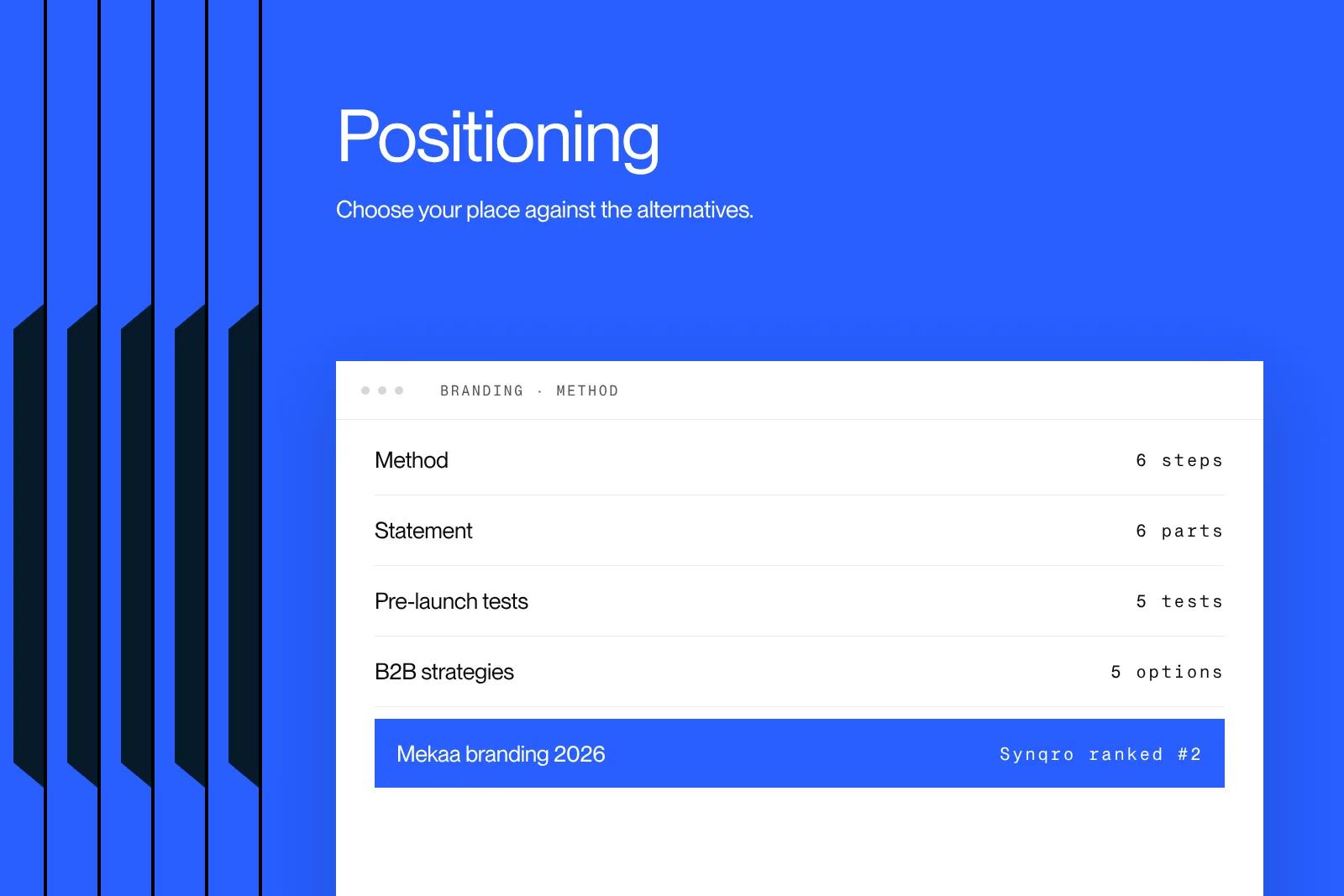
Brand positioning is the specific place you want to hold in your buyers' minds, compared with the alternatives they are weighing. In B2B, it fits in one sentence that says who you serve, what you do better than the other options and why anyone should believe you. This guide separates positioning from the brand platform, the value proposition and the tagline, then walks through our 6-step method with a positioning map and a statement template. You will also find real examples, including Synqro's own repositioning, plus five tests to run before launch and a way to carry the result onto your website and into AI answers.
Explore this post with…
What brand positioning means in B2B
Brand positioning is the deliberate choice of a distinct, credible place in a target buyer's mind, relative to the alternatives that buyer compares you with. It is not what you say about yourself. It is what a prospect remembers when they line you up against a competitor, a freelancer or the option of doing it in-house.
In B2B, that comparison is usually explicit. A procurement lead builds a shortlist of three vendors. A buying committee reads three proposals side by side. A VP asks ChatGPT which firms handle a given problem. If your place is unclear, buyers file you in the nearest box, and that box is usually price.
Strong positioning answers four questions in plain words:
- Who it is for. A defined audience, with an industry, a company size or a trigger situation.
- Against what. The real alternative the buyer considers, not a straw man.
- What is different. What you do better, or differently, on a criterion the buyer cares about.
- What proves it. A verifiable fact that makes the difference believable.
Positioning vs brand platform vs value proposition vs tagline
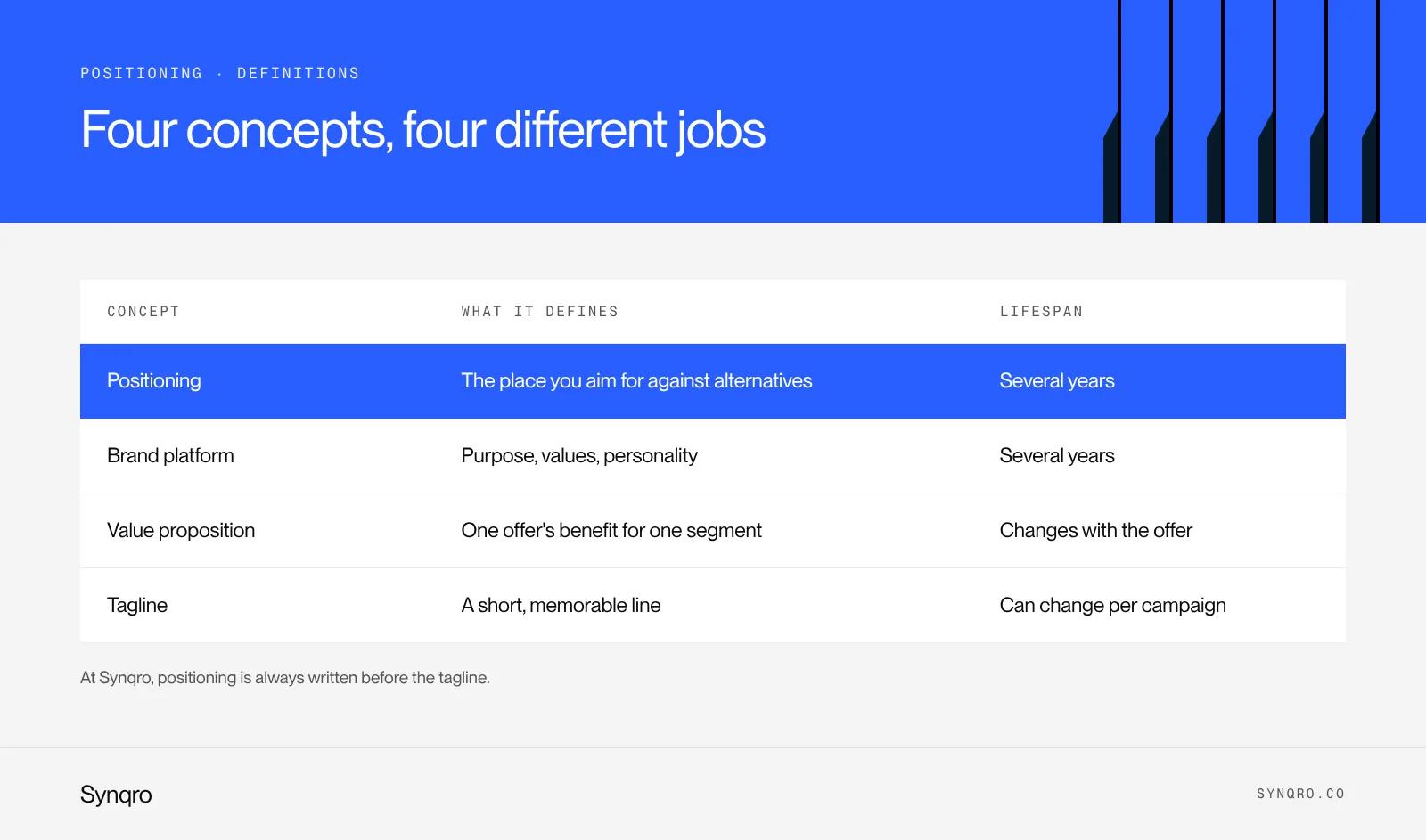
These four get mixed up in most briefs. They do different jobs for different readers. Positioning is a strategic decision. The brand platform is the document that holds it alongside purpose, values and personality. The value proposition turns it into a benefit for one offer. The tagline makes it a public line.
| Concept | What it defines | Main audience | Lifespan |
|---|---|---|---|
| Positioning | The place you aim for against alternatives | Leadership, team, agencies | Several years |
| Brand platform | Purpose, values, personality, positioning | The whole company and its vendors | Several years |
| Value proposition | The concrete benefit of one offer for one segment | Prospects, sales team | Changes with the offer |
| Tagline | A short, memorable line | Public, events, advertising | Can change per campaign |
At Synqro, we always write positioning first. A tagline found before the positioning is settled almost always gets rewritten, because it summarizes an idea nobody has committed to yet.
Five B2B positioning strategies
There are many ways to stand apart. In B2B, five show up in nearly every project we see. The right one depends on what you can prove, not on what sounds best in a workshop.
| Strategy | The idea | When it works | The risk |
|---|---|---|---|
| Specialization | One industry, size or function | Fragmented market, buyers want a peer | Growth ceiling if the niche is small |
| Expertise or method | A documented way of working | Services, long sales cycles | Stays abstract without proof |
| Customer experience | Speed, responsiveness, hands-on support | Rivals seen as slow or heavy | Easy to copy |
| Premium | Quality, rigor, a price you stand behind | Buyers paying for low risk | Needs an identity and site to match |
| New category | You create or redefine the category | Breakthrough products | You have to educate the market |
Low-price positioning exists too, but it is hard to defend in B2B services. Someone will always undercut you.
How to build brand positioning in 6 steps
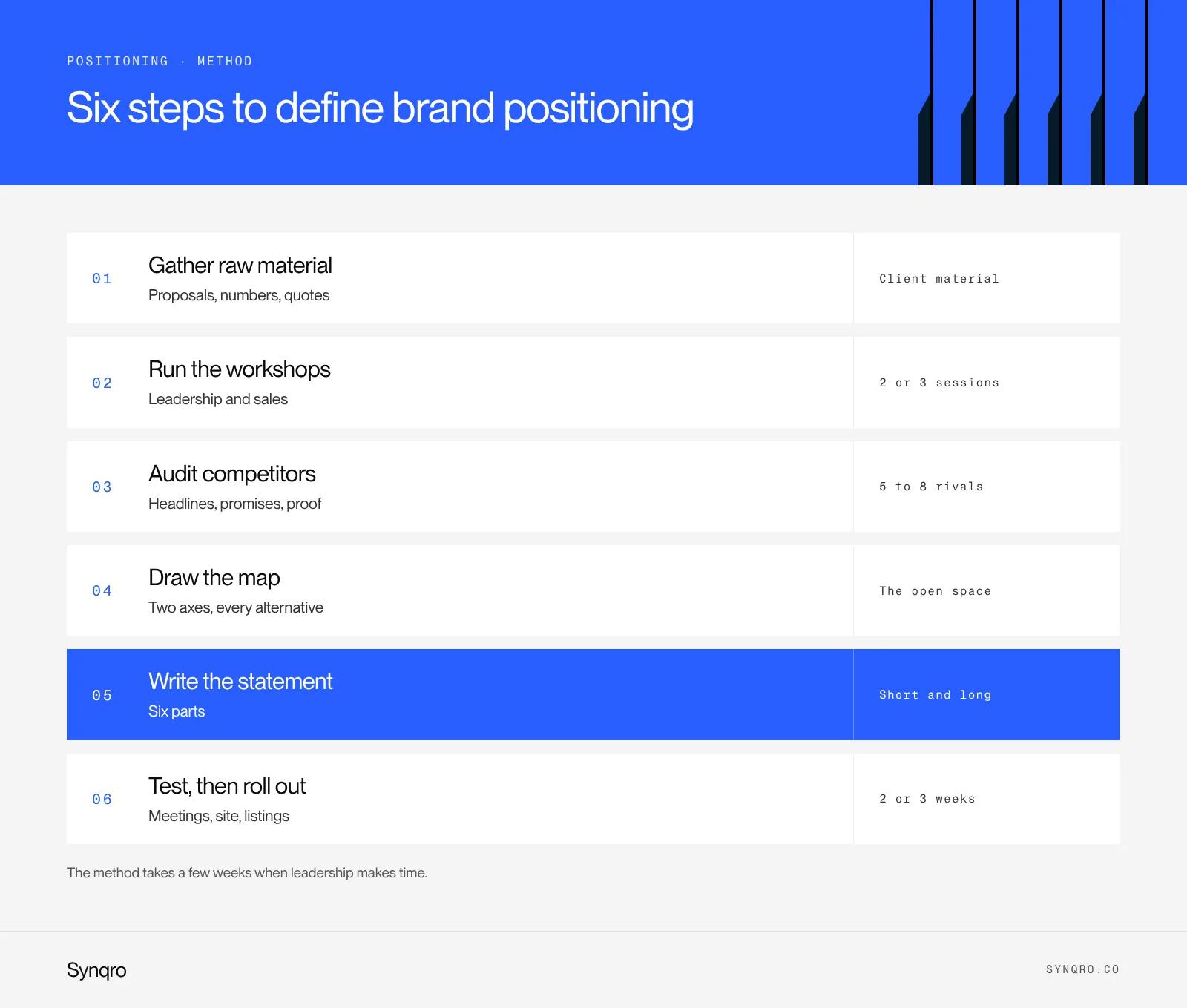
This is the method we use on brand projects. It takes a few weeks when the leadership team makes time for it.
- Gather raw material. Sales decks, won and lost proposals, real numbers, customer quotes.
- Run the workshops. Two or three sessions with leadership and sales.
- Audit competitors. Their homepage headlines, promises and proof points.
- Draw the positioning map. Two axes, every alternative plotted, the open space identified.
- Write the positioning statement. Six parts, a short version and a long one.
- Test, then roll out. With real customers first, then on the site, sales materials and third-party listings.
The workshops
The first workshop is not about the brand. We ask founders to walk through their last three wins and their last loss. Why the client signed, what they were comparing, where they hesitated. Those stories carry more weight than a list of values drafted in a meeting room.
Then we talk to sales. They hear the objections. If their pitch does not match the sentence leadership has in mind, the pitch is usually the one telling the truth.
The competitor audit
For five to eight competitors, we capture the homepage headline, the main promise, the proof on display and the price if it is public. It is a simple exercise and often a humbling one. We regularly find headlines that could be swapped between sites without anyone noticing. That is good news. It leaves room.
The positioning map
The map crosses two criteria that genuinely matter to the buyer. Every alternative goes on it, including freelancers and in-house teams. An empty quadrant only matters if real buyers need something there and you can occupy it with proof.
Applied to our own repositioning, the map can cross two axes. One ran from "single-tool specialist" to "brand, website and visibility under one roof". The other ran from "execution" to "strategy". That second corner is where we chose to stand when we moved from agence-synqro.fr to synqro.co.
The positioning statement
The template has six parts, in this order:
- Audience. Who you serve.
- Need. The problem they want solved.
- Category. The shelf buyers should put you on.
- Benefit. What you deliver differently.
- Alternative. What you are compared with.
- Proof. The fact that makes it credible.
The short version goes into materials. The long version stays internal as the reference for anyone writing on behalf of the brand.
Real B2B brand positioning examples
The examples below come from actual projects. We only state what appears on our published case studies.
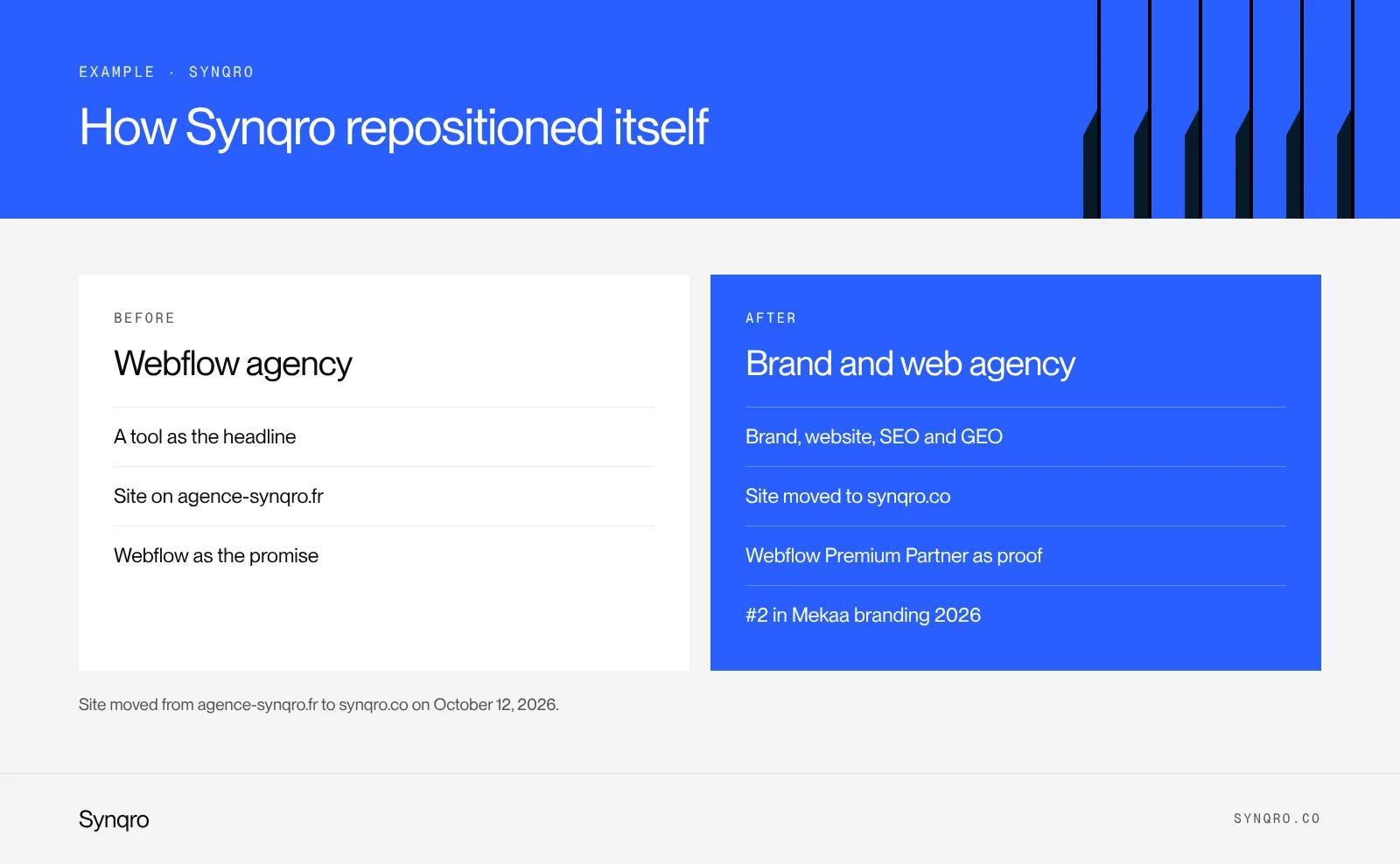
Synqro: from Webflow agency to brand and web agency
For years, Synqro introduced itself as a Webflow agency. It was accurate, but it described a tool, not a place in the market. We repositioned as a brand and web agency covering brand, website and SEO and GEO visibility in a single engagement. On October 12, 2026, we moved the site from agence-synqro.fr to synqro.co to carry that change.
Applied to Synqro, the formula would read: for B2B companies that want to be chosen and found, Synqro is a brand and web agency that connects brand, website and visibility, where many vendors deliver each piece separately. The proof is public: more than 150 companies supported since 2019, 52 Google reviews averaging 5.0 out of 5, and second place in Mekaa's 2026 ranking of branding agencies.
What the project taught us: finding the sentence is not the hard part. Accepting what you stop saying is. We are still a Webflow Premium Partner, but Webflow moved from our headline to our proof.
Diametral: from data experts to AI architects
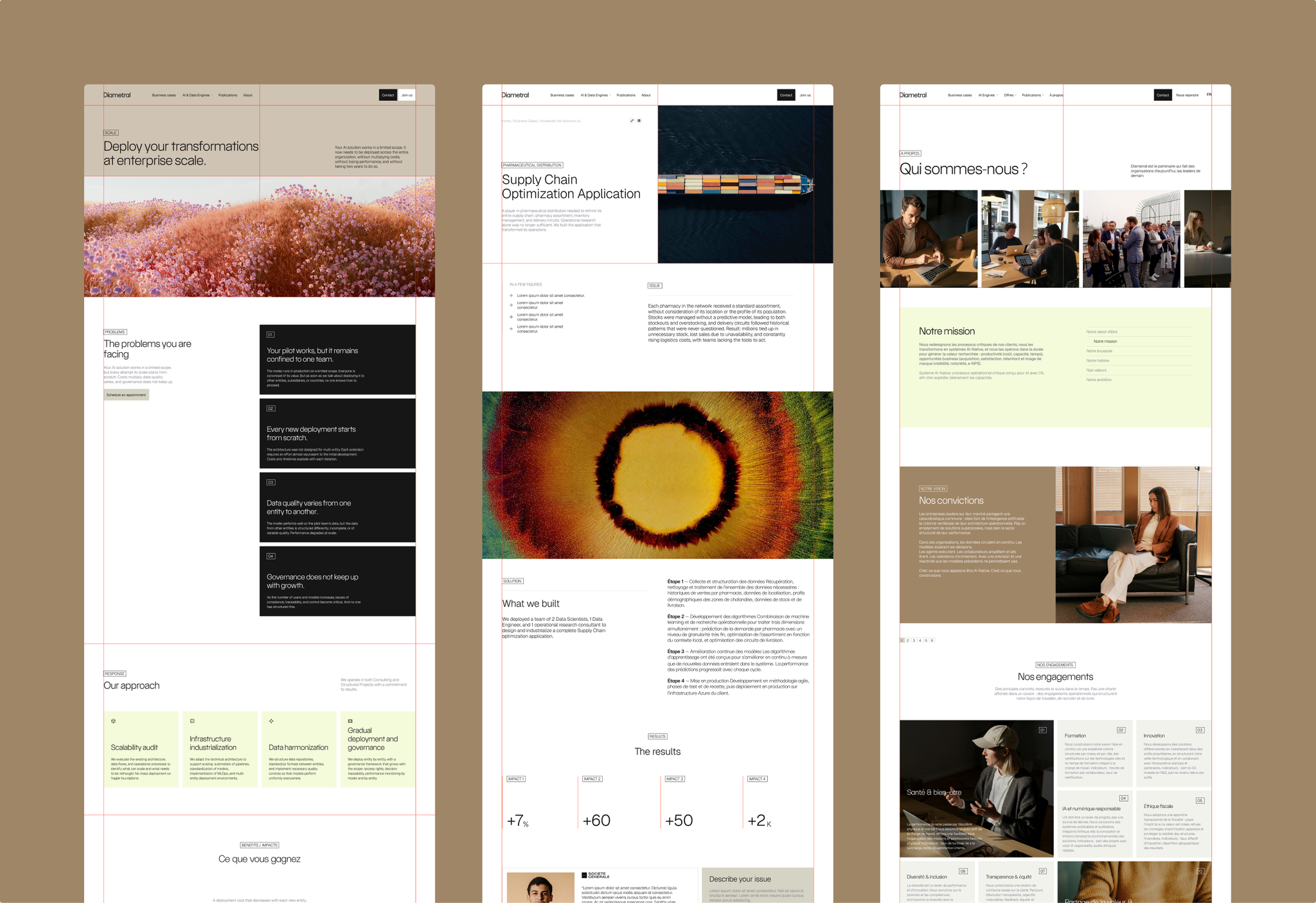
Founded in 2018 as LittleBigCode, Diametral built its reputation on technical execution. Working with Synqro, the company redefined its positioning around AI-native performance, engineering rigor and operational impact. Its case study sums it up: "From data expertise to architects of AI-native performance". The full story is in the Diametral case study.
Mocade and Growth Opportunity
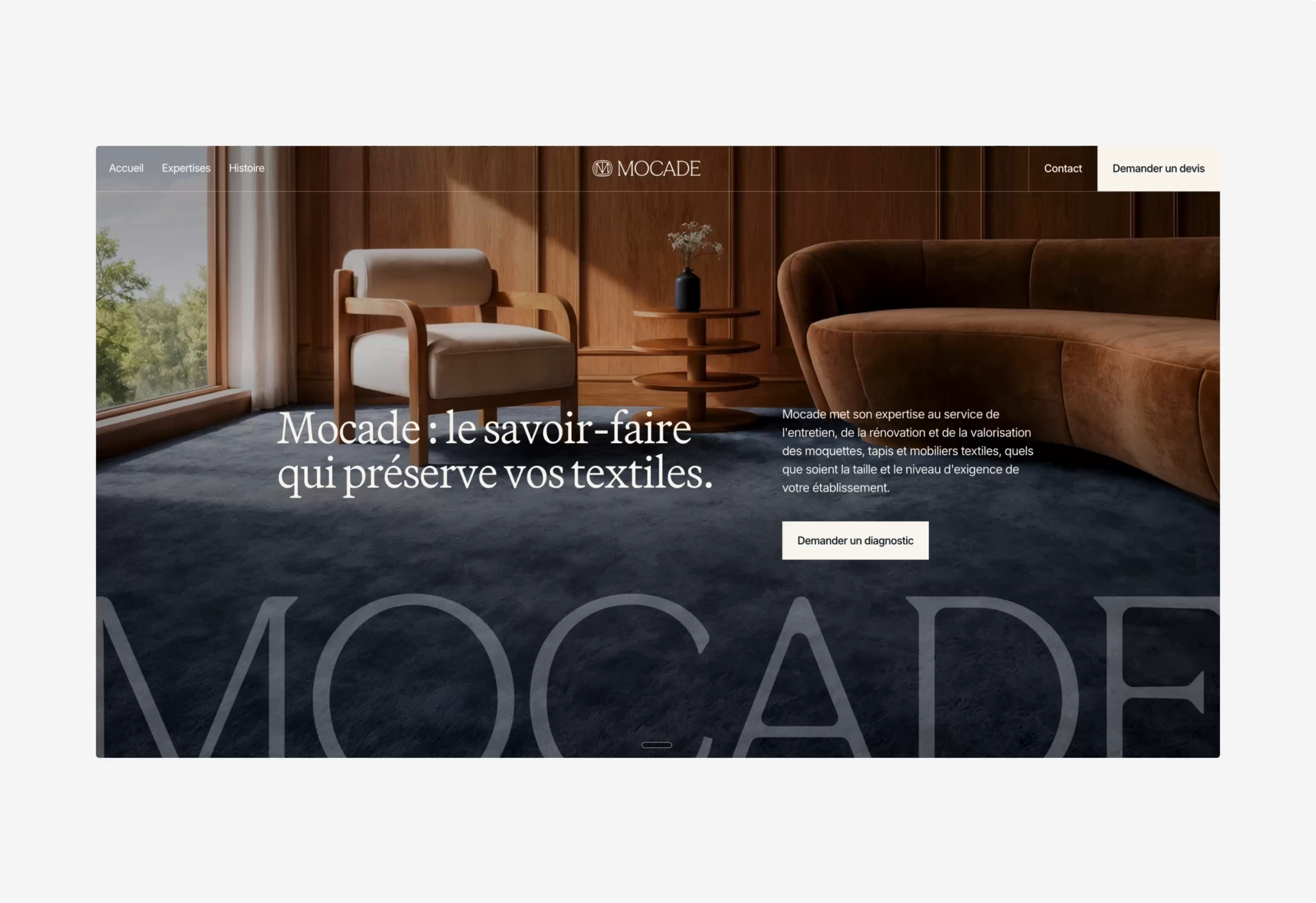
Mocade cares for carpets and fine textiles in luxury hotels and restaurants. Its trade was rarely seen as glamorous, yet its clients live by the codes of luxury. The positioning moved "from carpet cleaning to luxury textile care", and the brand was revealed at a major CBRE event. See the Mocade case study.
Growth Opportunity, a paid ads agency, already dug into clients' finances and sales before any campaign, but nothing showed it. Its positioning became "from ads agency to strategic growth partner". Since relaunching its brand and website, the agency has doubled its revenue.
How to test your brand positioning
Test positioning before you roll it out. You do not need a research firm. Five tests catch the expensive mistakes.
- The name-swap test. Remove your name from the statement. If a competitor could sign it as is, it is not done.
- The five-second test. Show a customer your draft homepage headline. Ask what you do and who it is for.
- The sales test. Have the team use the statement in meetings for two or three weeks. Log the questions it triggers.
- The proof test. Every word in the statement should point to a fact, a number or a case study.
- The sacrifice test. List what you will stop saying or selling. An empty list means the positioning is too broad.
At Synqro, the name-swap test always comes first. It knocks out a lot of first drafts, which is exactly its job.
Bringing positioning to your website
Your website is where positioning gets checked. A prospect spends a few seconds there before deciding to keep reading. If the homepage headline says something other than the approved statement, the site wins in the visitor's mind.
| Website element | What it should carry | Common mistake |
|---|---|---|
| Homepage headline | Category and difference, in plain words | A clever line with no trade in it |
| Subheadline | Audience and benefit | A list of services |
| Service pages | One value proposition per offer | The same copy pasted everywhere |
| Case studies | Proof, with facts | Visuals with no context |
| About page | The story and what you refuse to do | Generic values |
| Calls to action | The logical next step for the audience | "Learn more" everywhere |
Positioning also sets the rules for your visual identity. Premium positioning does not survive a patched-together style guide. Our own guidelines are an example: a single blue accent #285EFF, a night background #051A2A, PP Neue Montreal Regular for headings and 2 px corners. That restraint is a positioning choice, not just a matter of taste.
When positioning shifts a lot, the name question sometimes comes up. Before starting a brand naming project, check whether the current name really blocks the new position or only bothers people internally. At Synqro, naming starts at €1,500 excluding VAT, and a full website runs €5,000 to €20,000 excluding VAT over 8 to 12 weeks.
Brand positioning in AI answers
When a buyer asks an AI assistant to recommend a vendor, the answer summarizes what available sources say about you. No technical trick forces a citation. Inconsistent descriptions across sources, however, blur the message.
Align these on the same positioning statement:
- Your website. Homepage headline, about page and service pages.
- Your Google Business Profile. Google's guidelines ask for a name that reflects your real-world business name and a description with useful information about your services, with no links.
- Directories and rankings. The listings you control, and the ones you can ask to correct.
- LinkedIn. The company page and leadership profiles.
- Proposals. The first page uses the same wording.
The logic matches Google's. Its guidance on helpful content asks whether content provides original information and demonstrates first-hand expertise. Positioning built on your own cases and real numbers meets that bar better than generic copy. That is why our SEO and GEO method always starts by collecting client material.
Common brand positioning mistakes
- Targeting everyone. "Companies that want to grow" is not an audience.
- Mistaking a service list for positioning. What you do is not the place you hold.
- Claiming without proof. "Leader", "expert" and "innovative" convince no one without a number or a case.
- Changing the story by channel. Homepage, LinkedIn and proposals should tell the same story.
- Never revisiting it. Markets move. At Synqro, we reread positioning at every quarterly review, together with the SEO and GEO strategy.
If your positioning changes deeply, it often leads to a rebranding strategy, then a website redesign. To handle it all with one team, see our brand strategy and identity services or read our guide to B2B branding.
Frequently asked questions
It is the distinct, credible place you choose to hold in a target buyer's mind, relative to the alternatives that buyer compares you with.