Article
Brand naming: the complete process from brief to trademark
Branding13 min read

James BrunettoCo-fondateur & CEO
Brand naming is the process of creating and choosing the name of a company, a brand or a product. A good brand name is easy to remember, easy to say and spell, true to what you sell, and strong enough to register as a trademark. You get there with a method: a brief, a wide creative search, a shortlist, then legal, linguistic and digital checks before anyone falls in love with a candidate. This guide covers each step, the types of names, common mistakes, official filing fees and what happens once the name is chosen.
Explore this post with…
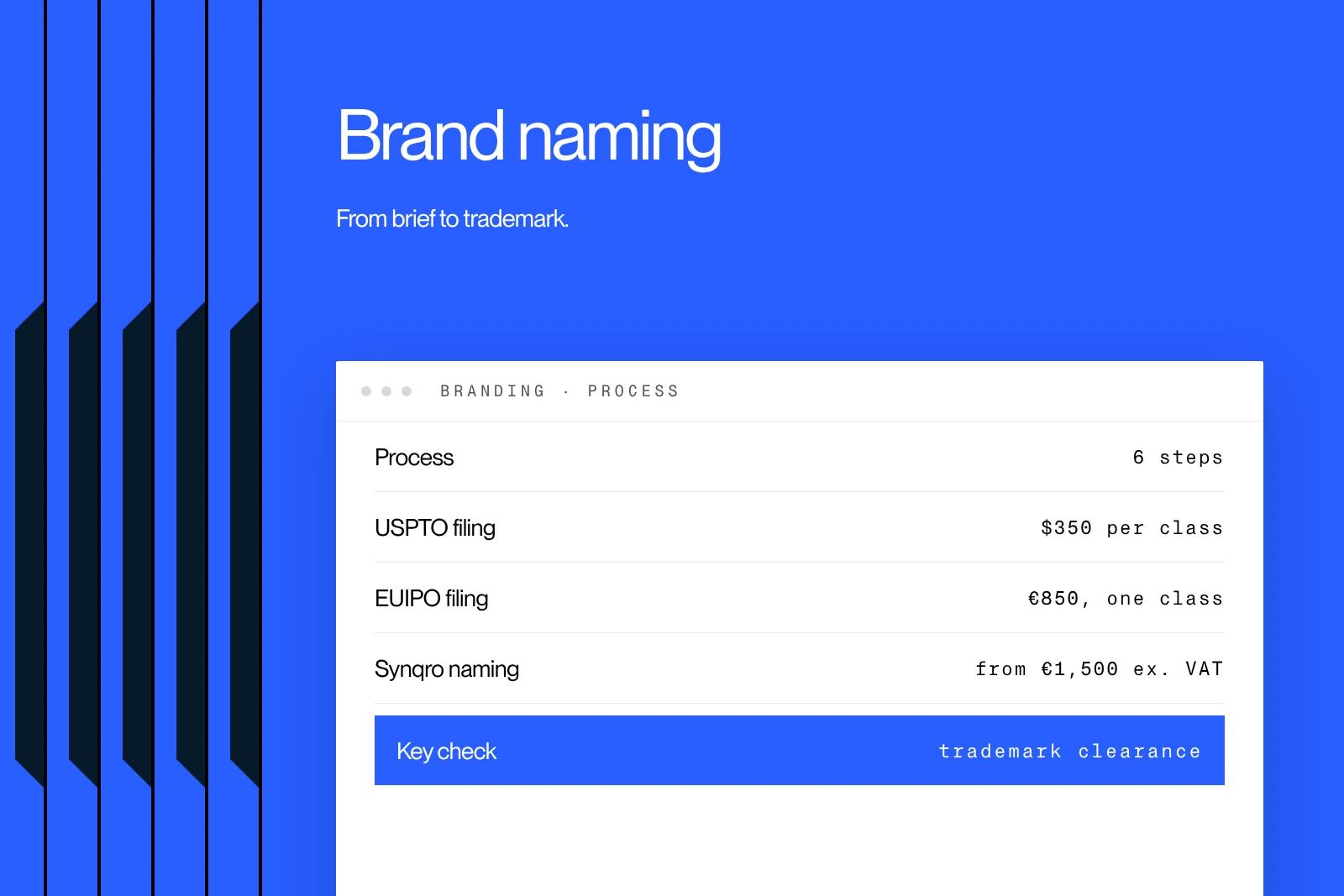
In short: brand naming follows six steps: brief and criteria, creative exploration, shortlist, checks, decision, filing. The check that decides everything is the trademark clearance search, which should be reviewed by a trademark attorney before you file. A US trademark application costs $350 per class at the USPTO, and an EU trade mark €850 for one class at the EUIPO (official fees checked in October 2026). A name never works alone: it carries a brand platform, a visual identity and a website, which are best planned straight after.
What is brand naming?
Brand naming is the work of creating and selecting the name of a brand, a company, a product or a service. It covers idea generation, selection, and the checks that make the name safe to use and possible to protect.
People often mix up several kinds of "name", and each one is protected differently.
| Name | What it does | How it is protected |
|---|---|---|
| Legal entity name | The registered name of the company | Company registration, limited protection |
| Trading name | The name the business operates under | Use in the market, local filings in some countries |
| Trademark | Distinguishes your goods or services | Filing with the USPTO, EUIPO or another office |
| Domain name | Your website address | Registration with a registrar |
Only a registered trademark gives you exclusive rights to the name for specific goods and services. Incorporating a company or buying a domain does not.
Why naming is harder than it used to be
Trademark registers are crowded, and short dictionary words in your category are usually taken somewhere: registered, parked as a .com, or used as a social handle. The USPTO lists likelihood of confusion with an existing mark as a common reason applications are refused.
The name also does more work than before. It is what people type into Google once they know you, what they ask ChatGPT about, and what appears in every email address. A name that is hard to spell loses branded searches. A name too close to a competitor's sends some of your awareness their way. Renaming two years in means a new logo, domain, redirects and sales material.
The types of brand names
The USPTO ranks marks by how distinctive they are, from strongest to weakest. That ranking matters more than any creative taxonomy, because it predicts how easy your name will be to register and defend.
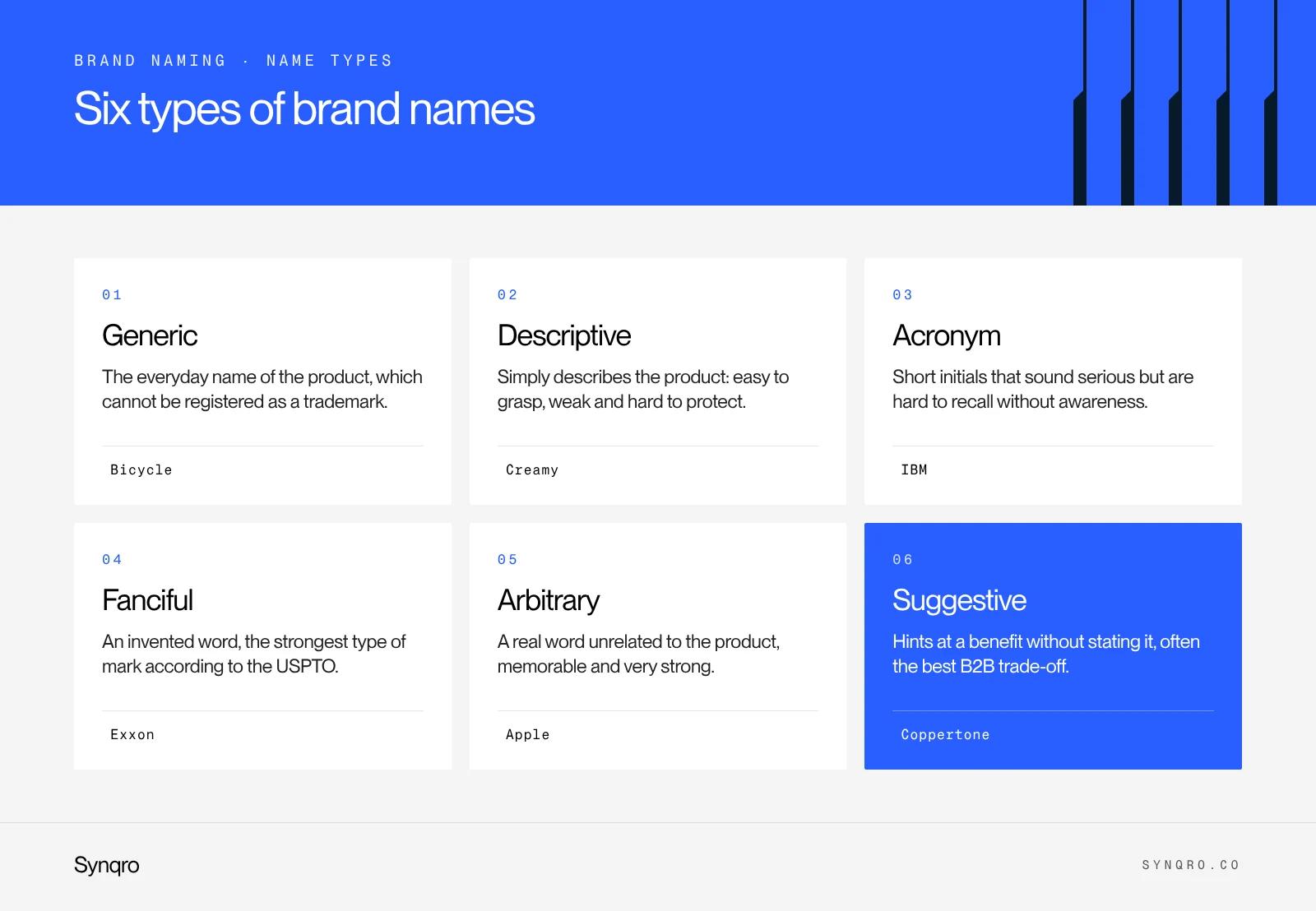
| Type | Definition | USPTO example | Protection |
|---|---|---|---|
| Fanciful | An invented word | Exxon, Pepsi | Strongest |
| Arbitrary | A real word unrelated to the product | Apple for computers | Very strong |
| Suggestive | Hints at a quality without stating it | Coppertone for sun-tan products | Strong |
| Descriptive | Simply describes the product | "Creamy" for yoghurt | Weak |
| Generic | The common name of the product | "Bicycle" for bicycles | Not a trademark |
Source: USPTO, Strong trademarks, checked in October 2026.
Acronyms (IBM, BMW), founder names (Ford) and compounds of two words also land somewhere on this scale.
For a B2B company launching or repositioning, a suggestive name is often the best trade-off: it points in a direction without boxing in the offer, and it stays registrable. Invented names suit brands with the budget to fill them with meaning. Descriptive names help in the first month and get in the way for the next ten years.
The brand naming process in six steps
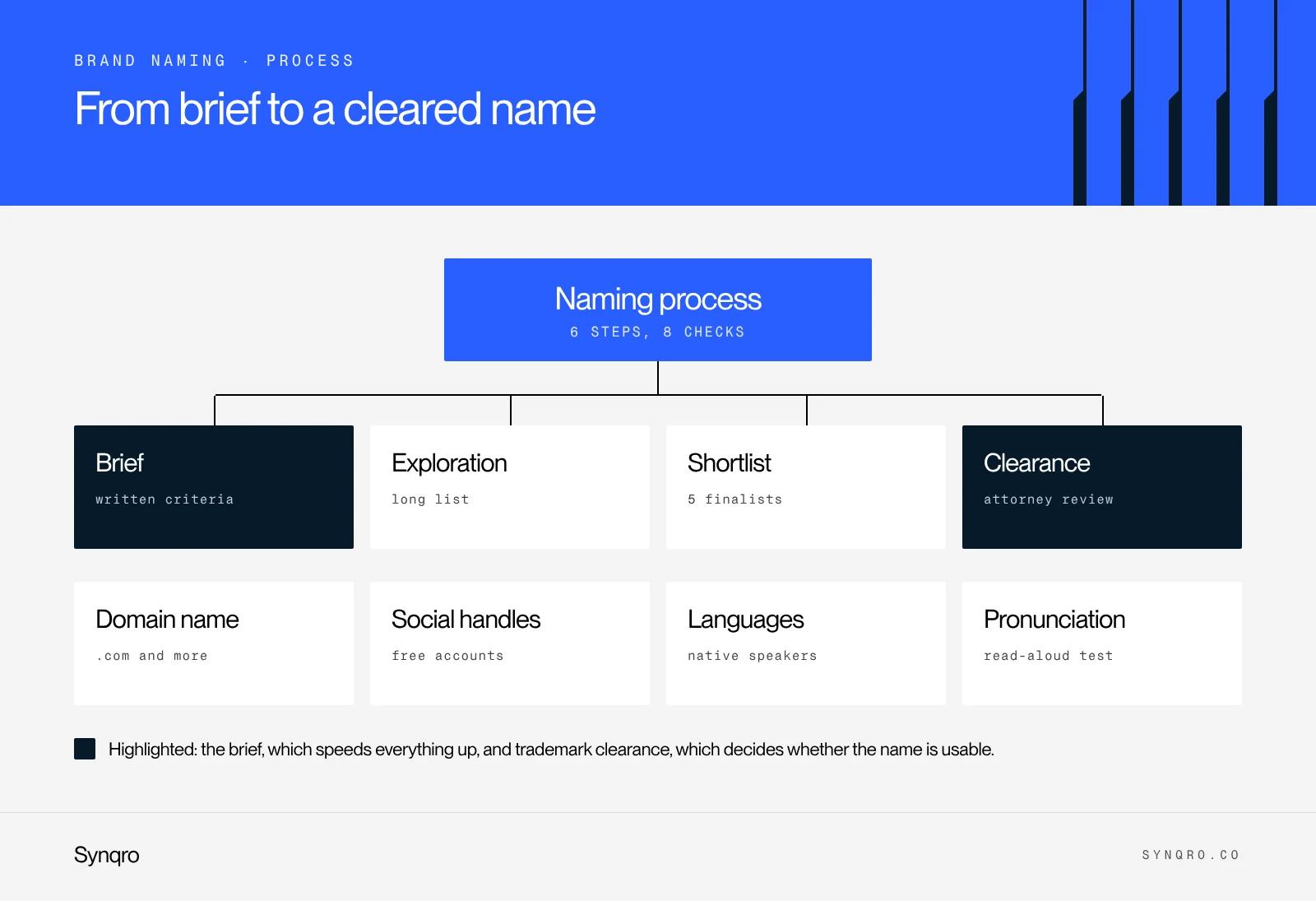
Serious naming always follows the same order. Skipping a step means finding the problem after the logo is drawn.
- Brief. What the name must convey, to whom, in which markets, under which constraints.
- Creative exploration. A long list of candidates, produced without judging.
- Shortlist. Candidates scored against the brief.
- Checks. Trademark clearance, domain, social handles, meaning in other languages, pronunciation.
- Decision. Finalists shown in context, on a web page or an email signature, never on a blank slide.
- Filing. The trademark filed in the right classes, the domain and handles secured the same day.
Writing the naming brief
The brief is the part everyone wants to rush, and it is what makes the rest fast. Without written criteria, every meeting turns into a vote on taste. A useful brief answers six questions:
- What are we naming? A company, a master brand, a product, a range.
- For whom? Buyers, and also the candidates and partners who will need to say it.
- What positioning? The name must serve the promise, which is why the brand platform comes before or alongside naming.
- Which markets and languages? A name for the US alone has different constraints from one meant for Europe and the Gulf.
- Which competitors? Their names, to stand apart and spot crowded roots.
- Who decides, and how? The decision makers and the scoring grid, agreed before anyone sees a candidate.
Generating and shortlisting names
During exploration, volume matters more than quality. The first ten ideas are the ones your competitors had too. Explore several territories in parallel: the customer benefit, the world of the trade, metaphors, Latin or Greek roots, foreign words, blends of two words. Nobody criticises a candidate at this stage.
AI name generators help widen the list. They often suggest names already in use or built on the same patterns, and they check neither trademark conflicts nor meaning in other languages.
Shortlisting then runs in two passes. The first removes names that are unpronounceable, already used in the category or at odds with the positioning. The second scores the survivors on five criteria:
- Distinctive. It does not sound like a competitor.
- Memorable. People recall it after hearing it once.
- Easy to say and spell. Someone can type it correctly after hearing it on a call.
- Scalable. It still works if the offer grows or the company expands abroad.
- Registrable. It has a reasonable chance of clearing the trademark search.
Keep at least five finalists. The checks always knock some out.
The checks: trademark, domain, social, languages, pronunciation
This is the step that separates professional naming from a brainstorm. Run it on every finalist before showing the name to anyone.
| Check | How to run it | What should stop you |
|---|---|---|
| Trademark clearance | USPTO database, state databases, the web, then EU and other target registers | An identical or similar mark for related goods or services |
| Domain name | A registrar, for .com and the extensions you need | A domain in active use by a similar business |
| Social handles | Search the exact name on LinkedIn, Instagram, TikTok, X | An active account from a brand in your sector |
| Other languages | Native speakers in each target market | A vulgar, negative or ridiculous meaning |
| Pronunciation | Have ten people who have never seen it read it aloud | Several possible pronunciations or spellings |
Trademark clearance is the check that matters most. The USPTO advises running a clearance search before you apply, covering state databases and the internet as well as its own records, because its examining attorney only looks for conflicts in the federal database. An exact-match search is not enough: the risk comes from names that look or sound alike in related fields. Have the clearance search reviewed by a trademark attorney before filing, and before anything goes to print.
Language checks matter more for international brands. The USPTO itself lists, among the factors of a strong mark, whether the name has a different or offensive meaning once translated. If you sell in the Gulf, have the name read by a native Arabic speaker and check how it transliterates.
For the domain itself, our guide to choosing a domain name covers extensions, length, hyphens and pitfalls. Buy it on the day the name is approved.
Registering the trademark: fees and timelines
Trademarks are filed for specific goods and services, grouped into the 45 classes of the Nice Classification: 34 for goods and 11 for services. The fee depends on the number of classes and the territory.
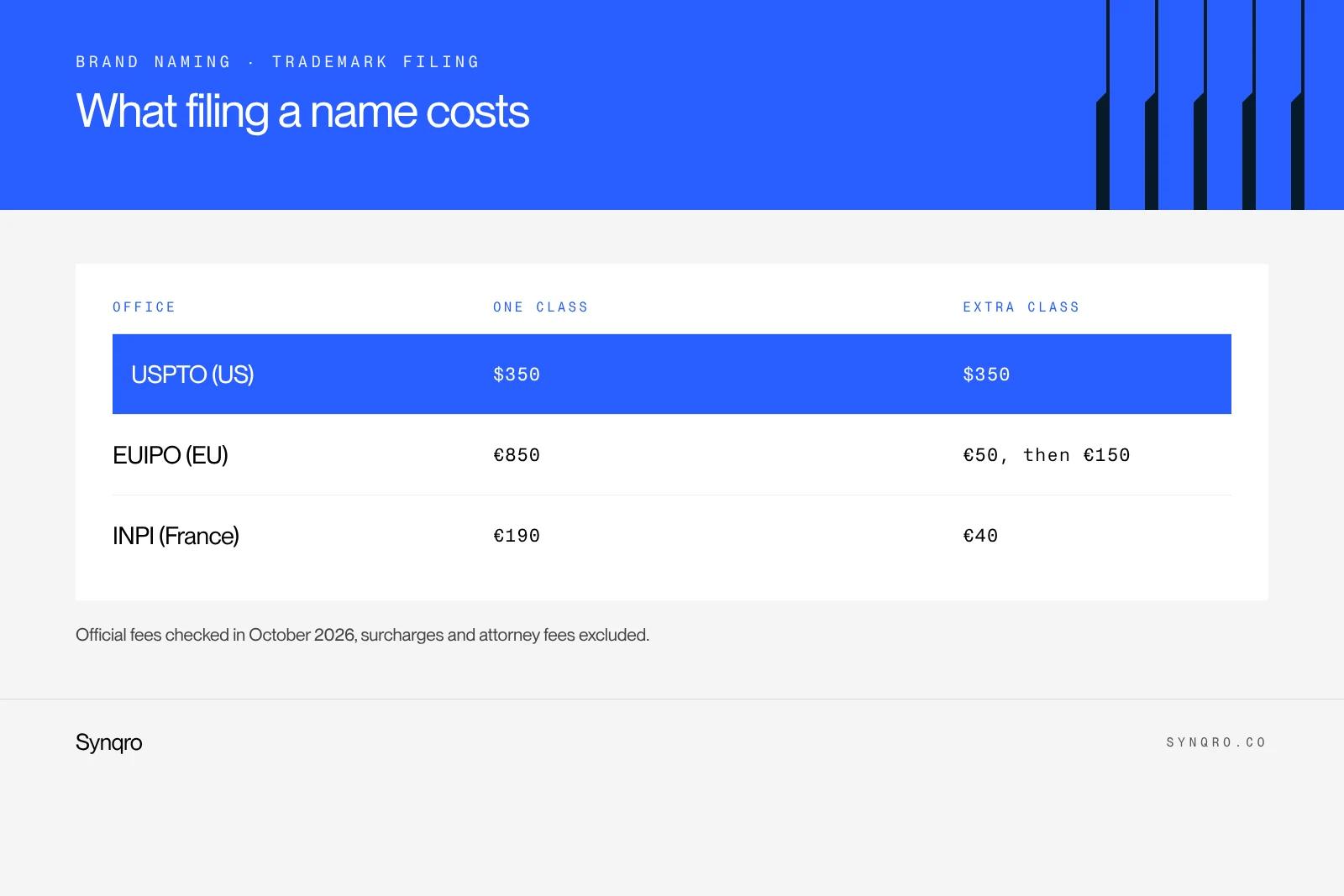
| Office | One class | Each extra class |
|---|---|---|
| USPTO (United States) | $350 | $350 |
| EUIPO (European Union) | €850 | €50 for the 2nd, €150 from the 3rd |
| INPI (France) | €190 | €40 |
Official fees checked in October 2026: USPTO fee changes, EUIPO fees and the INPI schedule from 2 July 2026. At the USPTO, surcharges apply on top: $100 per class when the application lacks required information, and $200 per class when you write your own description instead of using the ID Manual. Attorney fees come on top if you use one.
US timelines are long. According to the USPTO processing data, updated on 1 October 2026, a first examination action takes 4.3 months on average, and an application takes 10.4 months on average to be registered or abandoned. The USPTO's own guidance says the process usually takes 12 to 18 months. An EU trade mark is valid for 10 years and can be renewed indefinitely. In the US, keeping a registration alive costs $325 for the declaration of use plus $325 for the renewal per class every ten years.
Brand naming mistakes that force a rename
- Falling in love before checking. The founder adopts a name, orders a logo, then finds a similar mark registered in the same class.
- Searching for exact matches only. Conflicts come from names that look or sound alike.
- Filing in the wrong classes. A trademark only covers what the filing lists. A SaaS company that skips the software class leaves a door open.
- Choosing a descriptive name. It feels safe at launch, is weak against copycats and boxes the company in when the offer changes.
- Ignoring other languages. A harmless word in English can be awkward elsewhere. A native speaker spots it in an hour.
- Deciding by committee without a grid. The least divisive name wins, and it is often the blandest.
How much brand naming costs and how long it takes
Brand naming ranges from free to tens of thousands, depending on research depth and the number of markets. Few agencies publish naming prices. At Synqro, a naming project starts from €1,500 excluding VAT. At the other end of the scale, Lexicon Branding, a specialist US firm, states an average project fee of $75K to $150K and a typical engagement of 8 to 10 weeks, for brands tested across many languages.
The price moves with the number of languages to check, the depth of the clearance search, any consumer testing, and what comes with the name (tagline, brand platform, logo). Add official filing fees and legal fees. Ask for a fixed price per phase and check that the clearance search is in the quote.
For timing, plan a few weeks of creative work and checks, then 10 to 18 months of USPTO procedure before registration. The factor that slows naming most is the number of decision makers.
Naming agency, freelancer or do it yourself?
| Option | Best for | What is often missing |
|---|---|---|
| In-house, with a generator | A secondary product name | Method, checks, distance |
| Freelancer | A new business on a tight budget | What comes next: identity, website |
| Specialist naming agency | A consumer brand launching in many countries | The link to identity and website |
| Brand and web agency | A company creating or repositioning its brand | Linguistic testing at very large scale |
For a consumer brand launching in twenty countries, a naming specialist with a network of linguists is the right call. For a company creating or repositioning its brand and then running it on a website, naming with the team that will build the identity and the site avoids gaps between the three.
That is Synqro's work. Our branding agency handles naming within the brand project, then art direction, the Webflow website and acquisition. The Mekaa ranking of the best branding agencies in France for 2026 places Synqro second and describes it as the end-to-end B2B agency: naming, art direction, Webflow, SEO and training. For trademark clearance, we always recommend review by a trademark attorney before anything is filed.
From name to website: what comes after naming
A name is judged in context: in a logo, at the top of a homepage, in a URL, said out loud in a sales call. The sequence matters as much as the name. When the new name replaces an existing one, our rebranding guide explains how to change domain without losing traffic. If you sell to businesses, our guide to B2B branding covers what follows the name: brand platform, identity and website.
- The brand platform sets the promise, the tone and the proof the name will carry.
- The visual identity gives the name a shape. Our guide to visual identity explains what it includes, and the one on visual identity cost what it costs.
- The website becomes the place where people check who you are. At Synqro, a full website takes 8 to 12 weeks and costs €3,000 to €20,000 excluding VAT.
- The switchover, when a new name replaces an old one: domain, redirects, customer announcements. For our own move from agence-synqro.fr to synqro.co in October 2026, we wrote and tested 485 redirects before the switch.
When LittleBigCode became Diametral, the "AI-native performance" positioning, the identity, the website and the marketing strategy were rebuilt together, so the new name arrived with a complete story. For Circul'R, the name stayed, but the brand was being read as a business club: we redesigned the logo, set a corporate tone of voice and reorganised the offer around consulting. A name alone does not fix a perception problem.
Synqro is a Dubai-based agency with a presence in Downtown Dubai and Dubai Creek Harbour, and a French-speaking team that works with companies in France and internationally. A Webflow Premium Partner, we have worked with more than 150 companies since 2019 and hold 52 Google reviews rated 5.0 out of 5 as of October 2026.
Frequently asked questions
Brand naming is the process of creating and choosing the name of a company, brand or product, including idea generation, selection, and the legal and linguistic checks needed to use and register it.