Article
Rebranding strategy: steps, cost and the SEO risk
Branding14 min read

James BrunettoCo-fondateur & CEO
Rebranding means reworking an existing brand as a whole: its positioning, its message, sometimes its name, and the visual identity that expresses them. It goes much further than a logo redesign, and it nearly always ends with a new website, because the site is where people meet the new brand first. This guide covers the definition, the cases where you should hold back, the five steps of a rebranding strategy, real budgets recorded in 2026, and the part most guides skip: changing your name or domain without losing your search traffic.
Explore this post with…
In short: a rebrand changes what the brand says and how it looks, while a logo redesign only changes the mark. It is justified by a real change in the business (offer, audience, merger, a name that holds you back), never by boredom. Across 78 rebrands recorded by the French marketplace La Fabrique du Net, the median budget is €30,000. If the name or domain changes, your 301 redirect plan and the change of address in Google Search Console decide how much traffic you keep.
What is rebranding?
Rebranding is the process of redefining a brand that already exists: who it speaks to, what it promises, how it sounds and what it looks like. The word matters. You start from a brand with customers, a reputation, backlinks and people who search for its name, and the whole job is deciding what to keep and what to let go.
A rebrand and a logo redesign are different projects. The logo is one element of the visual identity, and the visual identity is the graphic expression of a positioning. Redrawing the logo while the positioning stays put is a refresh. We cover that case separately in our guide to logo redesign.
Rebrand vs brand refresh vs logo redesign
There are three levels of change. The level you choose sets the budget, the timeline and the amount of work on your website.
| Level | What changes | Impact on the website |
|---|---|---|
| Logo redesign or refresh | Logo, colours, typefaces | Visual update, same pages |
| Partial rebrand | Visual identity, messaging, offer structure, name kept | New copy, sitemap often reworked |
| Full rebrand | Positioning, messaging, identity, sometimes name and domain | Site rebuilt, redirect plan if the domain changes |
For most small and mid-sized companies, the partial rebrand is the right call. The name carries value and customers know it, but the way the brand presents itself no longer matches what the company sells. A full rebrand becomes necessary when the name itself is the problem, or when the business has changed so much that the old brand misleads people.
When to rebrand, and when to hold back
A rebrand is expensive, takes up leadership time for months and puts the recognition you have built at real risk. It should answer a change you can describe in one sentence.
- The business has changed. A data consultancy that now advises on AI can't keep the pitch it had at launch.
- The audience has changed. Selling to enterprise buyers after years of selling to small firms calls for different proof, a different tone and often a different look.
- A merger or acquisition. Two brands have to become one, or sit clearly under a shared roof.
- The name holds you back. A trademark conflict, a name that is hard to say abroad, or a name too narrow for today's offer.
- Perception no longer matches reality. Prospects see the company as something it isn't, and sales suffer.
The bad reasons are just as easy to spot: a team tired of a logo that customers see far less often than they do, a new CEO who wants to leave a mark, or a product problem that no identity will fix.
Gap remains the textbook warning. In October 2010 the retailer put a new logo on its website and dropped it about a week later after a wave of criticism. Marka Hansen, president of Gap North America, said "we did not go about this in the right way", as reported by CNN Money. What was missing was a reason customers could understand.
The five steps of a rebranding strategy
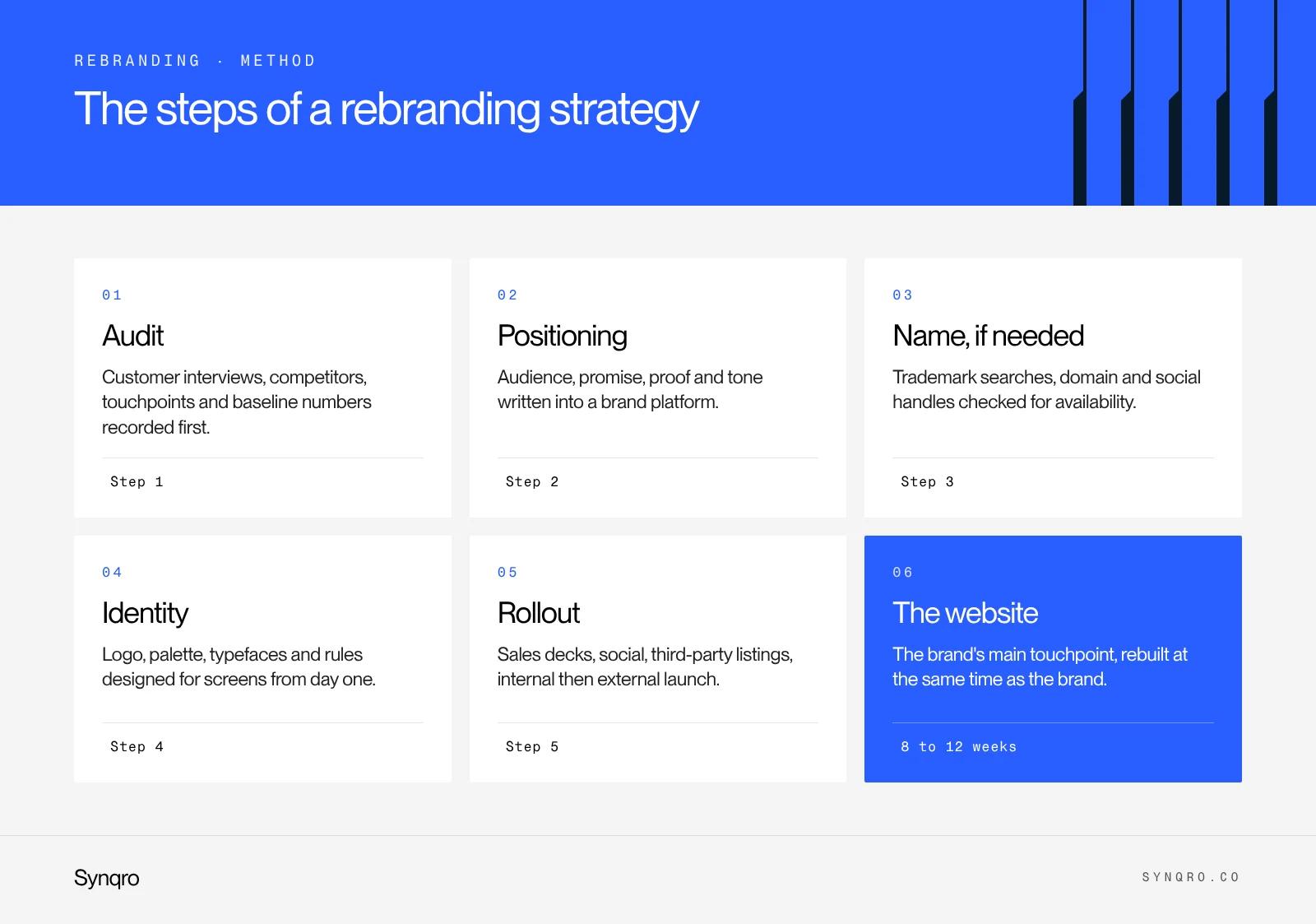
A rebranding strategy follows five steps, in this order. Swapping the first two, or the last two, is the most expensive mistake we see.
- Audit. Interviews with customers and with the sales team, a competitor review, an inventory of every touchpoint, and baseline numbers: share of branded searches in Search Console, conversion rate of your key pages, cost per lead.
- Positioning. Who the brand is for, what it promises, the proof that makes the promise credible, and the tone. This work ends in a brand platform, the document that settles arguments for years afterwards.
- Name, if needed. Trademark searches with the USPTO, the EUIPO or your local office, domain and social handle availability, and a pronunciation check in your target languages. Change the name only if the current one blocks you.
- Identity. Logo and variants, palette, typefaces, patterns, imagery and usage rules. Design it for screens from day one, since that is where it will be seen most.
- Rollout. Website, sales decks, social profiles, email signatures, third-party listings, then the announcement, internal first and external second. The baseline from step 1 lets you measure the effect over twelve months.
Strategy takes longer than design, and that is normal. In Sortlist's own rebrand, the agency La Superboite describes "seven months of strategy" and "only two of graphic design", according to Sortlist's account of the project.
Why the website should be rebuilt at the same time
The website is where the new brand is seen most often and by the widest audience: prospects, candidates, investors, partners, plus search engines and AI assistants that read it to describe your company. Launching a new identity on the old site does the opposite of what you want. A prospect who clicks through from a post in the new style lands on the old promise.
A new positioning also changes the order of your offers, the audiences you lead with and the proof you show. That is the moment to rewrite the sitemap and the copy, rather than repaint pages built for the old brand.
- Qobra, a sales commission platform, had its new brand designed by the agency Bruno. Synqro built the Webflow website that carried the rebrand, then spent two years improving it: an ROI calculator, funnels for each audience, and a dedicated funnel for its AI features in 2026. Inbound requests tripled and organic traffic grew sixteenfold. See the Qobra case study.
- Diametral, founded in 2018 as LittleBigCode, advises large organisations on data and AI. Its new "AI-native performance" positioning, its identity, its website and its marketing strategy were rebuilt together, as shown in the Diametral case study.
- BMA, a design and build contractor founded in 2006 with teams in Paris and Portugal, renewed its identity in 2025. Synqro redesigned and developed the websites of its two subsidiaries, and the site earned an Awwwards Honourable Mention. See the BMA case study.
Website design can start as soon as the identity direction is signed off. At Synqro, a full website takes 8 to 12 weeks: scoping workshop, sitemap and copy, design system in Figma, Webflow build, QA, then training for the marketing team. The full process, from brief to redirect plan, is in our guide to website redesign.
Changing your name or domain without losing SEO
A new name often means a new domain, and a new domain puts everything the old site earned back on the table: rankings, backlinks, branded searches. If the rebrand includes a new name, our brand naming guide covers the method and the checks to run before filing.
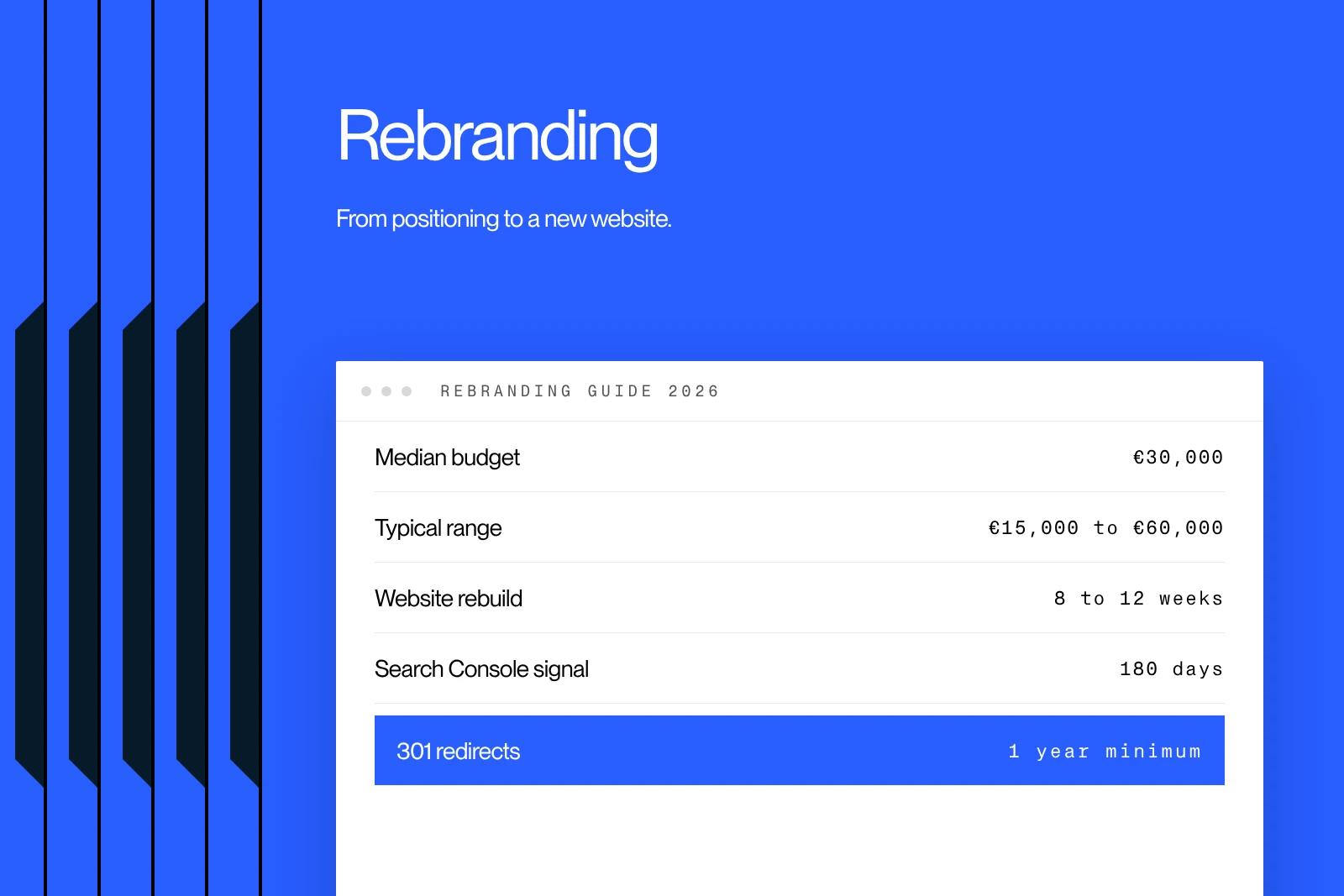
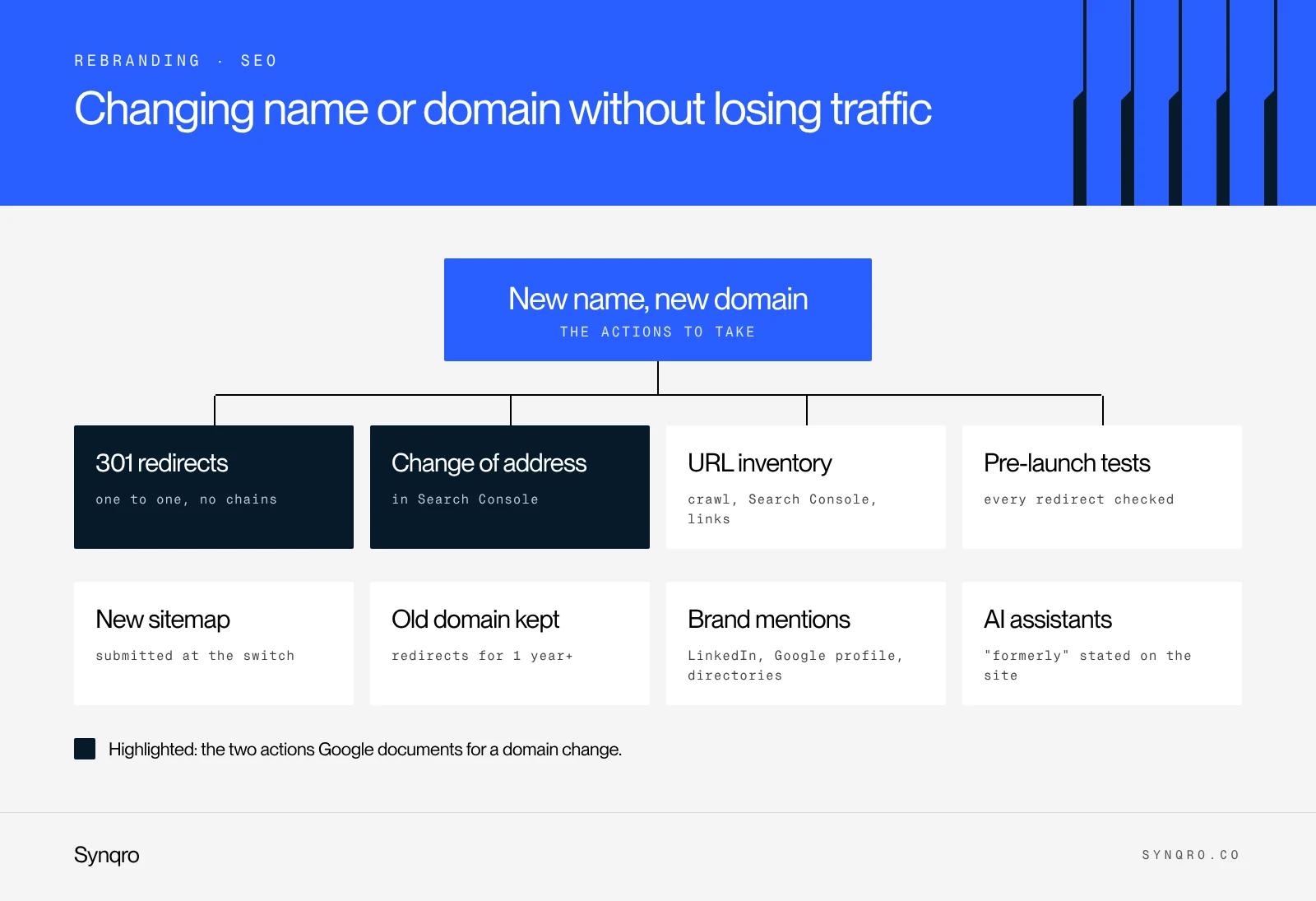
Google spells out the process in its guide to site moves with URL changes. Permanent 301 redirects don't cause a loss in PageRank. Google advises keeping them as long as possible, generally at least one year. And it warns to expect temporary ranking fluctuation while new URLs replace old ones, which can take a few weeks or more for a medium-sized site.
The checklist, in order:
- List every URL on the old site, from a crawl, Search Console and the pages that earn backlinks.
- Write a one-to-one mapping, each old page to its closest new equivalent, never everything to the homepage.
- Set up direct 301 redirects, with no redirect chains.
- Test every redirect before the switch, not after.
- Submit a change of address in Search Console. The Change of Address tool requires you to own both properties and to redirect the old homepage to the new one. The migration signal stays active for 180 days.
- Submit the new sitemap and keep the old domain registered, redirects included, for at least a year.
- Update brand mentions: top backlinks, LinkedIn page, Google Business Profile, directories, partner pages, email signatures.
We used this method on our own site. In October 2026, Synqro moved from agence-synqro.fr to synqro.co with 485 redirects written and tested before the switch. It is tedious work, and it is what protects your traffic.
Keeping AI assistants consistent
ChatGPT, Gemini and Perplexity describe a company from what they find on the web. If half the sources still use the old name or the old offer, the answer will blend the two. Three habits reduce the confusion: an explicit sentence on your site such as "founded in 2018 as LittleBigCode", as Diametral does; the same short company description everywhere; and updated third-party profiles that these assistants often cite, such as LinkedIn, business directories and press coverage.
How much does rebranding cost, and how long does it take?
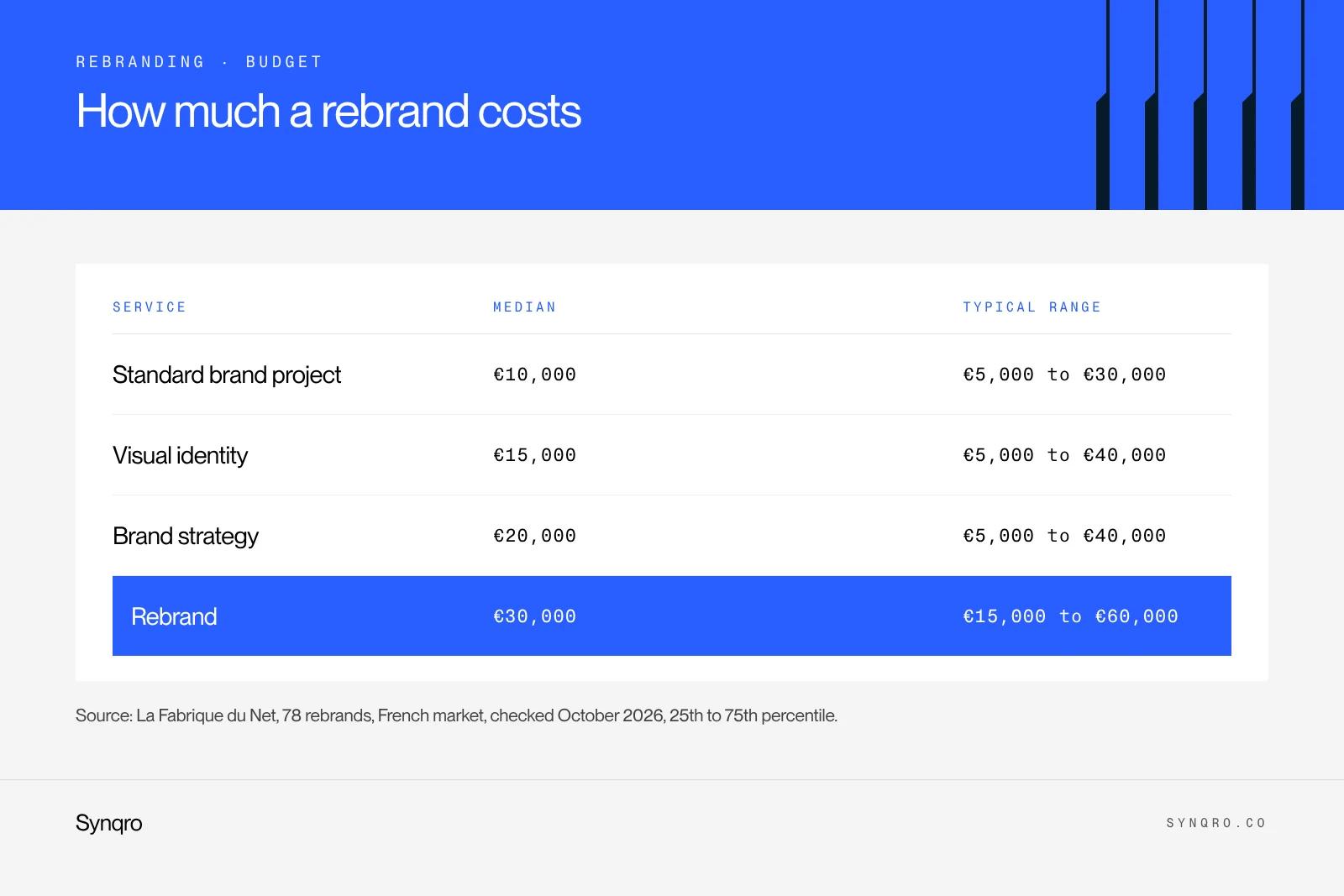
La Fabrique du Net, a French agency marketplace, publishes budgets from branding projects posted on its platform. Across 78 rebrands, the median budget is €30,000, and the middle half of projects sits between €15,000 and €60,000. One rebrand in four goes above €60,000. That is roughly three times the median for a standard brand project, according to its branding agency pricing data, checked in October 2026.
| Service | Median | Typical range |
|---|---|---|
| Standard brand project | €10,000 | €5,000 to €30,000 |
| Visual identity | €15,000 | €5,000 to €40,000 |
| Brand strategy | €20,000 | €5,000 to €40,000 |
| Rebrand | €30,000 | €15,000 to €60,000 |
Typical range means the 25th to 75th percentile, total project amount, French market. The source presents them as orders of magnitude.
The website comes on top when another team builds it, or sits inside the budget when one team handles both. At Synqro, a website costs €3,000 to €20,000 excluding VAT depending on scope, with a fixed price agreed before the first mockup. For companies that then want an outsourced design, tech and marketing team, annual support runs from €10,000 to €80,000 excluding VAT a year. Our breakdown of branding agency pricing and deliverables goes into what each line covers.
On timing, the Sortlist case gives a benchmark: about nine months, seven of them on strategy. A partial rebrand that keeps the name moves faster. Duration depends mostly on how quickly leadership signs off, whether naming is in scope, and how many assets need updating.
Rebranding examples: Jaguar and real-world cases
Jaguar's rebrand is one of the most searched of the past two years. On 18 November 2024, the carmaker announced a "completely transformed" brand built on the ethos "Copy Nothing" and a creative philosophy called "Exuberant Modernism": a new wordmark, a monogram, primary colours and a redrawn leaper. The concept car was only shown on 2 December 2024 at Miami Art Week, according to Jaguar's official announcement. The launch film showed no car at all, and when asked why, the brand's X account replied "Think of this as a declaration of intent", as NBC reported. The lesson: a brand launched before its product has to carry the whole promise alone, and that invites instant rejection.
Rebrands at smaller companies rarely look like Jaguar's. They are won on clarity of offer. Circul'R, a circular economy consultancy, is a good example of a partial rebrand. The brand was seen as a business club, while consulting generated most of its revenue. We redesigned the logo and its variants, created a modular pattern with a generator tool the team uses on its own, set a corporate tone of voice and reorganised the offer around consulting. The site shipped with its conversion paths and an SEO and GEO strategy, and qualified leads arrived soon after launch. Sara Bonnet, Head of Communication, says the work "allowed us to double our conversion rate" (translated from French). The full project is in the Circul'R case study.
Rebranding mistakes that sink the project
- Starting with the logo. Without written positioning, every design option is judged on taste, and the debate never ends.
- Announcing outside before inside. Sales reps who discover the new brand on LinkedIn can't defend it in a meeting.
- Launching the brand on the old website. Prospects see two different companies within two clicks.
- Redirecting every old URL to the homepage. Google can treat those redirects as soft 404s, and the rankings of inner pages vanish.
- Measuring nothing beforehand. Without a baseline, the rebrand gets judged on the board's mood.
One team or two for the rebrand and the website?
Both models work. The first splits the jobs, as with Qobra: brand by Bruno, website by Synqro. It works when the brand arrives with rules that hold up on screen and the two teams collaborate from the identity direction onwards.
The second gives everything to one team. It cuts the losses between brand guidelines and code (colours that render badly on screen, typefaces without a web licence, templates that break) and builds the SEO migration into the project from the start.
Synqro is a Dubai-based agency with a presence in Downtown Dubai and Dubai Creek Harbour, and a French-speaking team that works with companies in Paris, across France and abroad. It runs a full rebrand and the website redesign as one project: positioning, naming if needed, identity, Webflow website, SEO, GEO and team training. Synqro is a Webflow Premium Partner, has worked with more than 150 companies since 2019, and holds 52 Google reviews rated 5.0 out of 5 as of October 2026. Our method and projects are on our branding agency page.
Frequently asked questions
Rebranding is the process of reworking an existing brand, its positioning, messaging, sometimes its name, and the visual identity that expresses them, while building on what the brand has already earned.