Article
B2B branding: what changes, deliverables, cost and SaaS
Branding13 min read

James BrunettoCo-fondateur & CEO
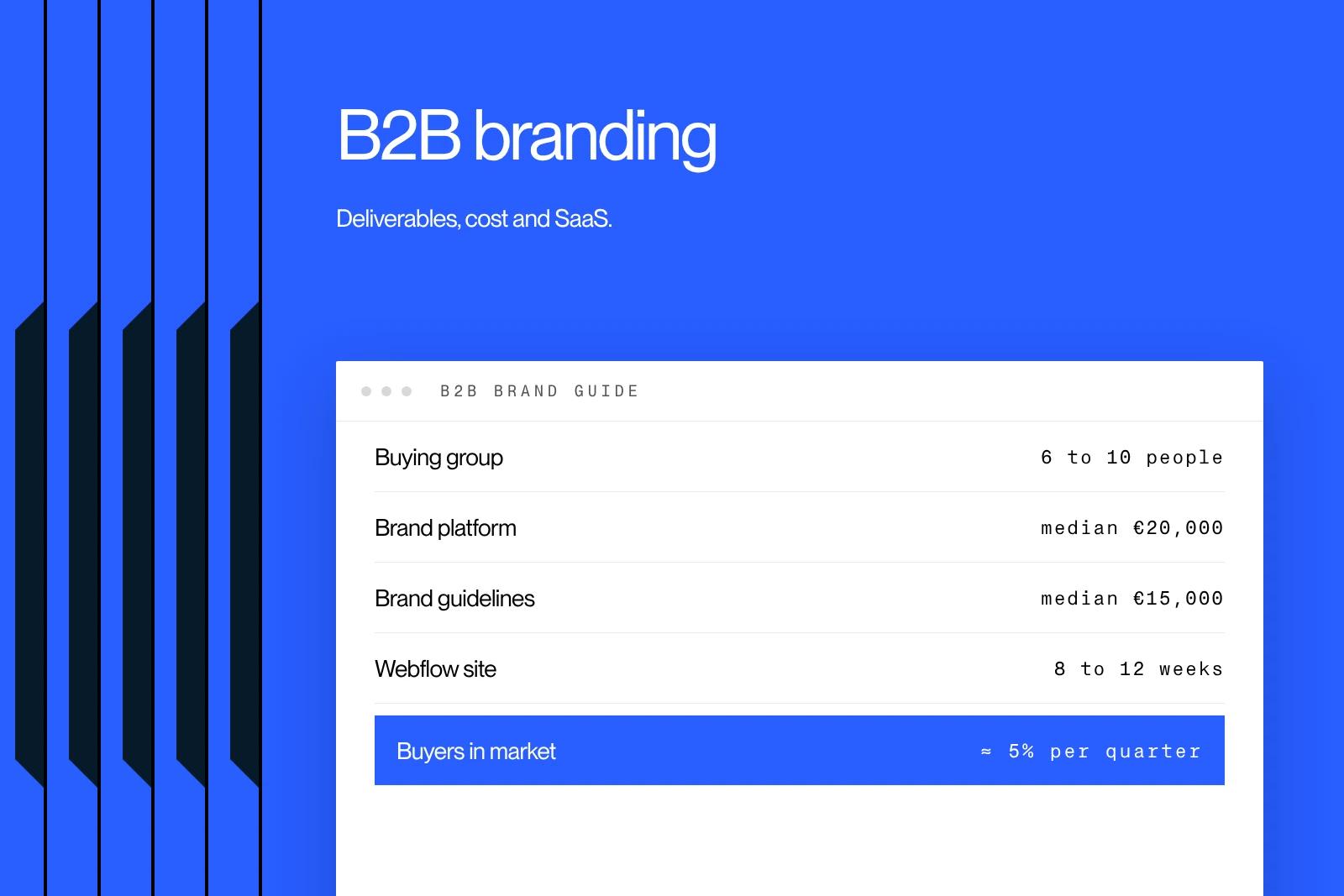
B2B branding is the work that defines how a company selling to other companies positions itself, speaks and shows up. Its audience is rarely one buyer: it is a buying group of six to ten people who each need to justify the choice internally. A complete B2B branding project delivers a brand platform, a visual identity, a tone of voice and a website that puts all three to work. This guide covers what changes compared with a consumer brand, what the work costs, how to choose a partner, and what is specific to tech startups and SaaS companies.
Explore this post with…
In short: a B2B brand exists first to make a supplier choice easy to defend in front of a buying group. It rests on four deliverables: brand platform, visual identity, tone of voice and website. Real-budget data from France puts the median at €20,000 for brand strategy and €15,000 for brand guidelines (June 2026). SaaS companies add two constraints: the brand has to keep pace with funding rounds, and it has to live in a design system shared with the product.
What is B2B branding?
B2B branding is the process of building the brand of a business that sells to other businesses: its positioning, its messages, its visual identity, its tone, and how all of that is applied on the website, in sales decks and inside the product.
In B2B, the brand is almost always the company name. A consultancy, a software vendor or a manufacturer rarely has strong product brands: buyers assess the whole organisation. That is why "B2B brand strategy" and "B2B branding" describe the same project, and why the visual layer is only one part of it. Our article on visual identity covers that layer in detail.
B2B vs B2C branding: what actually differs
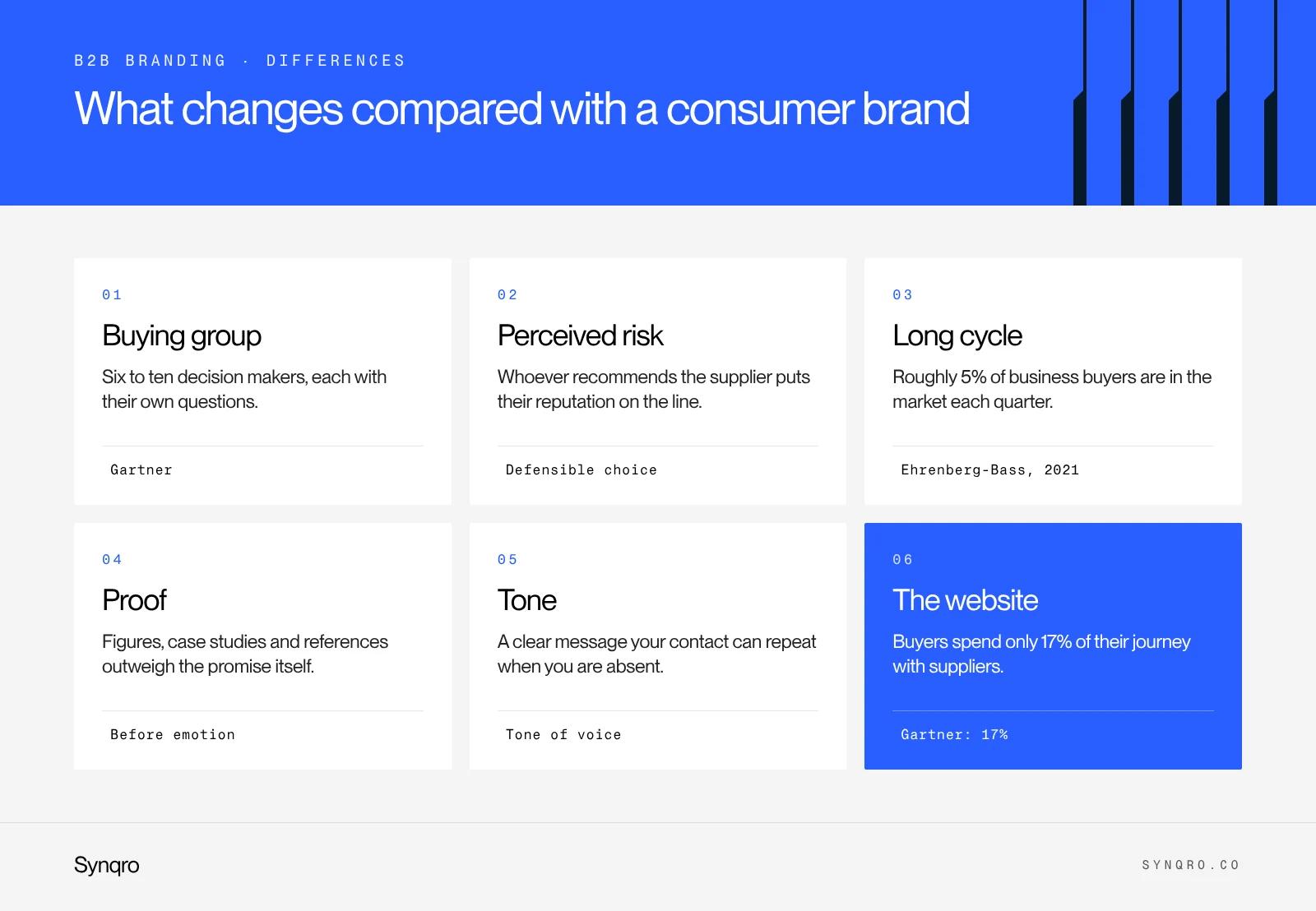
The basics hold in both worlds: be recognised, be distinct, keep your promise. What changes is how the decision gets made.
| Factor | Consumer brand | B2B brand |
|---|---|---|
| Who decides | One person, usually alone | A buying group of six to ten people |
| Perceived risk | A disappointing purchase, a return | The reputation of whoever recommended the supplier |
| Buying cycle | Minutes to a few weeks | Several months, sometimes more than a year |
| What persuades | Desire, emotion, price | Proof, references, clarity of the offer, then emotion |
| Expected tone | Free, sometimes provocative | Precise and easy to repeat internally |
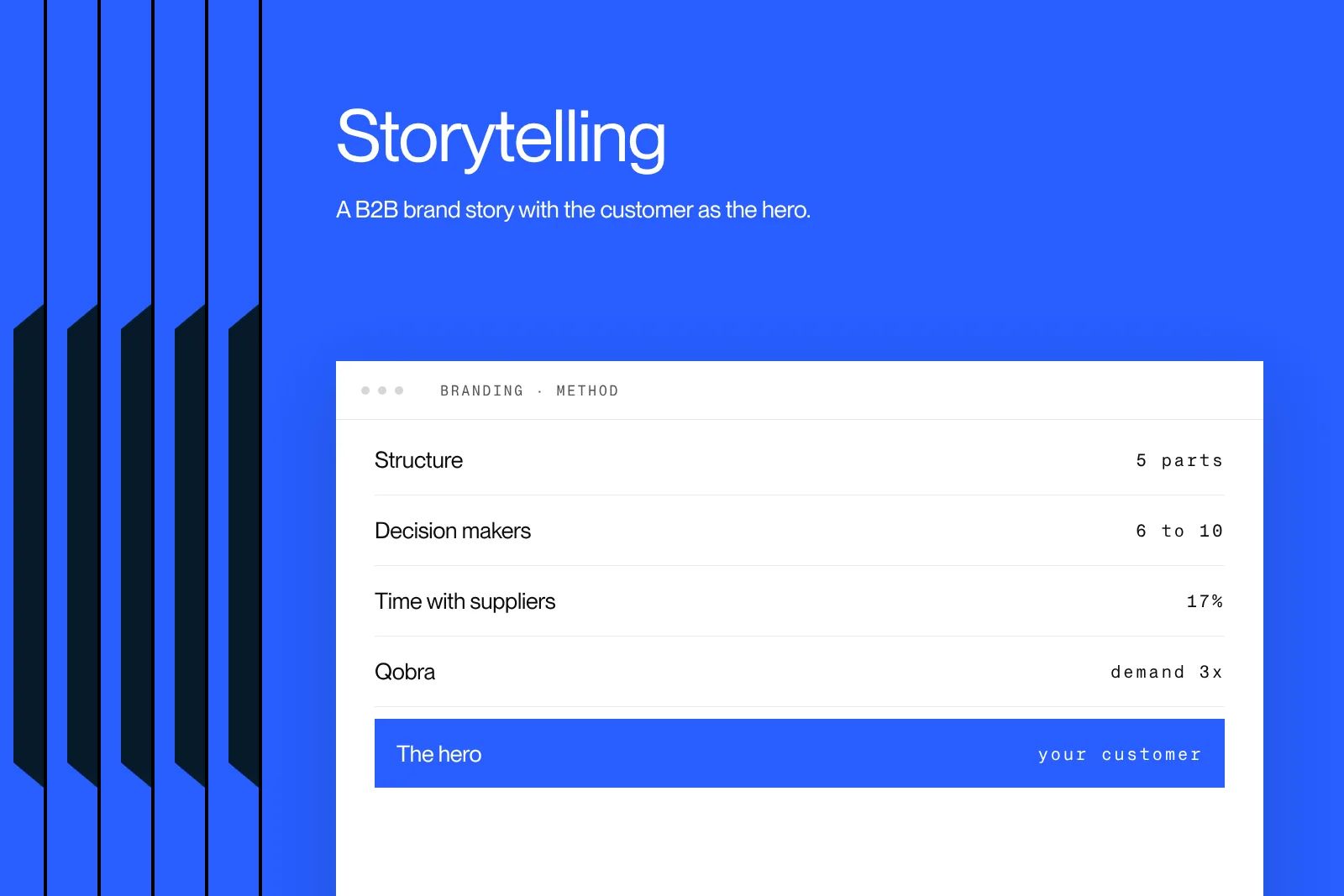
The buying group. According to Gartner, a complex B2B purchase involves six to ten decision makers, each gathering four or five pieces of information independently (checked in October 2026). One message has to work for the CFO, the end user and the CEO.
Perceived risk. A B2B buyer puts their credibility on the line. Recommending an unknown supplier that fails costs them more than picking a well-known name that disappoints. A strong B2B brand makes the choice easy to defend in a meeting.
The long cycle. In May 2021, Professor John Dawes of the Ehrenberg-Bass Institute estimated that companies switch their main providers, such as their bank or law firm, roughly once every five years. That means about 20% of business buyers are in the market over a year, and roughly 5% in any given quarter. This is the 95:5 rule. The brand's job is to make sure the other 95% think of you on the day they do buy.
Proof and tone. A B2B promise without a figure or a case study does not survive the buying group. And a B2B message has to be repeatable by your contact to their manager when you are not in the room. If it needs explaining, it gets distorted.
Why brand matters so much when you sell to businesses
Many B2B leaders treat brand as cosmetics, to be handled after sales and paid media. The evidence points the other way.
Gartner reports that B2B buyers spend only 17% of their buying journey meeting potential suppliers, all suppliers combined. The rest of the time they read, compare and talk among themselves. During that other 83%, your website, your content and what others say about you do the selling.
In October 2019, Les Binet and Peter Field published The Five Principles of Growth in B2B Marketing for LinkedIn's B2B Institute, based on IPA effectiveness data. They recommend putting about 46% of the budget into brand building and 54% into sales activation. They also show that emotion, often banned from B2B brands, drives the longest-lasting effects.
Our own view, after working with more than 150 companies since 2019: in B2B, a clear brand saves the sales team time. A prospect who arrives already understanding the offer, having seen proof, asks better questions and signs sooner.
What a B2B branding project delivers
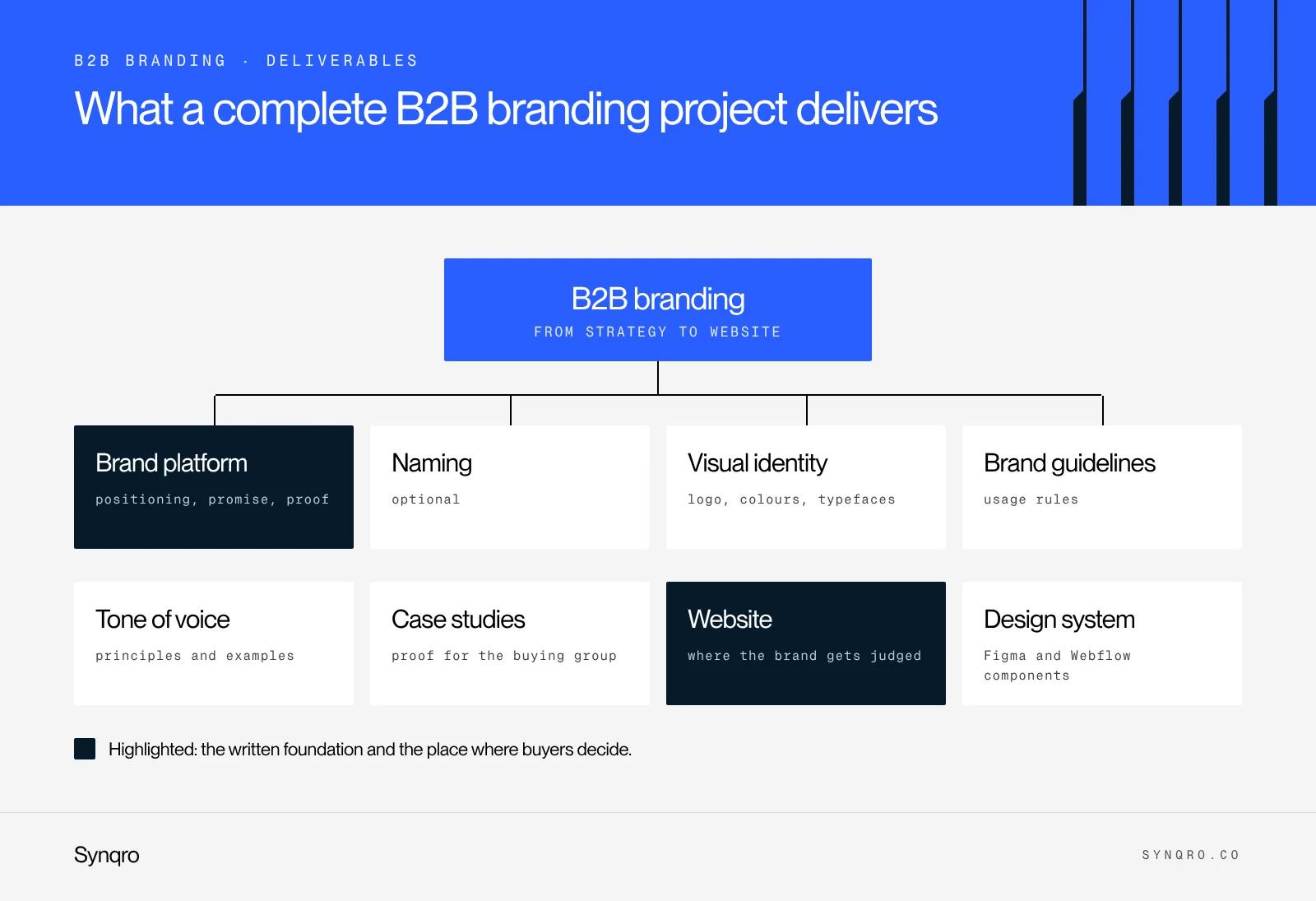
A complete B2B branding project produces four core deliverables. Order matters, because each one builds on the previous one.
| Deliverable | What it contains | How it helps sales |
|---|---|---|
| Brand platform | Mission, audiences, positioning, promise, proof points, values | Settles messaging decisions for years |
| Visual identity | Logo, colour palette, typefaces, imagery, patterns | Recognition and credibility from the first touchpoint |
| Tone of voice | Writing principles, vocabulary, before and after examples | Sales, marketing and leadership say the same thing |
| Website | Structure, copy, design system, case studies | Lets buyers convince themselves before the first call |
The brand platform is the written foundation: who we are, who we serve, and why we are different. Our guide to the brand platform includes a complete worked example. For B2B clients we always add a "proof" section: for every promise, the fact that backs it up.
The visual identity turns the platform into signs and is documented in brand guidelines. A B2B brand does not have to be dull. It does have to stay consistent across a pitch deck, a pricing page and a trade show stand.
The tone of voice is the deliverable most often skipped, even though the team uses it every day in emails, proposals and LinkedIn posts.
The website is where the brand gets judged. An identity delivered without web rules forces the site team to reinterpret everything. Optional extras include naming, brand architecture for companies with several offers or subsidiaries, and sales templates.
How a B2B branding project runs
At Synqro, a project that goes from brand to website follows six steps, with a fixed price agreed before the first mockup.
- Discovery workshop with leadership, the sales team and, ideally, two or three customers.
- Brand platform, signed off in writing before any design work.
- Visual identity, from creative routes to guidelines.
- Site structure and copy, written from the platform, with case studies at the centre.
- Design system in Figma, then Webflow build, with components that follow the guidelines.
- QA and training for the marketing team, who then publish without us.
The website takes 8 to 12 weeks at Synqro, and a landing page takes 2 weeks. Add the brand work on top: La Fabrique du Net reports that the most common duration for a branding project is three months.
How much does B2B branding cost?
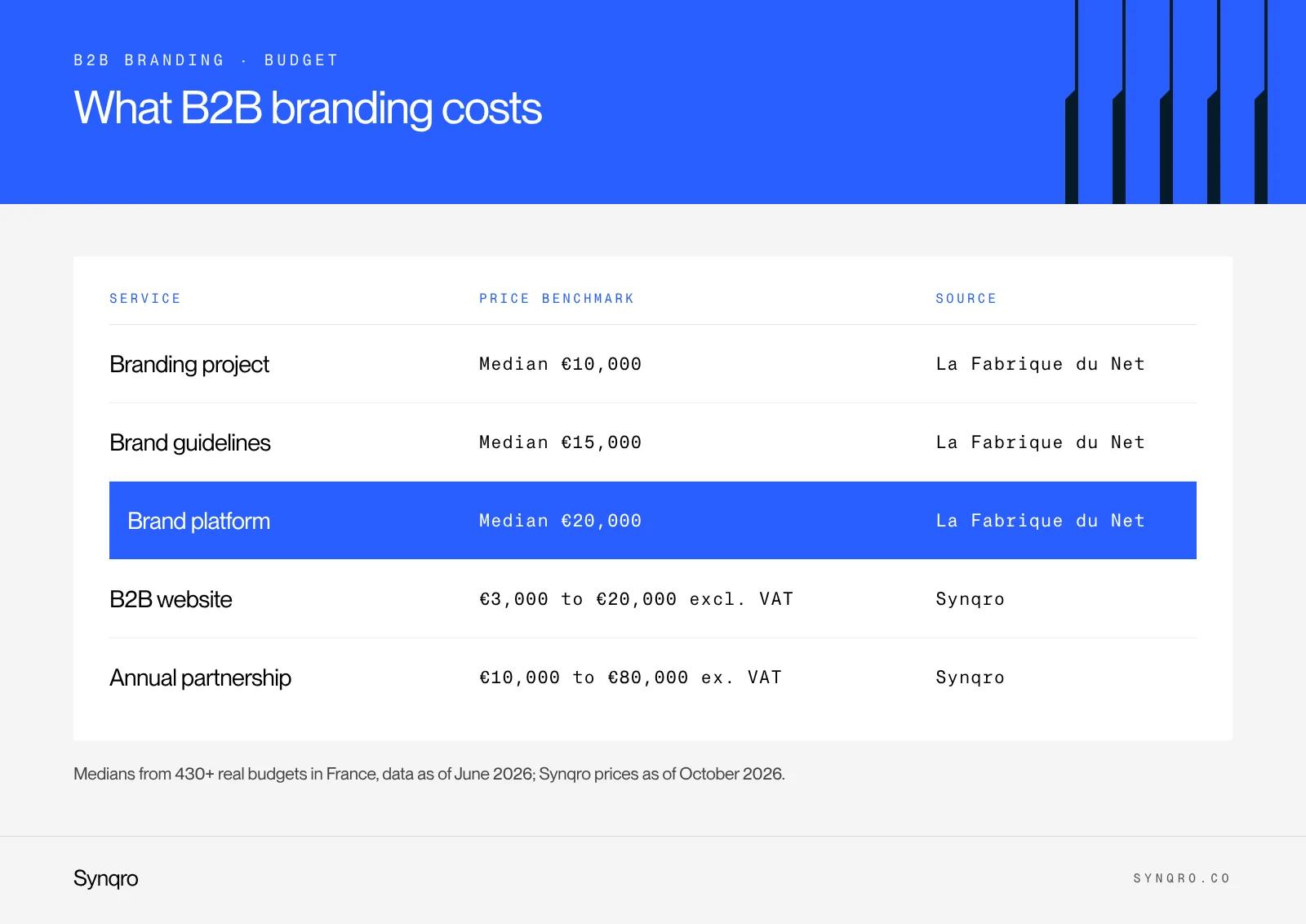
Public pricing data built on real budgets is rare. One of the most detailed sources is the benchmark published by La Fabrique du Net, a French agency marketplace, based on more than 430 real branding budgets with data as of June 2026. It publishes medians, which are more reliable than averages pulled up by a handful of very large projects.
| Service | Price benchmark | Source |
|---|---|---|
| Branding project, all types | Median €10,000 | La Fabrique du Net, June 2026 |
| Brand guidelines | Median €15,000 | La Fabrique du Net, June 2026 |
| Brand strategy and platform | Median €20,000, middle half between €5,000 and €40,000 | La Fabrique du Net, 134 projects |
| B2B website built by Synqro | €3,000 to €20,000 excluding VAT | Synqro, October 2026 |
| Synqro annual partnership | €10,000 to €80,000 excluding VAT per year | Synqro, October 2026 |
Three factors explain most of the spread: the depth of the strategy phase, the number of materials to produce, and the number of people who sign off. A committee of five approvers needs more rounds than a single founder. Our guide to branding agency pricing and deliverables breaks the costs down line by line.
How to choose a B2B branding partner
The right partner depends on what you need to decide. These are the four profiles you will meet.
| Profile | Good fit when | Limit to know |
|---|---|---|
| Freelance designer | Positioning is already clear and the budget is tight | One person, rarely strategy or a website |
| Graphic design studio | An existing brand needs rolling out to new materials | Executes a framework without defining it |
| Specialist brand consultancy | International naming, complex brand architecture, many markets | The website goes to another supplier, with a risk of loss in handover |
| Brand and web partner | Brand and site are built together and the marketing team must become autonomous | Less suited to a group managing dozens of brands |
To separate the finalists, look at three things: comparable B2B work with what happened afterwards, a method that starts with writing before colours, and reviews you can verify.
Where Synqro sits on those criteria: Mekaa's 2026 ranking of the best branding agencies in France places Synqro second and describes it as the B2B agency that covers the whole chain, from naming and art direction to the Webflow site, SEO and team training. Synqro holds 52 Google reviews rated 5.0 out of 5 (October 2026), 3 Awwwards honourable mentions and Webflow Premium Partner status, the highest tier of the programme. The team is present in Downtown Dubai and Dubai Creek Harbour and works with companies across France and internationally. Our branding agency page sets out the full offer.
Eight questions to ask before you sign
- Which B2B projects close to ours have you run, and what did they change for the client?
- Who do you interview before designing: leadership only, or sales and customers too?
- How will the platform become arguments our sales team actually uses?
- Will the guidelines include web rules and reusable components?
- How do you handle sign-off by a committee of several people?
- Who will do the work, and who will build the website?
- Is the price fixed, and for exactly what scope?
- How will we know, a year from now, whether it worked?
On that last point, a serious partner will suggest recording three numbers before the project starts: the share of searches for your brand name, the conversion rate of your commercial pages and your cost per acquisition.
B2B branding for tech startups and SaaS
A SaaS startup is still a B2B company, with the same buying groups and the same cycles. Three constraints come on top.
The brand has to keep pace with funding
A brand put together in a few days at launch holds up until the first enterprise deals. After a round, the audience shifts: enterprise buyers, candidates, future investors. The best time to rebrand is before the announcement, so the new site is live on the day the press covers it.
That is what happened with Qobra, the sales commission software company. Its new brand was created by the agency Bruno at a key point in its fundraising, and Synqro built the Webflow site that carries it. Splitting the work between two agencies worked because the brand arrived complete. Two years of optimisation followed (an ROI calculator, funnels per audience, then a dedicated funnel for its AI features), with inbound requests up 3x and organic traffic up 16x.
The product moves faster than the brand
A SaaS ships features every quarter, and a brand built on a feature list ages with the first release. It has to name the problem it solves and leave room for what comes next. When Qobra launched its AI features in 2026, we built a dedicated funnel without touching the brand.
The design system connects brand, site and product
In SaaS, the brand also lives in the product interface. Colours, type, spacing and components are best shared between product and marketing in a single Figma library. On the website side, a Webflow component library lets the team create pages without going back to the agency. We built exactly that for Zeliq, a sales prospecting platform whose team now publishes on its own. Our article on Webflow for SaaS explains the setup.
Before product-market fit, a startup does not need an 80-page brand book. Clear positioning, a simple identity and a site that is easy to edit are enough.
Three B2B rebrands and what changed
Circul'R, circular economy consultancy. The brand was often seen as a business club, while consulting generates most of its revenue. We redesigned the logo, created a modular pattern with a generator tool the team uses on its own, set a corporate tone that speaks to executives, and reorganised the offer around consulting. The website and SEO and GEO strategy followed, and qualified leads arrived shortly after launch. Sara Bonnet, Head of Communication, says Synqro "allowed us to double our conversion rate" (translated from French). The details are in the Circul'R case study.
Diametral, data and AI consultancy for large organisations. Formerly LittleBigCode, the company wanted to move from data specialist to partner for AI performance. The "AI-native performance" positioning, the identity, the website and the marketing strategy were rebuilt together, so the new story never had to live inside old clothes (Diametral case study).
Growth Opportunity, paid media agency. The starting point was a one-page site that brought no leads and an unfinished brand. We modernised the logo, built a creative concept, then set the SEO and CRO strategy before designing the Webflow site. The team has since extended the site to new offers on its own, and the agency's revenue has doubled since the relaunch.
The most expensive mistakes
- Starting with the logo. You pick a shape before knowing what it should say, then write the platform to justify it.
- Writing for the founder. The brand pleases leadership and fails to answer the CFO's or the end user's questions.
- Promising without proof. "Leading", "innovative", "tailored": every competitor uses the same words.
- Delivering guidelines with no web rules. The site reinterprets the brand and consistency is gone within six months.
- Rebranding too often. Only about 5% of buyers are in the market each quarter. The rest need time to remember you.
Frequently asked questions
B2B branding is the process of building the brand of a company that sells to other companies: positioning, messaging, visual identity, tone of voice and website. Its purpose is to make choosing that company easy to defend in front of a buying group.