Article
Hiring a Branding Studio: Real Prices, Deliverables and How to Choose
Branding8 min read

James BrunettoCo-fondateur & CEO
A branding agency builds the brand before the graphics: positioning, name, visual territory, usage rules. Here is what it delivers, what it costs based on 430 real budgets, and how to choose without getting it wrong.
Explore this post with…
A branding agency designs and structures a brand's identity: its positioning, its messaging, sometimes its name, its visual territory, and the rules that keep all of it consistent wherever the brand appears. It differs from a graphic design studio through the strategic work done upfront, and from a communications agency because it defines the message rather than broadcasting it. The deliverable is not a logo, it is a system.
This article answers three concrete questions: what the agency actually produces, what it costs, and how to choose the right one. The ranges quoted come from a survey of real budgets, not estimates.
What a branding firm actually delivers
The scope varies, but a complete project covers four layers.
The brand platform. The written foundation: who you are talking to, what you promise, what sets you apart, what tone you use. It is the document that settles trade-offs over the next five years. Without it, every new page, every campaign and every hire reopens the debate.
Naming. Optional, and heavy when it is in scope: name generation, legal screening with the INPI (the French patent and trademark office), domain name availability checks, pronunciation tests.
Visual identity. Logo and its variations, palette, typefaces, icon system, photo treatment, layout principles. What the term covers exactly is detailed in our article on the definition of visual identity, and the role of colors in our analysis of logo color meaning.
Application rules. Brand guidelines, templates, component library, examples of correct and incorrect use. This is the part underfunded projects sacrifice first, and it is the one that decides whether the identity holds up six months after delivery.
Branding, communications, design: where the line is
Three professions overlap and bill differently.
A branding agency defines what the brand is and how it shows up. A communications agency broadcasts that message: media plan, press relations, campaigns. A design studio produces materials, often very well, but from a framework it is given.
The common mistake is buying execution while thinking you are buying strategy. A logo delivered without a brand platform is pretty and unusable: nobody in the company knows what to do with it the day they need to write a careers page or a sales pitch.
How much a branding project costs
La Fabrique du Net (a French platform that matches companies with agencies) compiled more than 430 budgets from real projects submitted on its platform, with data as of June 2026. The study publishes medians rather than averages, because the average exceeds €23,000 due to a minority of very large projects, while the median stays at €10,000.
| Service | Median | Typical range |
|---|---|---|
| Brand image | €10,000 | €5,000 to €34,500 |
| Logo | €15,000 | €5,000 to €30,000 |
| Visual identity | €15,000 | €5,000 to €40,000 |
| Brand strategy | €20,000 | €5,000 to €40,000 |
| Full rebrand | €30,000 | €15,000 to €60,000 |
Source: La Fabrique du Net, more than 430 real budgets, data as of June 2026. Typical range = 25th to 75th percentile. Only breakdowns based on at least 20 projects are published.
Two takeaways from this table. First, the gap between the first and third quartiles is huge on every line: the price depends not on the service but on the depth of the strategic phase and the number of materials to produce. Second, these figures reflect agency projects. An experienced freelancer handles a very small business's visual identity well below the median, with a narrower scope. The cost breakdown is in our article on the cost of a visual identity.
Be wary of offers at a few hundred euros. They exist, they produce a file, and they produce nothing else. There is no research, no trademark clearance search, no usage rules, and often no written transfer of rights.
Six questions to ask before you sign
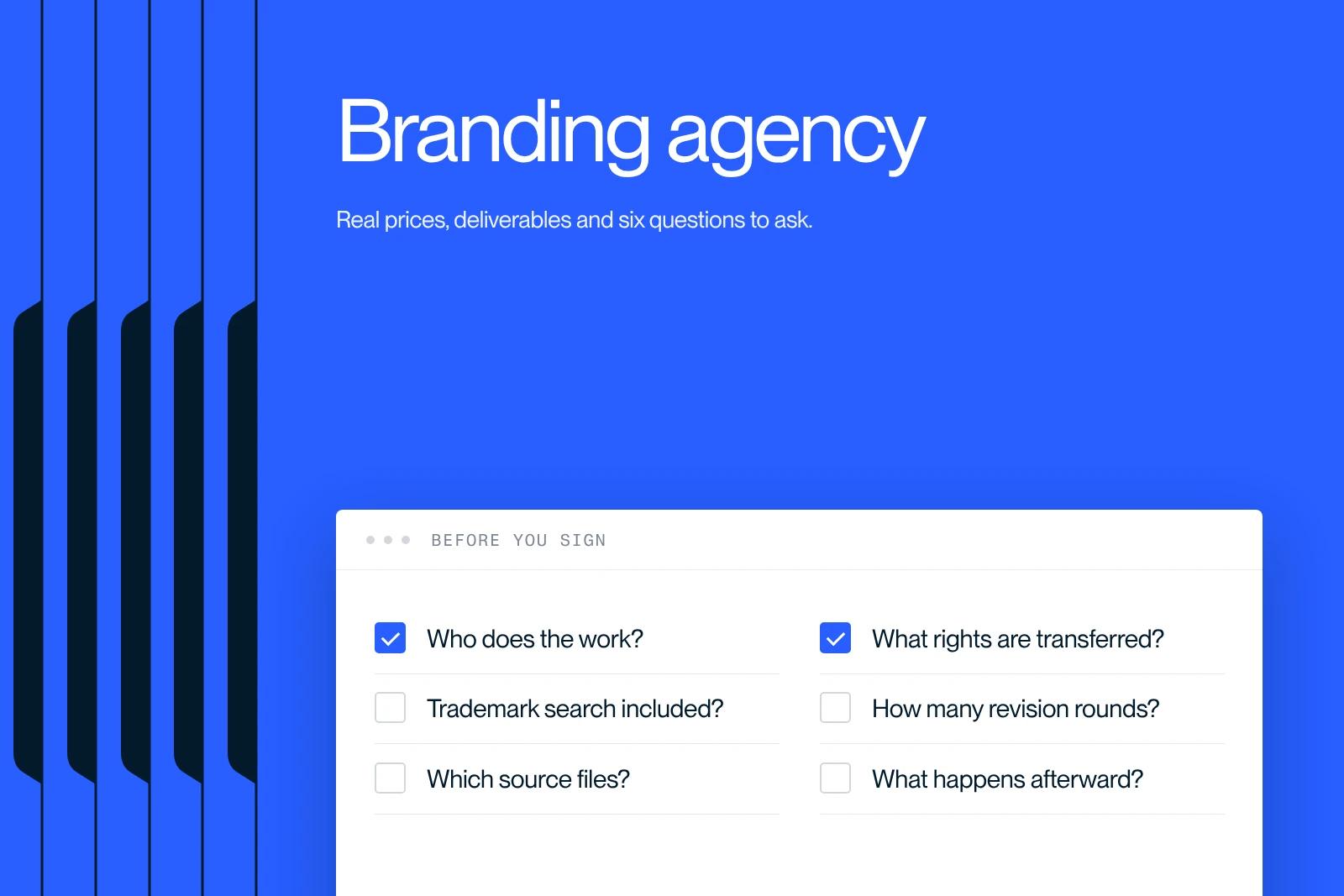
Who does the work? The art director who presents in the meeting is not always the one who produces. Ask for names and allocated time.
What rights are transferred, and when? The transfer of economic rights must be written, explicit, and limited in time and territory. Without a clear clause, you are paying for a use, not for ownership.
Is the trademark clearance search included? A logo that resembles a registered trademark in your INPI class gets changed eighteen months later, at your expense.
How many rounds of revisions? Projects go off track on this point more than any other. A number of iterations written into the quote protects both sides.
Which source files? Open vector files, fonts under a transferable license, editable templates. A flattened PDF is not a deliverable.
What happens afterward? An identity lives on a website, in a presentation tool, on sales materials. Ask who produces those variations, and at what rate.
Agency, freelancer or in-house studio
A freelancer suits a new business or a refresh: controlled cost, a single point of contact, fast decisions. The limit is capacity: one brain, and if they become unavailable, the project stops.
An agency makes sense when the scope goes beyond visuals: competitive research, naming, several markets, several languages, rollout across many materials. You are paying for a team and a method.
An in-house studio only makes sense with a steady volume of production. Below that, it costs more than it brings in and sits idle between campaigns.
How to tell whether branding paid off
Branding is not measured in clicks the following month, and any agency that promises otherwise is selling something else. Three indicators hold up over twelve months: the share of searches for your brand name in Google Search Console, the conversion rate of your commercial landing pages, and your paid acquisition cost, which drops when the brand is recognized.
The condition is to record these three values before the project. A rebrand without a measured starting point can only ever be judged by the mood of the leadership team.
When the brand meets the website
An identity is judged on the medium where it works hardest, and that is almost always the website. A system designed without technical constraints produces screens that look stunning in a presentation and are impossible to maintain in production: fourteen nearly identical shades, three fonts under non-transferable licenses, templates that break as soon as the content length changes.
For Garden Reclaimer, we built a premium business website with custom 3D assets, carrying the identity all the way through, from the design system to the real components. That move from brand guidelines to code is what determines perceived consistency, not the delivery presentation. Our article on web design explains how the two fit together, and the one on website redesign covers the case where both projects run together.
Synqro is a branding agency and Webflow Premium Partner, with a French-speaking team that works with companies in Paris and across France. We won't replace a naming specialist on an international brand platform, and we say so. But when an identity needs to become a website that holds up, that is our job. Write to us.
Frequently asked questions
Branding is the whole: positioning, promise, tone, name, and their visual expression. Visual identity is only the graphic part: logo, colors, typefaces, layout rules. You can redo a visual identity without touching the branding; the reverse is rarely useful.