Article
Domain Name: How to Choose and Buy One in 2026
Webflow9 min read

James BrunettoCo-fondateur & CEO
A domain name is the readable address of a website, for example agence-synqro.fr. You don't buy it, you rent it. Here is how to choose one, what it really costs and what to set up right after.
Explore this post with…
A domain name is the readable address you type to reach a website, for example agence-synqro.fr. Technically, it is a label that DNS translates into an IP address to reach the server hosting the pages. You don't really buy it, you rent it: a registration lasts one to ten years and can be renewed indefinitely. As long as you renew, it's yours. The day you miss the deadline, it goes back on the market and anyone can take it.
This guide covers choosing, buying and setting up a domain. It stops at the DNS zone. What happens next, the server, storage and bandwidth, is a matter of web hosting, and the difference between the domain, the website and the server is explained in our article on the definition of a website.
How to read a domain name
A domain reads from right to left. In agence-synqro.fr, the .fr is the extension, also called the TLD. agence-synqro is the second-level domain, the part you choose and pay for. Whatever goes in front, like www or blog, is a subdomain: it's free, and you can create as many as you like from your DNS zone.
Three players are involved. ICANN coordinates the naming system worldwide. The registry manages a given extension, for example Afnic for .fr (Afnic is the French registry). The registrar is the company you pay: OVHcloud, Gandi, IONOS, Cloudflare, Hostinger. Your account lives there, and that's who you'll contact the day something goes wrong.
Choosing a name: five criteria, in this order
Short and easy to say. The real test isn't visual, it's spoken. If you have to spell your domain over the phone and explain twice where the hyphen goes, the name has failed. Multiple hyphens, numbers and homophones cost you visitors every day.
Available as a trademark, not just as a domain. A domain that's free at the registrar may already be registered as a trademark with the INPI (the French intellectual property office) in your business class. Checking the trademark database takes five minutes and avoids a cease-and-desist letter two years later, when the name is on your business cards, your invoices and your backlinks.
Room to grow. A name that describes your current offer too precisely holds you back the day the offer changes. A brand name ages better than a product name. If the name itself is still to be found, a branding agency can lead the naming work.
A clean history. An expired domain has already had a life. Before you take it over, check what it used to host, using the Internet Archive and a backlink tool. A spammy past is paid for in penalties you didn't earn.
No forced keyword. Putting your target query in the domain is no longer a ranking lever. Our client CADvision, in 3D printing, ranks for transactional queries in a very competitive market with a brand domain that contains none of those words. The pages do the work, not the address.
Which extension to choose
For a French business serving French customers, .fr is the default choice. It's recognizable, less crowded than .com, and reassures people about where you are based. Afnic, its registry, reported 4.6 million active names in early September 2026, for the extension's 40th anniversary.
.com remains the international standard and what many internet users type by reflex. If your brand has the slightest ambition outside France, get both and point the second one to the first with a redirect. It costs the price of one domain per year and keeps a competitor from setting up next door.
Newer generic extensions, .io, .ai, .studio, .agency, make sense when they say something about your business. Two caveats: their renewal price is often several times the first-year price, and part of the public still reads them as second-tier addresses. Avoid extensions that cost less than one euro the first year for a serious site: they are widely used for spam, and that reputation rubs off.
How much a domain name really costs
The advertised price is the first-year price. The price that matters is the renewal price, which you'll pay every year for the whole life of the site.
| Extension | First year | Renewal | Good to know |
|---|---|---|---|
| .fr | €4.99 excl. VAT | €7.79 excl. VAT | Default choice in France, small gap between first year and renewal |
| .com | €7.99 excl. VAT | €13.49 excl. VAT | International standard, renewal costs almost double |
| .eu | €7.49 excl. VAT | €7.49 excl. VAT | Useful for a European business, reserved for EU residents |
| .io | €30.99 excl. VAT on promotion | €59.74 excl. VAT | Renewal doubles, budget it over ten years before committing |
| €1 offers | €1 excl. VAT | €11 to €15 excl. VAT | Teaser price from big registrars, the real price arrives the next year |
OVHcloud and IONOS prices collected by La Fabrique du Net in July 2026. Ballpark figures, check the registrar's page on the day you buy.
Add two lines to the budget. Registration data protection, often included, sometimes charged: without it, your contact details are public in WHOIS and you'll get sales calls within an hour of buying. And the TLS certificate, now free with most hosts, but worth checking.
In an overall project budget, the domain is a negligible line. The costs that matter are elsewhere, and we break them down in our analysis of how much a website costs.
Buying a domain name, step by step
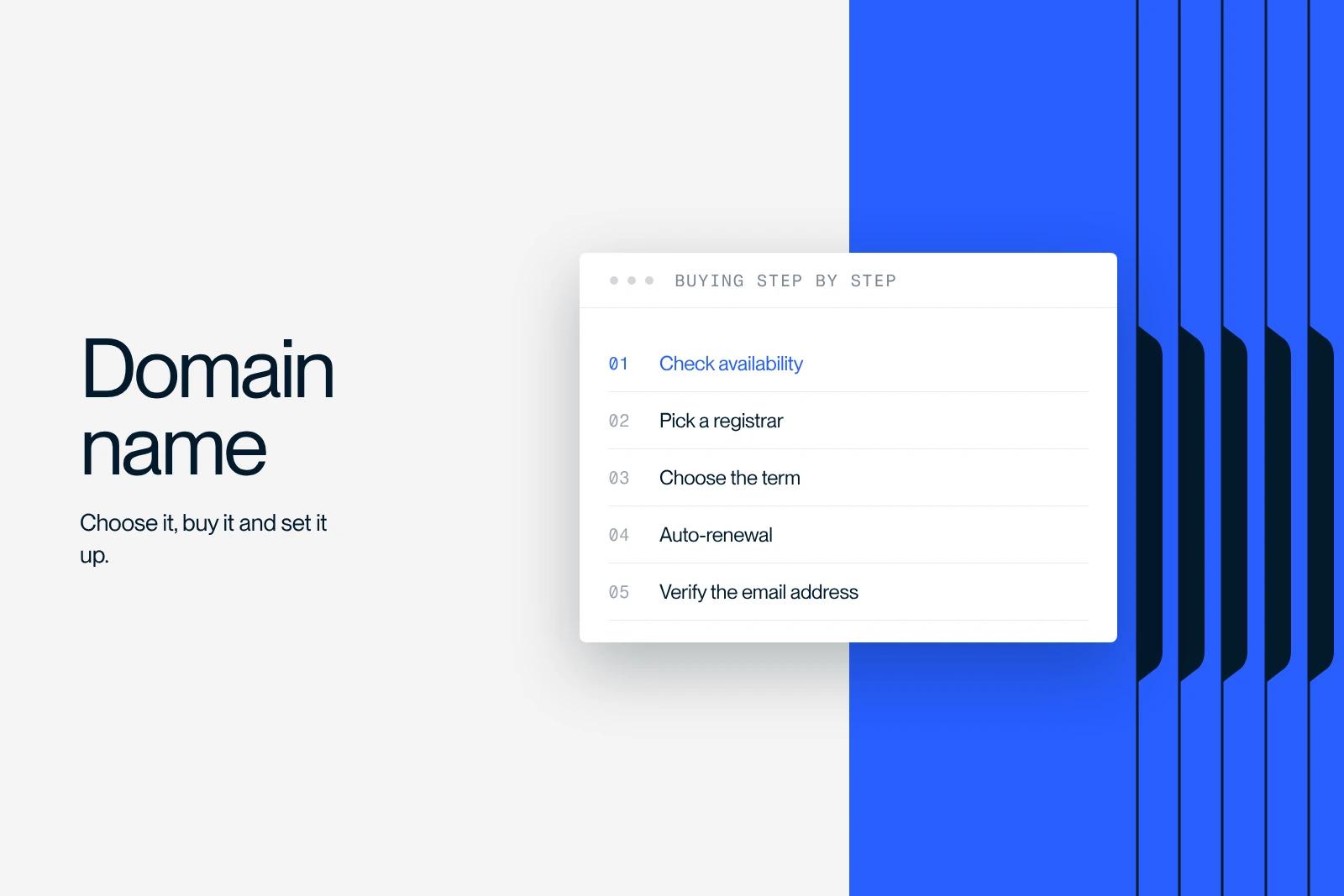
1. Check availability. Use the registrar's search engine. Be wary of unknown search sites: some register the names you test so they can resell them at a higher price.
2. Choose the registrar. Compare the renewal price rather than the teaser price, the DNS management interface, and the transfer policy. A registrar that makes leaving complicated is a warning sign.
3. Choose the duration. One year is enough to test a project. For a brand you're keeping, take several years at once: that's one less renewal to forget. .fr allows up to ten years.
4. Turn on auto-renewal and check the contact email. This is the one step people regret skipping. An expired domain takes down the website and the email addresses on the same morning.
5. Validate your email address. For generic extensions, ICANN requires this validation. Without it, the domain is suspended after a few days.
The name you want is already taken
Start by looking at what's behind it. A domain parked on an ad page has no active project, so a conversation is possible. An active website means no.
WHOIS gives you the expiration date. If it's close and the domain looks abandoned, you can try a backorder with a specialist, with no guarantee. Otherwise, contact the owner directly with a concrete offer rather than asking for a price: stating a budget keeps the price from rising to match your enthusiasm.
In most cases, the best trade-off is to pick another name. A four-figure domain buys an address, not an audience.
Three settings to configure right after buying
A domain on its own does nothing. Three things put it to work.
DNS records. An A or CNAME record to point the domain to your hosting, MX records for email, a TXT record to verify ownership with Google tools. If you use a website builder, it gives you the exact values to copy.
A single canonical version. Your site should answer on one address only. Choose between the www and non-www version, 301-redirect the other, and do the same from HTTP to HTTPS. Otherwise, four different addresses serve the same page and split the credit. The mechanism and its pitfalls are explained in our article on the canonical URL.
Email authentication. SPF, DKIM and DMARC in the DNS zone. Without these three records, your messages land in spam and your domain can be spoofed to send email in your name.
Changing domains without losing your rankings
A domain migration is the riskiest operation in a website's life. It goes well when the redirect plan is set beforehand, page by page, with a 301 redirect from each old URL to its exact equivalent. No mass redirect to the homepage: Google treats it as a disguised error page and the link value is lost.
The rest is a matter of method: keep both properties in Google Search Console, submit the change of address, watch logs and rankings for six weeks, and change nothing else at the same time. A site that changes its domain, design and URL structure on the same day makes any diagnosis impossible. Our article on the 301 redirect covers the implementation, and the SEO side should be prepared upfront with a Webflow SEO agency.
Synqro is a Webflow agency and Premium Partner that works with companies in Paris and across France. We run these migrations end to end, from the redirect plan to rank tracking. If you're at that stage, let's talk about your project.
Frequently asked questions
No, you register it for a set period, from one to ten years depending on the extension. It's a renewable right of use, not permanent ownership. If the renewal isn't paid, the name becomes available again after a holding period.