Article
What Is a Website? Definition, How It Works, Real Costs
Webflow10 min read

James BrunettoCo-fondateur & CEO
A website is a set of web pages linked together, placed under one authority and reachable from one address. A web page is the unit inside it: a single document with its own URL.
This guide gives the official definitions, shows what happens between typing an address and seeing the page, separates the website from the internet, and lists 2026 figures with their sources and dates.
Explore this post with…
In short: a website is a set of linked pages served under the same authority and the same address, such as synqro.co. It is not the internet (the network) and not a single web page (one document). When you type an address, your browser finds the server through DNS, requests the page over HTTP, receives it in packets and renders it. For a business, the useful question is not the definition but the type of site, because that sets the budget: a median of €3,500 for a brochure site and €10,000 for e-commerce in French data from July 2026.
What is a website, exactly?
France's official gazette (Journal officiel) published its internet vocabulary on December 8, 2002. It uses the term site and defines it as a set of documents and applications placed under the same authority and accessible over the web from the same universal address. Two details matter. The single authority is what makes a site one site. And the mention of applications blurred the line with web apps as early as 2002.
The Larousse dictionary is plainer: a set of web pages accessible via the internet on a server identified by an address.
The most rigorous definition is technical. In the MDN glossary (updated January 23, 2026), a site is the set of pages served from the same registrable domain, meaning the public suffix plus the label just before it. So support.mozilla.org and developer.mozilla.org belong to the same site, mozilla.org, although they are two different origins. That difference matters in practice, notably for cookies.
Our working definition in client briefs is simpler: a website is everything a visitor can reach under your domain name, managed by you, built to serve one goal.
Website, web page, web app, internet: what is the difference?
| Term | What it is | Example |
|---|---|---|
| Internet | The physical network of connected machines and the protocols they use to talk to each other | Cables, routers, servers |
| The web | One application running on the internet, alongside others such as email | Pages fetched by a browser over HTTP |
| Website | A set of pages under one authority and one address | synqro.co |
| Web page | One document reachable through a unique URL, usually written in HTML | A single blog article |
| Web application | A site you use rather than read: you log in and your data persists between sessions | An online invoicing tool |
A website is therefore not necessarily on the internet. A company intranet is a website reachable only from an internal network, which is why French vocabulary separates site web from site internet. In everyday conversation the two are interchangeable and nobody will correct you. In a project brief, being precise avoids costly misunderstandings.
What happens when you type a web address
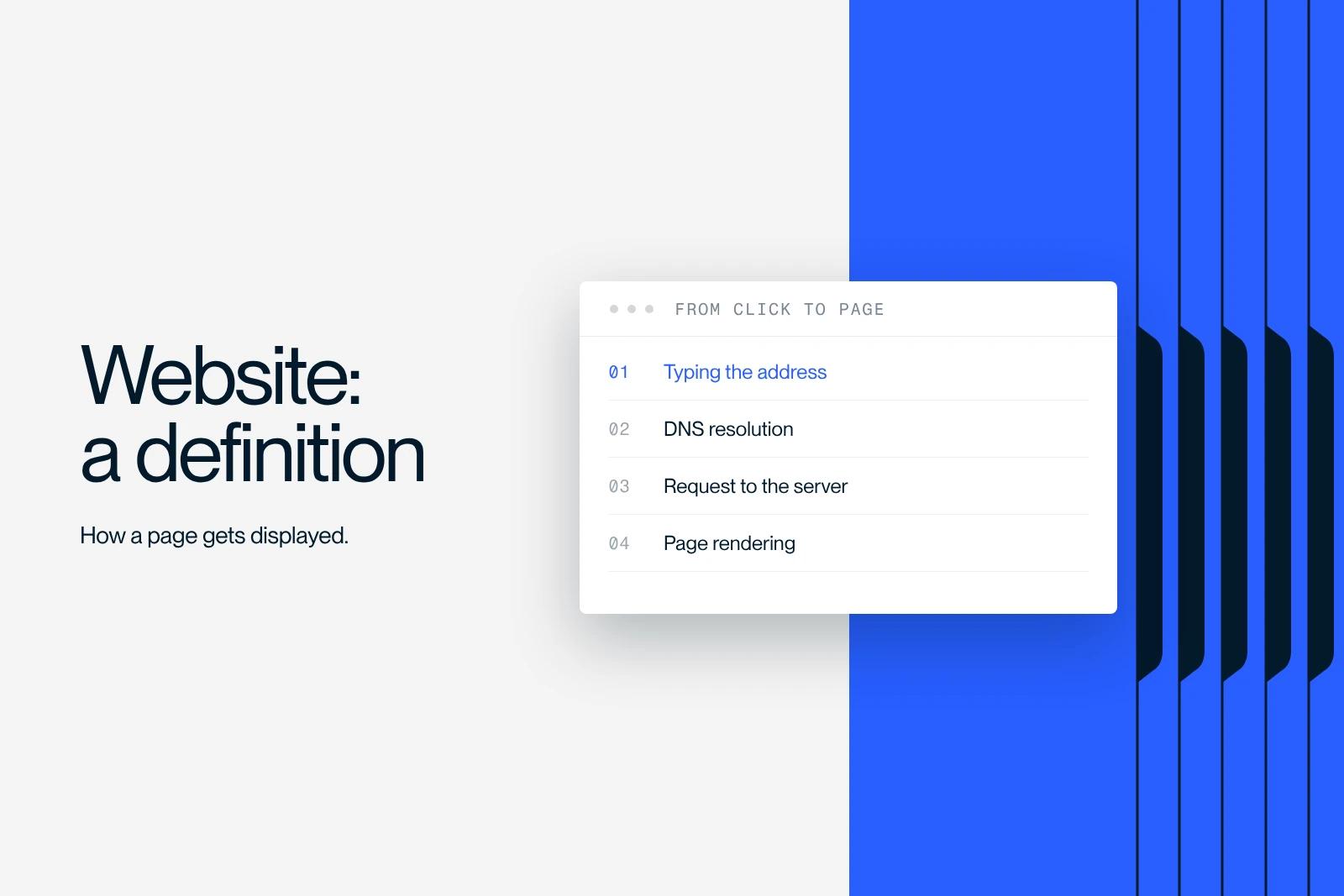
The full chain fits in five steps, documented by MDN.
- DNS resolution. Your browser does not know where the domain you typed lives. It asks the DNS, the internet's directory, which returns an IP address. Four servers take part in a full resolution: the recursive resolver, the root server, the top-level domain server and the authoritative name server.
- The HTTP request. The browser opens a connection to that address and sends a GET request. HTTP is text-based, stateless and asymmetric: only the client can start the exchange.
- The server response. The web server, which is both a machine and a piece of software, checks that a resource matches the requested URL. It returns the file, generates it on the fly, or returns an error code such as the famous 404.
- Packet transfer. The response is split into packets, each with a header and a payload. They may travel along different paths before being reassembled.
- Rendering. The browser parses the HTML, applies the CSS, runs the JavaScript and paints the page. This step sets perceived speed, and it is where most performance problems happen.
Static, dynamic or web application: how a site is built
A static site serves ready-made files. The URL maps to a file returned by the server. It is fast, robust, cheap to host and enough for most business websites.
A dynamic site generates content on demand, often from a database. That is what a CMS does when it assembles an article from fields stored separately. Modern platforms blur the line: you manage content dynamically, then publish static pages served by a content delivery network.
A web application is not something you read, it is something you use. Users log in, create and edit data, and that state persists between sessions. The line between a web app and a dynamic site is gradual, and no official source settles it.
In our projects, most business sites sit in the middle: content managed in a CMS, published as fast pages. That is how Webflow works, with no plugins to maintain.
Which type of website fits your goal?
These categories are industry conventions, not formal definitions. They still matter because they drive the budget.
| Type | Purpose | Budget or timeline we can source |
|---|---|---|
| Brochure website | Present an activity and generate enquiries, a few pages, no transactions | Median €3,500 (La Fabrique du Net, July 2026) |
| E-commerce website | Sell online with a catalog, cart and payment | Median €10,000 (same source) |
| Corporate website | Present the whole company to every audience | Depends on the number of pages and audiences |
| Blog or media site | Publish regularly, which needs a CMS that writers like | Depends on the CMS and the volume |
| Landing page | One page for one campaign and one action | 2 weeks at Synqro |
The corporate website is the broader version of the brochure site. Across all types, the median is €5,200 over 1,312 real budgets collected in early July 2026 by La Fabrique du Net, a French platform that matches businesses with agencies. At Synqro, a Webflow agency based in Dubai with a French-speaking team, sites run from €3,000 to €20,000 excl. VAT and a complete site is delivered in 8 to 12 weeks. The breakdown by technology and provider is in our guide to how much a website costs.
Website figures for 2026
Web figures age fast and keep circulating long after they stop being true, so each one below carries its source and date.
| Data point | Value | Source and date |
|---|---|---|
| Websites recorded worldwide | 1,494,915,628 sites across 305,348,459 unique domains | Netcraft Web Server Survey, July 2026 |
| Domain names worldwide | about 395 million, up 6.2% year over year | Afnic (French domain registry), report published July 6, 2026, 2025 data |
| WordPress share | 39.6% of all websites, 58.3% of the CMS market | W3Techs, October 22, 2026 |
| Sites using HTTPS by default | 90.0% | W3Techs, September 2026 |
| Traffic by device worldwide | mobile 49.36%, desktop 49.11%, tablet 1.54% | StatCounter, August 2026 |
| Traffic by device in France | desktop 52.98%, mobile 44.59%, tablet 2.43% | StatCounter, August 2026 |
The last row contradicts a common reflex. In France, desktop still accounts for most web traffic, while mobile has just moved ahead worldwide. Mobile-first design is still good practice, but testing only on mobile is a mistake if your audience is French and professional.
A note on method: W3Techs measures a sample of sites it considers relevant, excluding parked domains and spam. Its CMS shares are not calculated across the entire web.
What a website costs to keep online
A site needs two things to exist publicly: a domain name, which is its address, and hosting, which is the server space where its files live.
Typical hosting runs from €1 to €10 per month for shared hosting, €5 to €35 for a virtual private server, from €50 for a dedicated server and from €100 for cloud hosting. Comparisons tend to forget that introductory prices go up at renewal, enough to change the math over three years. Our web hosting guide covers the plans and this pricing trap.
All-in-one platforms bundle hosting in the subscription. Webflow plans started at $15 per month (Basic) and $25 per month (Premium), billed annually, when we checked webflow.com/pricing on October 21, 2026.
How to start without rebuilding the site in a year
The order that avoids rework is always the same.
- The goal and the type of site.
- The site structure, because it shapes both navigation and SEO.
- The content, which always takes longer than planned.
- The technology, last. The choice of website building platform follows from everything before it, never the other way around.
The most common mistake is choosing the tool first. It produces sites that have to be rebuilt much sooner than planned.
What we see in our projects
Synqro is a brand and web agency based in Dubai, with a French-speaking team that works with companies in Paris, across France and internationally, remotely or on site. We are a Webflow Premium Partner and have supported 150+ companies since 2019. Our method: a scoping workshop, site structure and copy, component-based design in Figma, Webflow build, review, then training for your marketing team at delivery. We start with structure and content, not mockups, because that is where what the site will bring in gets decided.
For Qobra, a commission-management SaaS, we built a Webflow site to support its rebranding, then optimized it for two years with an ROI calculator and funnels by target. Requests tripled and organic traffic grew 16 times (see the Qobra case study). For Garden Reclaimer, in e-commerce, we built a premium brochure website with custom 3D assets: the type of site and the visual ambition were driven by the product positioning, not by taste. Details in the Garden Reclaimer case study.
If you do not know yet which type of site fits, tell us your goal rather than the solution.
Frequently asked questions
A set of pages and resources linked by hyperlinks, placed under a single authority and accessible from a single address. This is the definition in France's Journal officiel of December 8, 2002, which uses the word site.