Article
Web hosting: how to choose and what it costs
Webflow7 min read

James BrunettoCo-fondateur & CEO
Web hosting is renting space on a server permanently connected to the internet, where your site's files are stored so they are accessible at all times. Without hosting, a site exists on your computer but not on the web. The domain name is the address; the hosting is the land.
The choice comes down to three questions: how many visitors, how much downtime you can tolerate, and who administers the server. This article gives real price ranges and the criteria that actually matter.
Explore this post with…
The five types of hosting
Shared hosting
Your site shares a server with hundreds of others. It is the cheapest and simplest option, with one structural flaw: a neighboring site that uses too many resources can slow yours down. Suitable for a brochure site, a portfolio or a blog up to a few thousand visits per month.
VPS
A physical server split into virtual machines, with guaranteed resources. You gain stability and configuration freedom, and lose simplicity: unless the plan is managed, system administration is up to you.
Dedicated server
A whole machine for you. Maximum performance and full control, but sysadmin skills become mandatory. Rarely justified for a brochure site, even a large one.
Cloud
Resources spread across several machines, billed by usage and resizable. It is the answer to unpredictable traffic spikes. The trade-off is a variable bill that is hard to predict if nobody monitors usage.
All-in-one platforms
Webflow, Shopify or Squarespace include hosting in the subscription. You have no server to choose, no security update to apply and no SSL certificate to renew. On the other hand, you lose the freedom to move your site elsewhere without rebuilding it.
What it costs in 2026
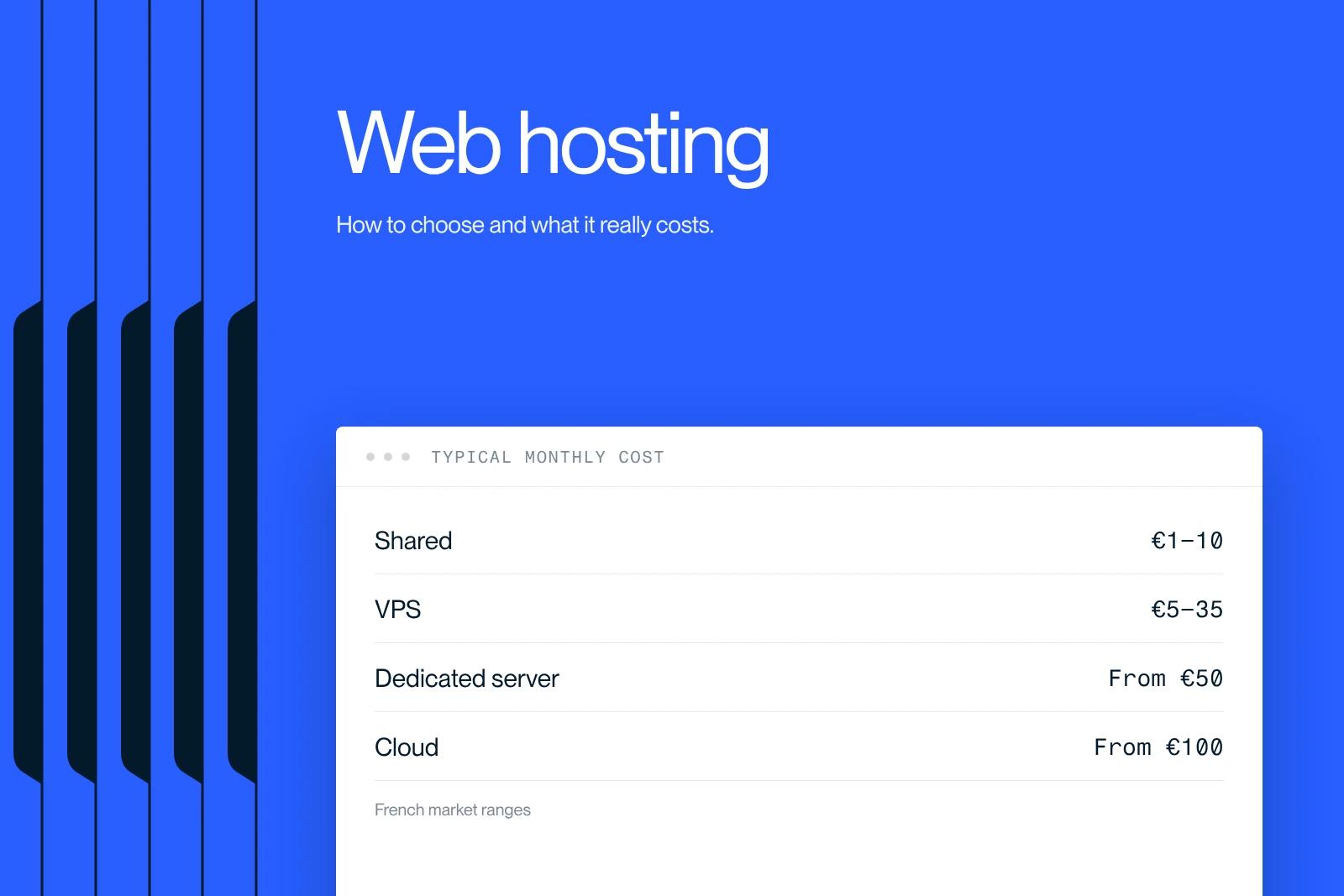
Price ranges observed on the French market give the following order of magnitude: €1 to €10 per month for shared hosting, €5 to €35 for a VPS, from €50 for a dedicated server and from €100 for cloud infrastructure. These figures are indicative: hosting providers rarely publish a pricing method that can be compared from one offer to the next.
The trap is not the advertised price, it is the renewal. Many shared hosting offers show a promotional rate for the first year, then go back to the regular price. The right way to compare two offers is to calculate the total cost over thirty-six months, not the first-year rate. Some providers, such as the French host o2switch, have chosen a single offer at a stable price to get out of this pattern.
On Webflow, hosting is part of the site plan. Pricing was overhauled on May 13, 2026: Starter remains free, Basic costs $15 per month billed annually ($25 billed monthly) and Premium $25 per month billed annually ($39 billed monthly). The former CMS and Business plans were merged into Premium, which includes 20,000 CMS items and 40 collections. A Team plan, at $2,500 per month, targets large marketing teams. The tiers are detailed in our article on Webflow pricing.
The criteria that really matter
- Server location, for latency and for GDPR. European hosting makes the topic simpler without settling it on its own: see our guide to a GDPR-compliant Webflow site.
- Automatic backups and, above all, restoring them. A backup you do not know how to restore is worthless.
- The SSL certificate, now included everywhere through Let's Encrypt. Avoid a host that charges for it as an option.
- Support, its language and its real hours. That is what matters on the day of an outage, not the rest of the year.
- The ability to leave. Before you sign, check how you will get your files and your database back.
Does hosting affect SEO?
Indirectly, yes, and on only two points.
Server response time feeds into the Core Web Vitals, which are part of the page experience signals. A slow server response weighs on the entire loading chain.
Then availability. A site that is unreachable when Googlebot visits does not lose its rankings immediately, but repeated downtime eventually reduces crawl frequency.
On the other hand, changing hosts does not push a site up in the results. If your pages are stuck, the problem is almost always elsewhere: intent, structure, content.
Changing hosts without breaking the site
A migration is prepared in four steps: keep URLs strictly identical, plan redirects for those that change, lower the DNS TTL before the switch, and check indexing afterward. Our guide to migrating from WordPress to Webflow details these mechanics, which apply beyond that specific pair.
For Neoptim, a fintech consulting firm, the migration to Webflow happened without any loss of rankings and with a faster site at the end. That is the expected result of a well-prepared migration: the change of infrastructure should only show up in load times.
Which hosting for which project
A brochure site or a blog: shared hosting, checking the renewal price. An all-in-one platform if you do not want to administer anything.
A company site with editorial content: an all-in-one platform or a managed VPS, depending on whether you have technical skills in-house.
An e-commerce site or an application: VPS, cloud or a specialized platform, with real attention to backups and scaling.
For Cashbee, we built a custom site on Webflow. Since hosting is built into the platform, the team has no server to administer and no security updates to track. The details are in the Cashbee case study.
Our view
For the vast majority of company sites, hosting is a topic you should not spend time on. The real cost of a bad choice is not the monthly bill, it is the hours spent handling an incident nobody saw coming.
Synqro is a Webflow Premium Partner agency that works with companies in Paris and across France. As a Webflow agency, we recommend in most cases a platform that includes hosting, and we explain the setup in our guide to hosting a Webflow site. If you are unsure about your current setup, tell us about your site.
Frequently asked questions
Ranges observed in France go from €1 to €10 per month for shared hosting, €5 to €35 for a VPS, from €50 for a dedicated server and from €100 for cloud. Always compare the cost over three years, since price increases at renewal are common.