Article
Framer vs Webflow in 2026: Verified Pricing, CMS, SEO, Startups
Webflow11 min read

Guillaume SchluppConsultant SEO
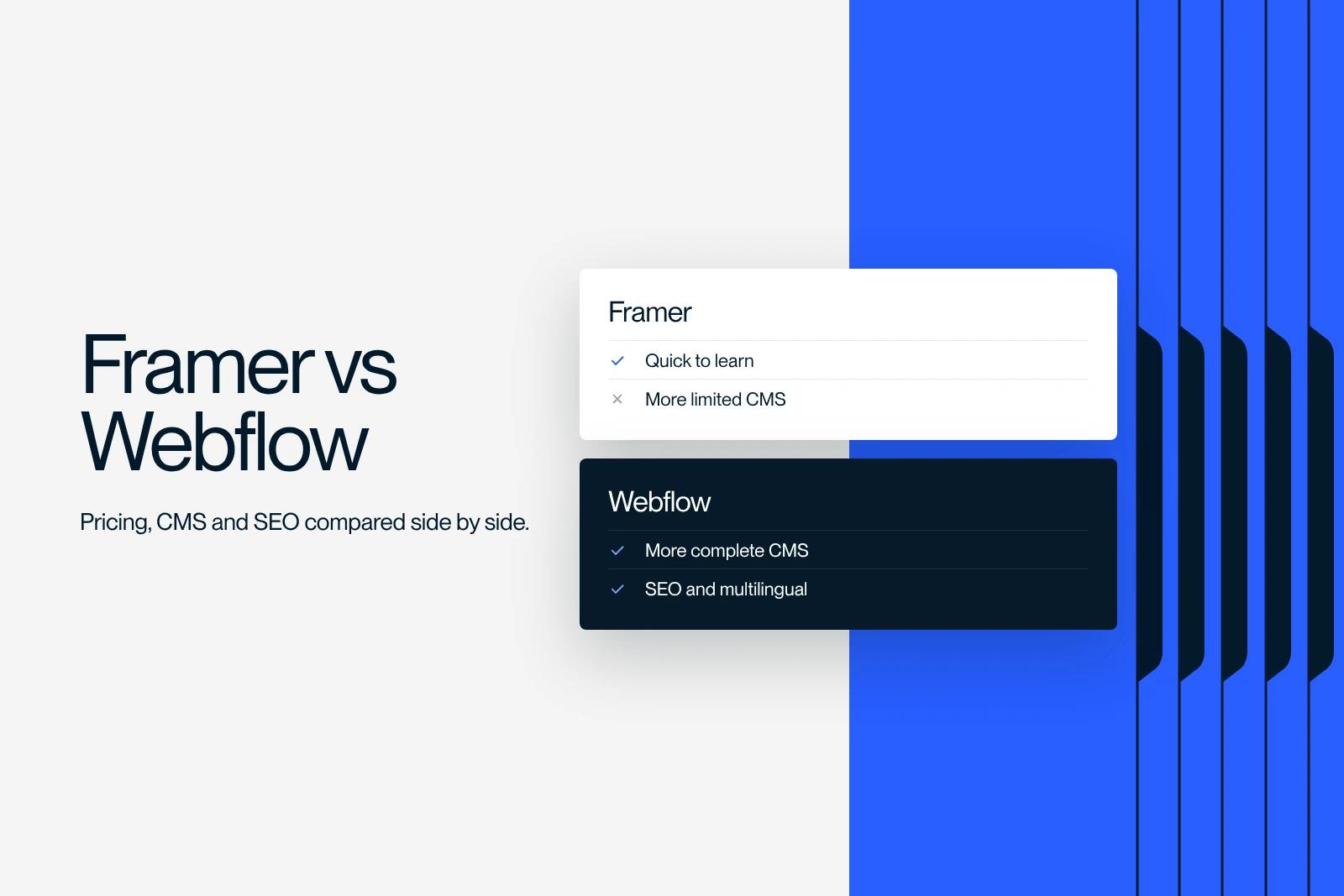
Framer is the right choice for a landing page or a site under thirty pages that has to ship in days; Webflow is the right choice as soon as the site becomes a marketing asset with a CMS, several contributors and pages produced in volume. On price, checked October 21, 2026: Framer Basic $10 and Pro $30 per month, Webflow Basic $15 and Premium $25 per month, billed yearly.
This comparison goes line by line, then answers the question startups ask us most: Webflow or Framer to launch, and for the two years after.
Explore this post with…
In short: Framer wins on speed of creation and entry price: a designer coming from Figma publishes a site in days, for $10 per month. Webflow wins on structure: 20,000 CMS items and 40 collections on Premium versus 2,500 items and 10 collections on Framer Pro, native ecommerce, code export and a public API. For a startup, it comes down to one question: will your site stay a brochure, or become an acquisition tool with dozens of new pages per quarter? Brochure: Framer. Tool: Webflow.
Synqro is a Webflow agency and a Webflow Premium Partner, the highest tier of the Webflow partner program. Our bias is known, so we state it. We regularly advise against Webflow when the project is a single landing page or a ten-page site with no CMS: in those cases Framer is faster and cheaper. Every figure below comes from the official pages, checked on October 21, 2026.
Framer vs Webflow at a glance
| Criterion | Framer | Webflow |
|---|---|---|
| Best for | Designers, product teams, landing pages, short sites | Marketing teams, CMS-driven sites, multi-contributor sites |
| Entry price with a custom domain | Basic $10 per month | Basic $15 per month, no CMS |
| Price with a full CMS | Pro $30 per month (10 collections, 2,500 items) | Premium $25 per month (40 collections, 20,000 items) |
| Learning curve | Low, coming from Figma | Steeper: CSS classes, HTML structure |
| CMS | Light, 2 to 10 collections depending on plan | Deep, public Data API, MCP server |
| SEO | Meta tags, sitemap, redirects from Pro, translated URL paths | Meta tags, sitemap, redirects, structured data, fine control of markup |
| Localization | $20 per locale, translated URL paths | Localize from $9 per month for 1 to 3 locales, subdirectories, hreflang |
| Ecommerce | No native cart, third-party plugins | Native, $29 to $212 per month |
| Code export | No | HTML, CSS and JS on a paid Workspace, without the CMS |
| Working as a team | $20 per editor, $10 per content editor | Workspace Core $19 or Growth $49 per month |
Framer and Webflow pricing in 2026
Webflow simplified its plans on May 13, 2026, per Webflow's official notice: the old CMS and Business plans merged into a single Premium plan. Existing sites moved from June 29, 2026, and Freelancer and Agency accounts move on November 16, 2026. Any comparison still quoting a CMS or Business plan is out of date, and its prices are wrong. The same goes for Framer's old Mini plan, which no longer appears on its pricing page.
Prices checked on October 21, 2026 on framer.com/pricing and webflow.com/pricing, billed yearly:
| Plan | Price per month | What you get |
|---|---|---|
| Framer Free | $0 | Framer domain, 1 GB bandwidth, for testing |
| Framer Basic | $10 | 30 pages, 2 collections, 1,000 CMS items, 50 GB, 30-day analytics |
| Framer Pro | $30 | 150 pages, 10 collections, 2,500 CMS items, 100 GB, redirects, staging, branching |
| Webflow Starter | $0 | 2 pages, webflow.io domain, for testing |
| Webflow Basic | $15 ($25 month to month) | 300 static pages, 10 GB, no CMS |
| Webflow Premium | $25 ($39 month to month) | 300 pages, 20,000 CMS items, 40 collections, 50 GB expandable |
| Webflow Team | $2,500, annual contract | 100 collections, 10 seats, 2 locales, page branching |
Three reading traps that comparisons never flag.
The Webflow double cost. The Site plan is not enough once several people design: a Workspace is added, Core at $19 per month billed yearly, Growth at $49, Freelancer at $16 and Agency at $35. On Framer, billing is per workspace, with extra editors at $20 per month and content editors at $10.
Localization costs on both sides. Framer charges $20 per translation locale, up to 20. Webflow sells the Localize add-on at $9 per month for 1 to 3 locales (Essential) or $29 for 1 to 10 (Advanced), and includes it in the Team plan. For a bilingual site with a CMS: Framer Pro plus one locale, $50 per month; Webflow Premium plus Localize Essential, $34 per month.
Framer overages. Beyond the Pro plan limits, Framer charges $20 per 100 extra pages, $40 per 10 extra collections and $20 per 10,000 extra CMS items. A site that grows on Framer ends up costing as much as Webflow Premium, with less headroom. Every Webflow add-on is detailed in our guide to Webflow pricing.
Webflow or Framer for a startup?
This is the question we get most, and the answer depends on what the site will have to do in eighteen months, not at launch.
| Criterion | Framer | Webflow |
|---|---|---|
| Time to launch | Days from a Figma mockup, no developer | Two weeks for a landing page, 8 to 12 weeks for a full site in our projects |
| CMS for content | Enough for a blog and a few case studies | Needed once you produce landing pages per persona, per integration, comparisons |
| SEO | Good for a short site | Better control of markup and automation across hundreds of pages |
| Localization | Simple and fast, $20 per locale | Localize, cheaper from two languages with a CMS |
| Team | One designer is enough | A developer at launch, then the marketing team alone |
| 2-year cost, bilingual site with CMS | $1,200 (Pro $30 plus one locale $20, over 24 months) | $816 (Premium $25 plus Localize $9, over 24 months), $1,272 with a Core Workspace |
Pre-seed and seed. Pick Framer. You need a credible landing page, a form and a light blog, and you will change your messaging three times in six months. Framer keeps up with that pace without a developer.
Series A and beyond. Pick Webflow. The site becomes an acquisition tool: pages per persona, per use case, per integration, comparisons, calculators, partner programs. That's CMS, automation and several contributors. Qobra, a sales commission management SaaS, is the clearest example in our projects: a Webflow site built to support its rebrand, then two years of optimization with an ROI calculator and funnels per target audience, for inbound requests multiplied by three and organic traffic multiplied by sixteen. The details are in the Qobra case study.
The trap in between. Launching on Framer and migrating to Webflow twelve months later is common, and it's not a disaster, as long as you plan the migration from day one: clean URLs, structured content, no dependence on closed components.
CMS: the gap is not marginal
This is the criterion that settles a B2B project fastest.
Framer caps at 2 collections and 1,000 items on Basic, 10 collections and 2,500 items on Pro, expandable for a fee. Since February 2026, a Server API in beta lets you sync collections with external sources such as Notion or Airtable.
Webflow goes up to 20,000 items and 40 collections on Premium, 100 collections on Team, with a public Data API and an MCP server. The limits that matter in production are on the display side, per Webflow's documentation: 40 collection lists per page, 10 nested lists, 100 items per list without pagination.
In practice: a blog of fifty articles and three case studies fits comfortably on Framer. A product catalog, a resource library or a site with thousands of template-generated pages does not.
SEO and localization
Fundamentally, neither stops you from doing things right. Both handle title and meta description tags, the sitemap, redirects (from the Pro plan on Framer) and structured data. What moves the needle on Google is still content, internal linking and backlinks.
Framer translates the URL paths of every page per locale and manages hreflang tags. Webflow Localize puts each language in a subdirectory, generates hreflang and the localized sitemap, and translates metadata page by page.
What changes at scale: across hundreds of pages, fine control of markup, CMS fields dedicated to SEO and automation through the API are simpler on Webflow. It's also the platform where our own optimizations ship fastest.
Reversibility: who can leave?
Framer offers no HTML export for self-hosting, per its own documentation: published sites rely on its infrastructure. A Framer site gets rebuilt, it doesn't get moved.
Webflow lets you export HTML, CSS and JavaScript on a paid Workspace, without CMS content, ecommerce, forms, user accounts or secondary locales, per its documentation. The CMS exports separately as CSV. That's not full independence, but it's an exit door. We cover it in our article on exporting Webflow code.
Ecommerce
Framer has no native cart or checkout in 2026. Stores run through third-party plugins tied to Shopify or payment tools, which works for a handful of products and gets uncomfortable beyond that.
Webflow has a native three-plan offer: Standard at $29 per month for 500 products and a 2% transaction fee, Plus at $74 for 5,000 products with no fee, Advanced at $212 for 15,000 products. It's not the best on the market for large catalogs, but it's integrated with the CMS.
When Framer is the right choice
A launch landing page or an event site. The site has an expiry date, it has to look good and ship fast.
A site under thirty pages without a heavy CMS. A light blog, a few case studies, a team page: Basic or Pro is enough.
A product team that lives in Figma. Nobody wants to learn a CSS class system, and the design changes often.
A tight budget with immediate localization. Basic plus one locale, $30 per month, for a short bilingual site.
When Webflow is the right choice
A real CMS. Hundreds of generated pages, cross-references, several content types.
Several contributors. Marketing, content, product, partners: the Workspace and roles exist for that.
Native ecommerce or API automation. Syncing a CRM, generating pages, connecting internal tools.
A reversibility requirement. Being able to export the code matters in some procurement policies.
For Zeliq, a sales prospecting platform, we rebuilt the site on Webflow with a component library, then trained the team to use it: the details are in the Zeliq case study.
Webflow or custom development?
This question often follows the Framer one. A custom build (Next.js, Astro) makes sense when the site is the application itself, or when needs go beyond what a visual CMS allows: business logic, complex user accounts, heavy integrations. For a marketing site, custom code costs more to build and above all to evolve, because every page goes back through a developer. Our position: Webflow for the marketing site, code for the product, and a clear line between the two.
Migrating from Framer to Webflow
The migration comes down to three things: moving the content, keeping the URLs and matching the animations. Since Framer exports no code, the rebuild is manual, which is also the chance to rework the site structure. The 301 redirect map in Webflow is the part not to miss: every old URL needs its destination before the switch. We applied the same rule to our own migration from agence-synqro.fr to synqro.co in October 2026, with 485 redirects written and tested before switching.
Our take
We recommend Framer for a single landing page, an event site or a ten-page site. We recommend Webflow as soon as content becomes an asset, meaning when the CMS and automation matter more than time to launch. We recommend neither for a store with thousands of products, where Shopify does better. If you're also weighing WordPress, our Webflow vs WordPress comparison covers the other big option. And if you want an opinion on your specific case, send us the context.
Frequently asked questions
Framer on small projects: $10 per month billed yearly versus $15 for Webflow Basic, which has no CMS. Once you need a CMS, Webflow Premium at $25 per month gives you 20,000 items where Framer Pro at $30 gives you 2,500. Add a Webflow Workspace if several people design. Prices checked October 21, 2026.