Article
How long does it take to build a website? Real timelines 2026
Webflow5 min read

James BrunettoCo-fondateur & CEO
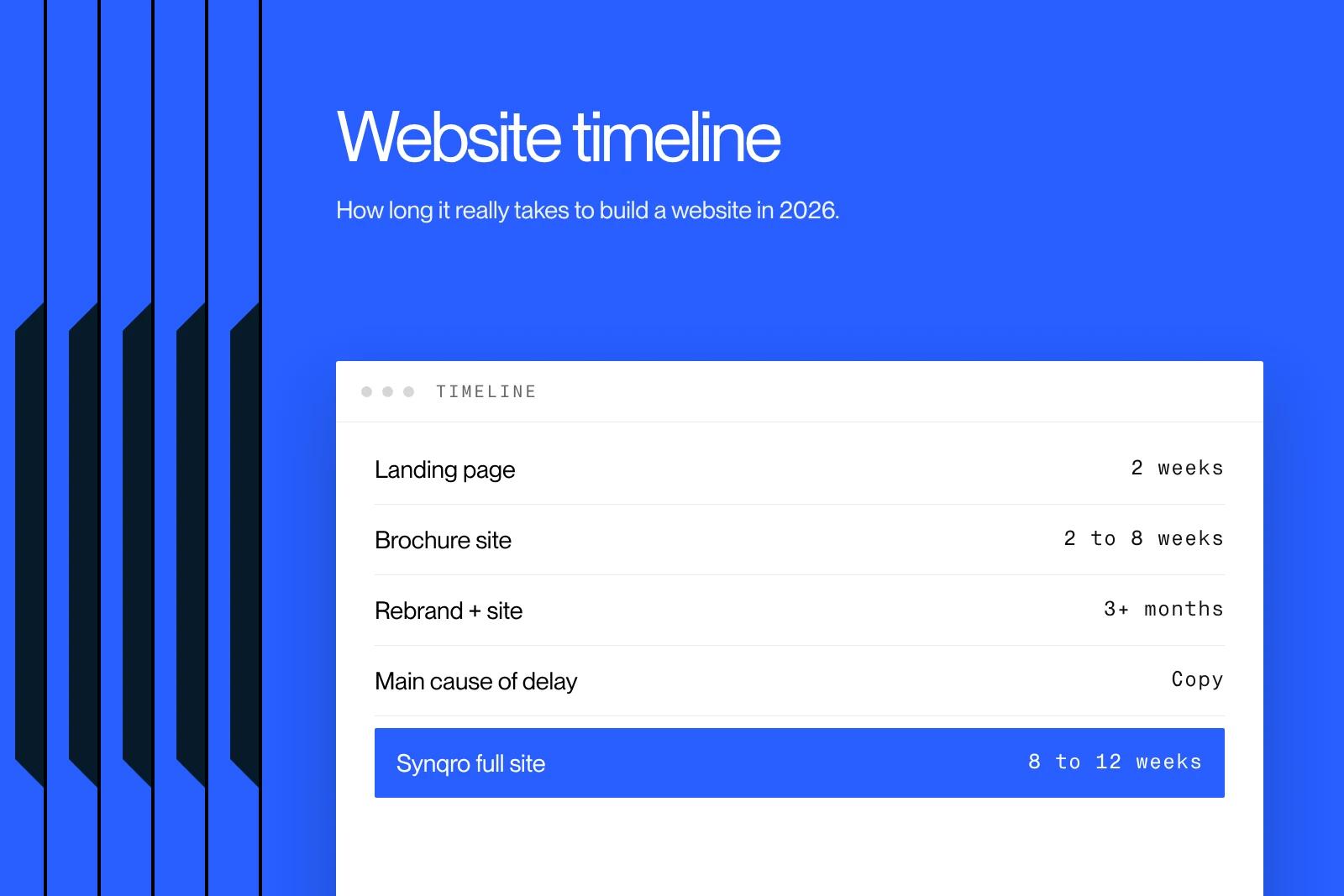
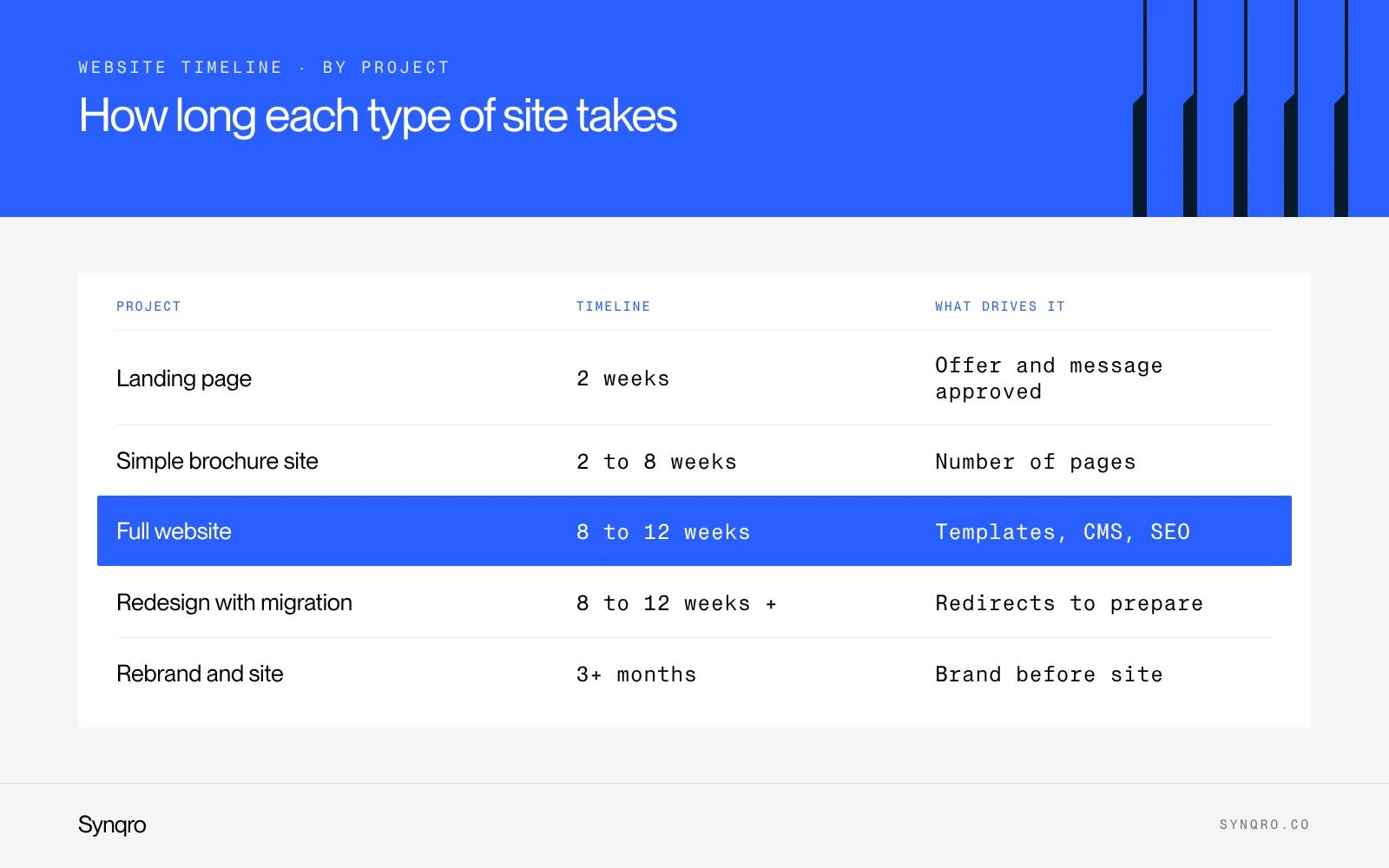
Allow around 2 weeks for a landing page, a few more weeks for a simple brochure site and 8 to 12 weeks for a full company website, from the scoping workshop to launch. Add a rebrand and the project often runs past three months. Here is the detailed schedule for a full website, what makes the timeline vary, the most common causes of delay and how to save time without cutting corners.
Explore this post with…
In short: at Synqro, a full website is delivered in 8 to 12 weeks and a landing page in 2 weeks. The timeline depends less on technology than on three things: when the copy is ready, how fast approvals come back and how much brand work has to happen first. A project rarely runs late because of development.
Timelines by type of website
| Type of project | Typical timeline | What it depends on |
|---|---|---|
| Landing page | 2 weeks | Approved message, a single offer |
| Simple brochure site (5 to 10 pages) | Between 2 and 8 weeks depending on the number of pages | Copy ready, existing identity |
| Full company website | 8 to 12 weeks | Number of templates, CMS, integrations, SEO |
| Redesign with migration | 8 to 12 weeks, plus redirect preparation | Volume of old pages and traffic to protect |
| Rebrand and new website | More than 3 months | Brand platform and identity to create before the site |
The landing page and the full website are our usual timelines, the brochure site falls in between. The last row comes down to brand work: on the branding projects tracked by La Fabrique du Net on the French market, the most common duration is three months, before the site design even starts. We cover this in our article on the brand platform.
The schedule for a full website, week by week
Here is the typical breakdown of a 10-week project, following the method we use. Durations are indicative: they tighten or stretch depending on the number of pages and how quickly feedback comes back.
| Weeks | Stage | What happens | What you approve |
|---|---|---|---|
| 1 | Scoping | Workshop with marketing and sales, review of the existing site and Search Console | Scoping document: pages, schedule, fixed price |
| 2 to 3 | Structure and copy | Wireframes and copy for each template; for a redesign, URL inventory and redirect plan | Structure and content |
| 4 to 6 | Design | Key pages on desktop and mobile, built as reusable components, annotated in Figma | Mockups |
| 6 to 9 | Development | Webflow build, CMS, forms, integrations, SEO checks | Full site on a staging environment |
| 10 | Testing and launch | Tests, redirects, go-live, team training | Launch |
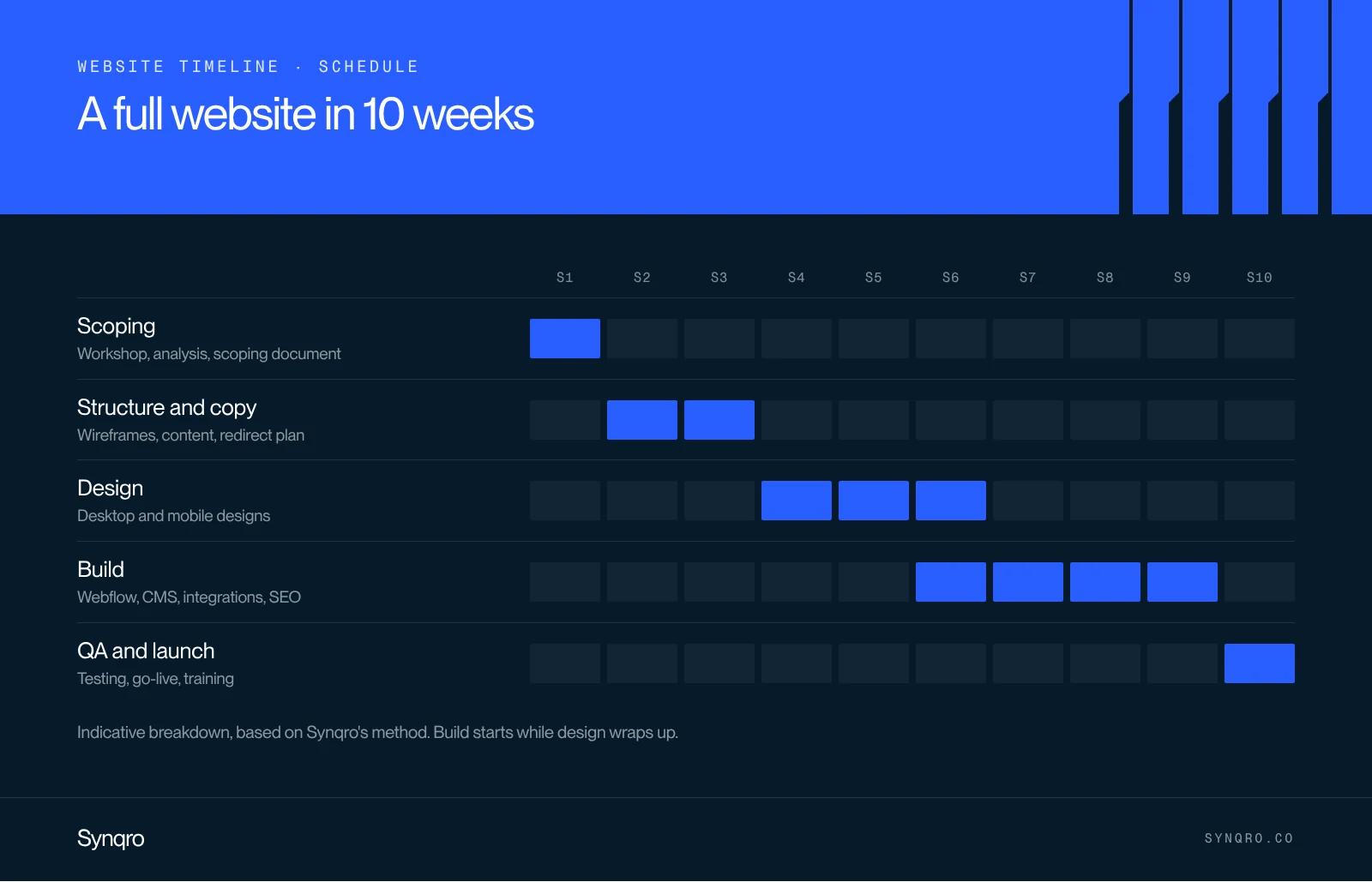
Two stages overlap on purpose. Development starts while design is wrapping up, as soon as components are approved. And the URL inventory happens at the very start: it is the one task you cannot catch up on at the last minute. During our own migration to synqro.co, the plan included 485 redirects, all tested before the switch.
What makes the timeline vary
- The number of templates, more than the number of pages. Ten posts on the same template page take less time than three completely different pages. The Webflow CMS is built for exactly that.
- Integrations. CRM, booking tool, client area, calculator: each one adds testing.
- Languages. Each language adds copy to produce, review and test.
- Custom design versus adapting an existing template.
- Brand work to do first. Brand guidelines that are not ready delay design by several weeks.
Why website projects run late
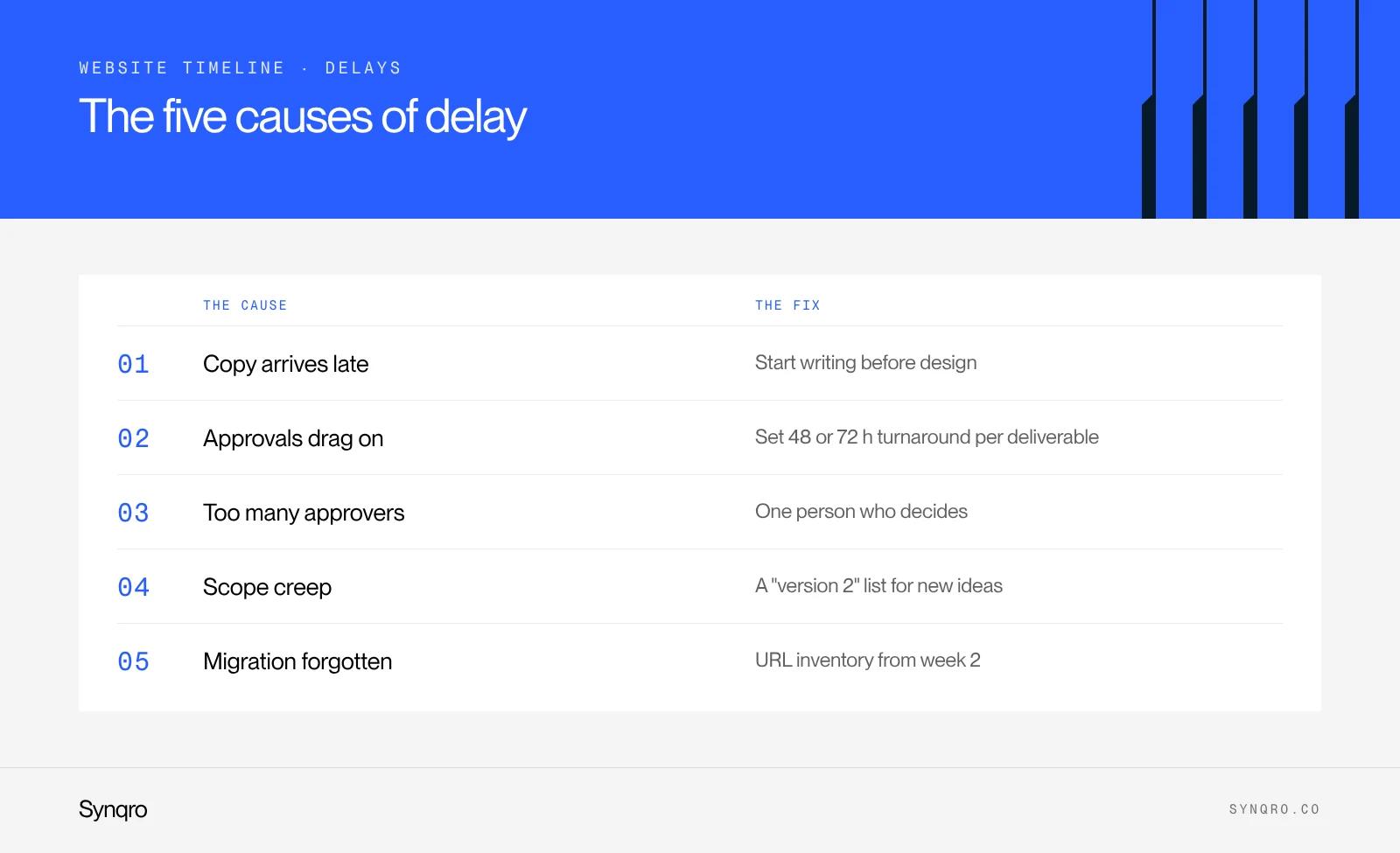
Delays almost always have the same causes, and none of them is technical.
- Copy arrives late. This is the number one cause. Design waits for content, development waits for design.
- Approvals drag on. Feedback that takes two weeks to arrive pushes the whole schedule back two weeks.
- Too many people approve. Five conflicting opinions on a mockup, and the stage starts over.
- The scope grows along the way. A new section, a new language, an "extra" feature.
- The migration is forgotten. Discovering the old URLs the day before launch blocks the switch.
How to save time without cutting corners
- Write a short, precise brief. Our website brief template sets out the milestones and the people who approve.
- Name a single decision-maker on your side.
- Set feedback dates in advance, from scoping onwards: 48 or 72 hours per deliverable.
- Start the copy first. If you write it in-house, begin before design even starts.
- Keep a "version 2" list for ideas that come up during the project, instead of adding them to the scope.
Webflow, WordPress, custom code: does the tool change the timeline?
A little, but less than people think. On Webflow, design and development happen in the same tool, with no plugins to install or update, and the marketing team is autonomous from handover. That is a real gain on company websites, and it is why we use it as a Webflow agency. A custom-coded site takes longer to build and maintain. WordPress sits in between, depending on the theme and plugins. Our Webflow vs WordPress comparison details these differences.
Choose the tool based on the need, not on a few days saved. What really keeps a project on schedule is preparation and discipline on approvals.
Frequently asked questions
Around 2 weeks for a landing page, a few more weeks for a simple brochure site and 8 to 12 weeks for a full company website, from the scoping workshop to launch.