Article
Corporate website: definition, key pages, examples and cost
Webflow13 min read

James BrunettoCo-fondateur & CEO
A corporate website is the official website of a company. It presents who the company is, what it does, who it works with and how to contact it, to every audience at once: prospects, candidates, investors, partners and the press. It is not an online shop and not a single campaign page. Here is what it should contain page by page, how it differs from a brochure site, four B2B corporate websites we built and what each one changed, and what it really costs and takes to build.
Explore this post with…
In short: a corporate website is the reference version of your company online. It answers five audiences with nine core pages, and its first job today is to confirm a choice buyers have mostly made before they call you. Built by an agency, it costs €3,000 to €20,000 excluding VAT and takes 8 to 12 weeks at Synqro. The pages that make the difference are rarely the home page: they are the case studies, the about page and the service pages.
What is a corporate website?
A corporate website is the website a company publishes in its own name to present the whole organisation. Its subject is the company itself: its business, its offer, its references, its team, its values and the ways to get in touch.
The word "corporate" misleads people. It does not mean "for large groups" or "grey and formal". A 20-person consulting firm, a SaaS company after its Series A and an industrial group with five subsidiaries all need one. What they share is the job of the site: being the place where anyone checks who you are before doing business with you.
In French the same thing is called a "site institutionnel" or "site corporate". In English you will also see "company website" or "business website". The terms overlap. What matters is the scope: the whole company, for several audiences, over several years.
Corporate website, brochure site, landing page: the differences
These formats get mixed up in briefs and quotes, which makes quotes impossible to compare. Here is how we separate them.
| Format | Subject | Main audience | Typical size | Lifespan |
|---|---|---|---|---|
| Corporate website | The whole company | Prospects, candidates, investors, partners, press | 10 to 40 pages, often multilingual | 3 to 5 years, updated continuously |
| Brochure website | An offer or a small business | Prospects | 3 to 12 pages | 2 to 4 years |
| Landing page | One campaign or one offer | One segment of prospects | 1 page | A few weeks to a few months |
| E-commerce site | A product catalogue | Buyers | Catalogue driven | Continuous |
In practice, a small company's corporate website and a brochure website often look alike. The difference shows in the brief: a corporate site has to speak to candidates and partners too, and it has to survive the next fundraising, acquisition or new offer without a full rebuild. We cover the smaller format in our guide to brochure website costs.
Who reads a corporate website, and what they look for
The mistake we see most often is a corporate site written for one reader, the CEO. Five audiences visit it, each with a different question, and each needs a page that answers it.
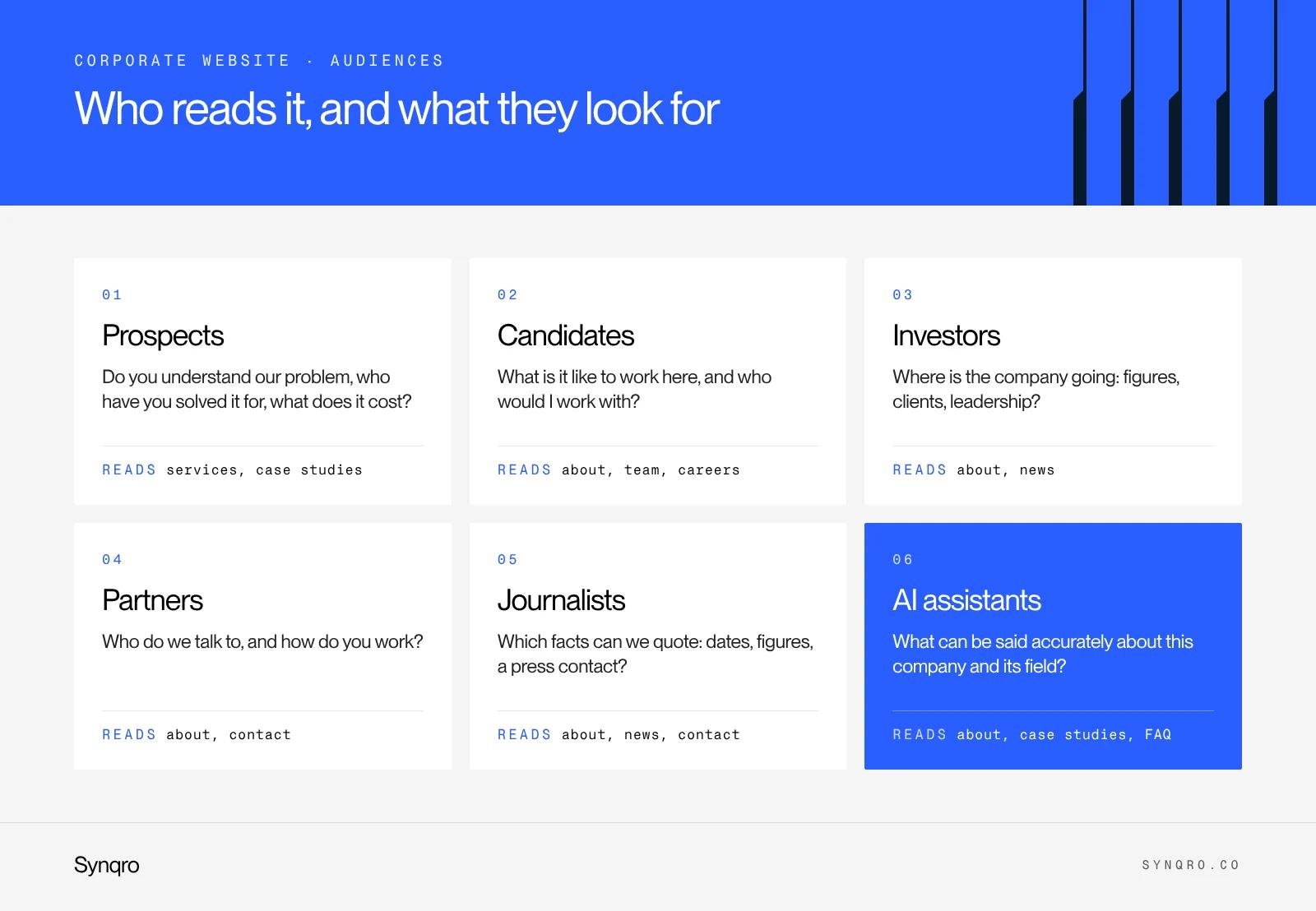
- Prospects want to know if you understand their problem, who you have done it for and how much it costs. They read the service pages and the case studies.
- Candidates want to know what working there is like. They read the about page, the team, the careers page and the tone of everything else.
- Investors and acquirers want the trajectory: figures, clients, leadership, press. They read the about page and the news.
- Partners and suppliers want to know who to contact and how you work.
- Journalists want facts they can quote: dates, figures, a press kit, a contact.
There is now a sixth reader: AI assistants. When someone asks ChatGPT, Gemini or Google's AI Mode "who does X in Paris" or "is company Y reliable", the answer is built from pages like yours. A corporate website with clear facts gives them something accurate to say.
Why a corporate website still matters in B2B
Most B2B buyers do their homework without you. Gartner's research on the B2B buying journey found that buyers spend only 17% of their buying time meeting potential suppliers, split across every supplier they consider. The rest goes to research, a large part of it online (Gartner).
6sense's 2024 Buyer Experience Report goes further: buyers are nearly 70% through their process before they engage a seller, they make first contact themselves 80% of the time, and 81% already have a preferred vendor at that point (6sense, via Business Wire).
Put simply: by the time a prospect fills in your form, your website has already argued your case, well or badly. That is why we treat a corporate site as a sales tool, not a business card.
The 9 pages every corporate website needs
A corporate site does not need to be big. It needs these nine pages to be good. Everything else is optional.
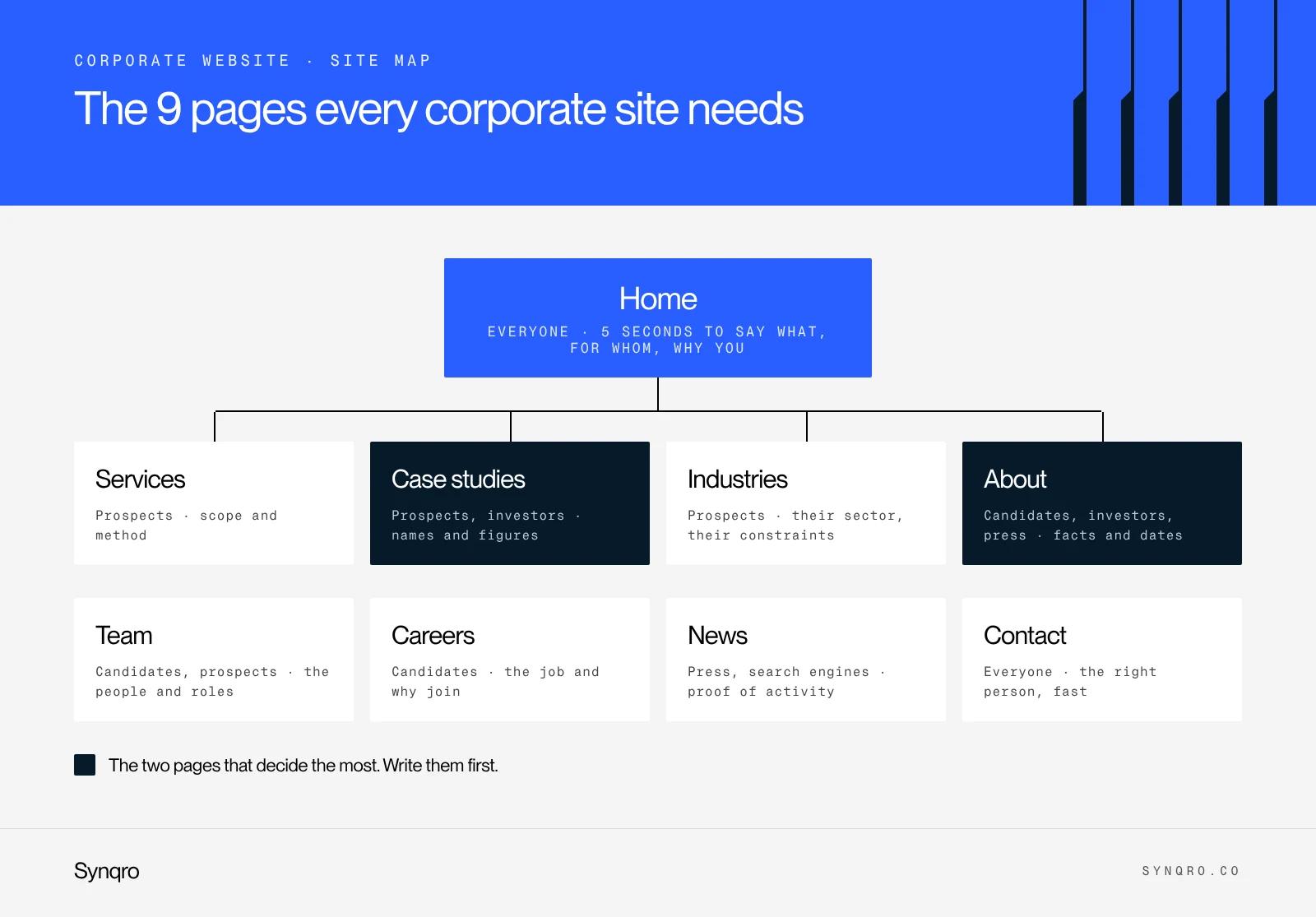
| Page | Who it serves | What it must prove |
|---|---|---|
| Home | Everyone | What you do, for whom, and why you, in five seconds |
| Services or solutions | Prospects | How you solve a specific problem, with the scope and the method |
| Case studies | Prospects, investors | That you have done it before, with names and figures |
| Industries | Prospects | That you know their sector and its constraints |
| About | Candidates, investors, press | Your story, your leadership, your figures and dates |
| Team or leadership | Candidates, prospects | The people behind the work, with their roles |
| Careers | Candidates | What the job is and why join |
| News or insights | Press, prospects, search engines | That the company is active and knows its subject |
| Contact | Everyone | How to reach the right person, quickly |
Two pages decide more than the others. The case studies, because they are the only page where you show instead of tell. And the about page, because it is the one candidates, investors, journalists and AI assistants all read to describe you. Most companies write it last, in a hurry. Write it first.
Add the legal pages your market requires (legal notice, privacy policy, cookie settings) and, if you sell abroad, one version per language with its own URLs.
What separates a good corporate website from a dull one
After more than 150 sites delivered since 2019, these are the six rules we apply on every corporate project.
- Lead with what sells. The site should open on the activity that brings in revenue, even if the company does other things. At Circul'R, consulting drove most of the revenue but the brand was seen as a business club. We put consulting first and the club in support.
- Proof over adjectives. "Innovative", "agile" and "trusted partner" convince nobody. A named client, a dated figure and a screenshot do.
- One page per audience question. If candidates have to read your service pages to find out what working with you is like, you are losing them.
- Tone of voice is part of the design. A corporate tone does not mean a stiff one. It means the vocabulary of the people you want to convince.
- Built so the team can run it. A corporate site lives for years. If every new case study needs a developer, it stops being updated within six months. We build on a CMS the marketing team can edit, and we train them at delivery.
- Ready for search and AI from day one. Clean structure, one topic per page, facts written in full sentences. This is what lets Google and AI assistants describe you correctly.
Corporate website examples: four B2B projects we built
Rather than another list of famous sites, here are four corporate websites we worked on, what the brief was and what changed. Each one is documented in full on our work page.
Circul'R: putting consulting at the heart of the site. Circul'R helps companies move to circular models. We redesigned the brand, rebuilt the hierarchy of the offer around consulting, designed the conversion journeys and an SEO and GEO strategy meant to become its first acquisition channel, then developed the whole site. The team was trained and runs it on its own. Qualified leads came in soon after launch.
BMA: one group, two subsidiaries. BMA is a design-and-build contractor founded in 2006 with teams in Paris and Portugal. After a new identity in 2025, we redesigned the websites of both subsidiaries, from design to development. The site earned an Honorable Mention at the Awwwards. The lesson: a group site has to make the structure obvious without making the visitor work for it.
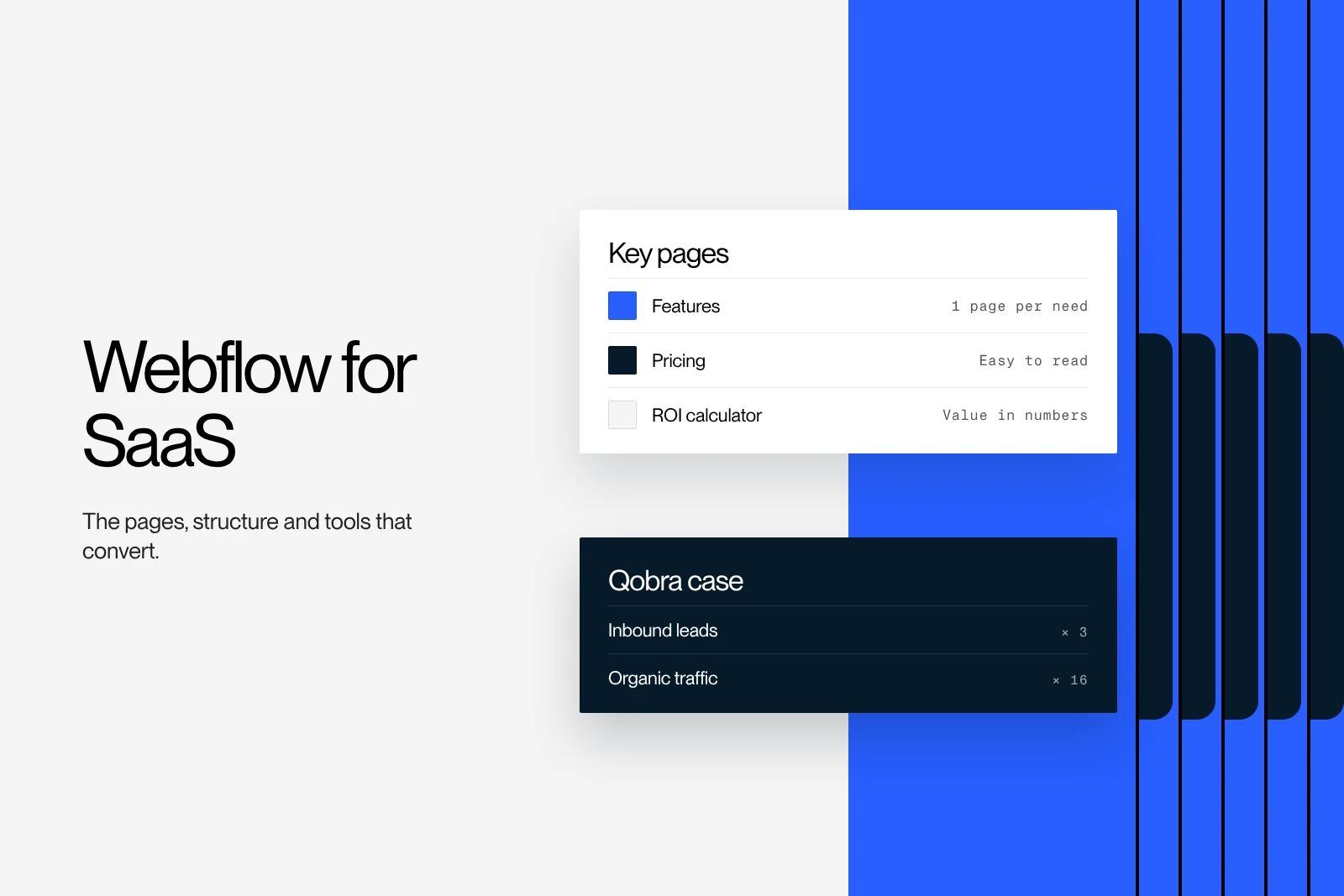
Qobra: a corporate site that keeps up with fundraising. Qobra automates sales commission management. We built its Webflow site for a rebrand at a key moment of its fundraising, then kept working on it for two years: an ROI calculator, funnels for each new audience, a funnel for its AI features in 2026. Inbound leads were multiplied by three and organic traffic by sixteen.
Diametral: a new name, a new position. Formerly LittleBigCode, Diametral moved from data expertise to AI-native performance for large organisations. Brand, website and marketing strategy were rebuilt together so the new positioning reads the same everywhere, in a market where the buyers are enterprise leaders.
What these four have in common: the site was briefed as a business tool, the brand work came before or with the site, and the client's team kept it alive after launch.
How much does a corporate website cost?
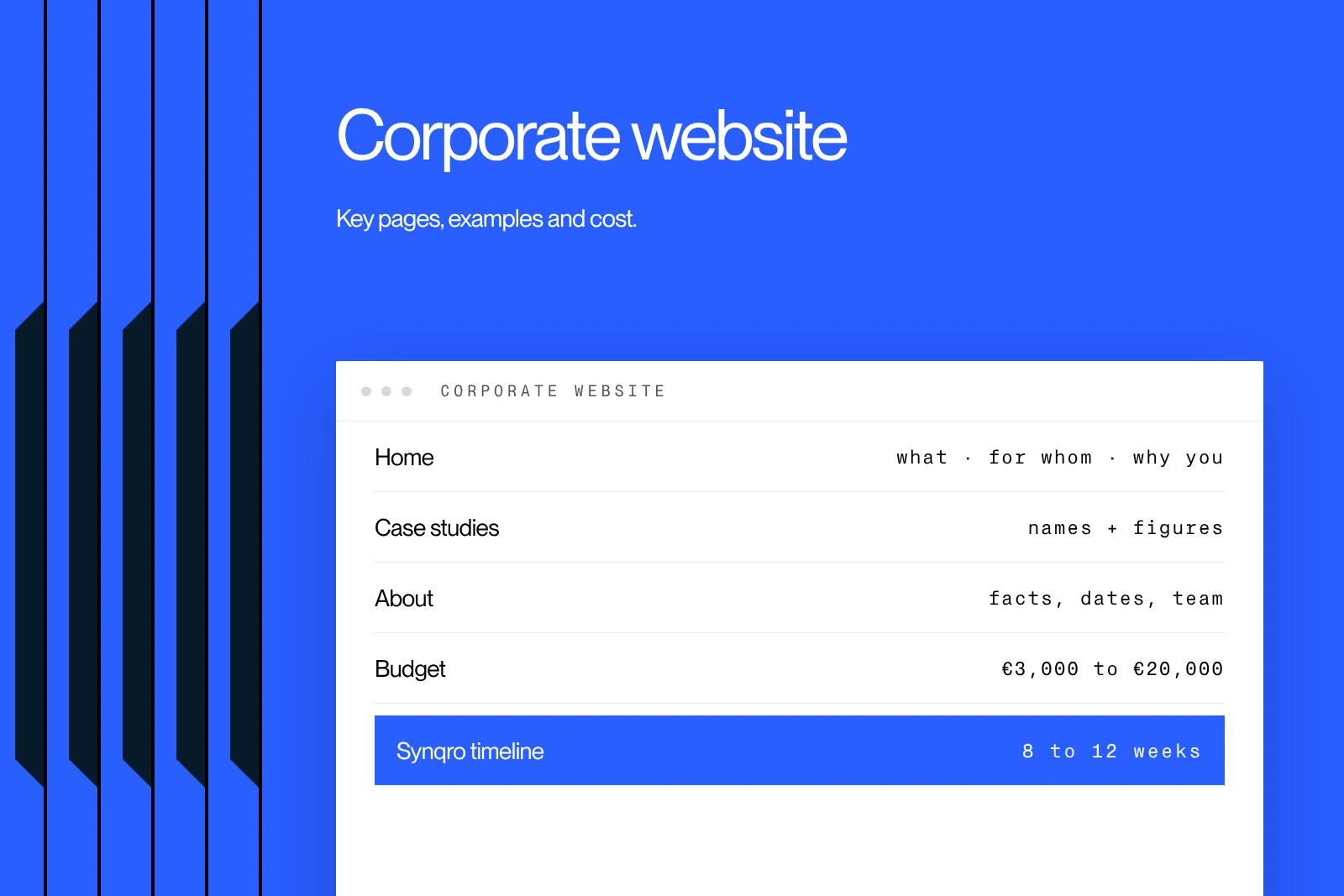
A corporate website built by an agency costs between €3,000 and €20,000 excluding VAT at Synqro. The range depends on three things: the number of page templates, whether the brand needs work first, and the number of languages.
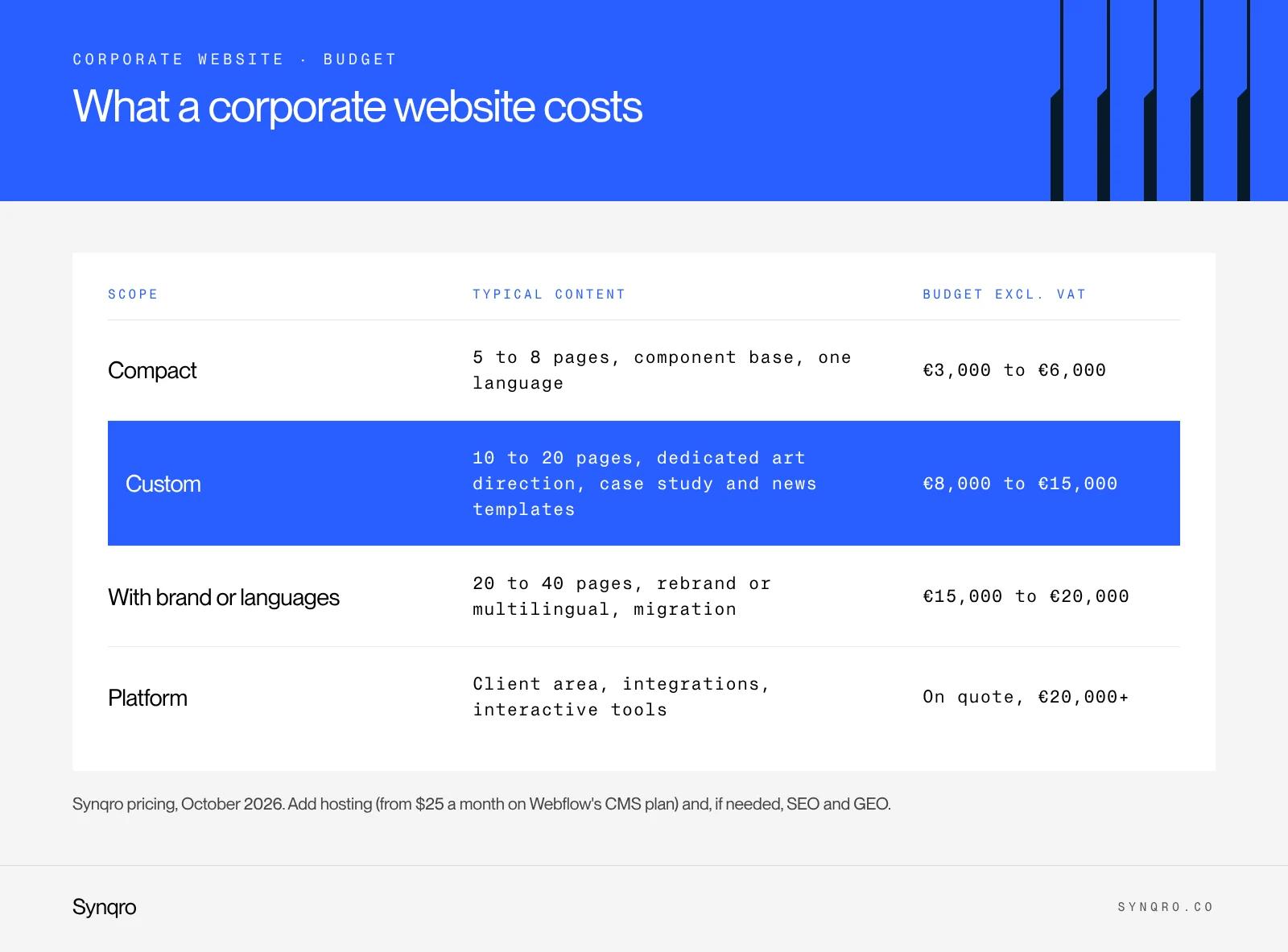
| Scope | Typical content | Budget (excl. VAT) |
|---|---|---|
| Compact corporate site | 5 to 8 pages on an existing component base, one language | €3,000 to €6,000 |
| Custom corporate site | 10 to 20 pages, dedicated art direction, case study and news templates | €8,000 to €15,000 |
| Corporate site with brand work or several languages | 20 to 40 pages, rebrand or multilingual, migration from an old site | €15,000 to €20,000 |
| Platform | Client area, business integrations, interactive tools | On quote, above €20,000 |
Running costs come on top. On Webflow, the CMS site plan costs $25 a month billed yearly (Webflow pricing), hosting and security included. If you want the site to bring in leads through search, plan for an SEO and GEO budget, which at Synqro runs from €1,000 to €5,000 a month.
A freelancer will usually quote €1,000 to €5,000 for a smaller site with a defined scope. It is a good option when you supply the content and the brief is clear. Our brochure website cost guide, linked above, breaks down these quotes line by line.
How long does it take to build?
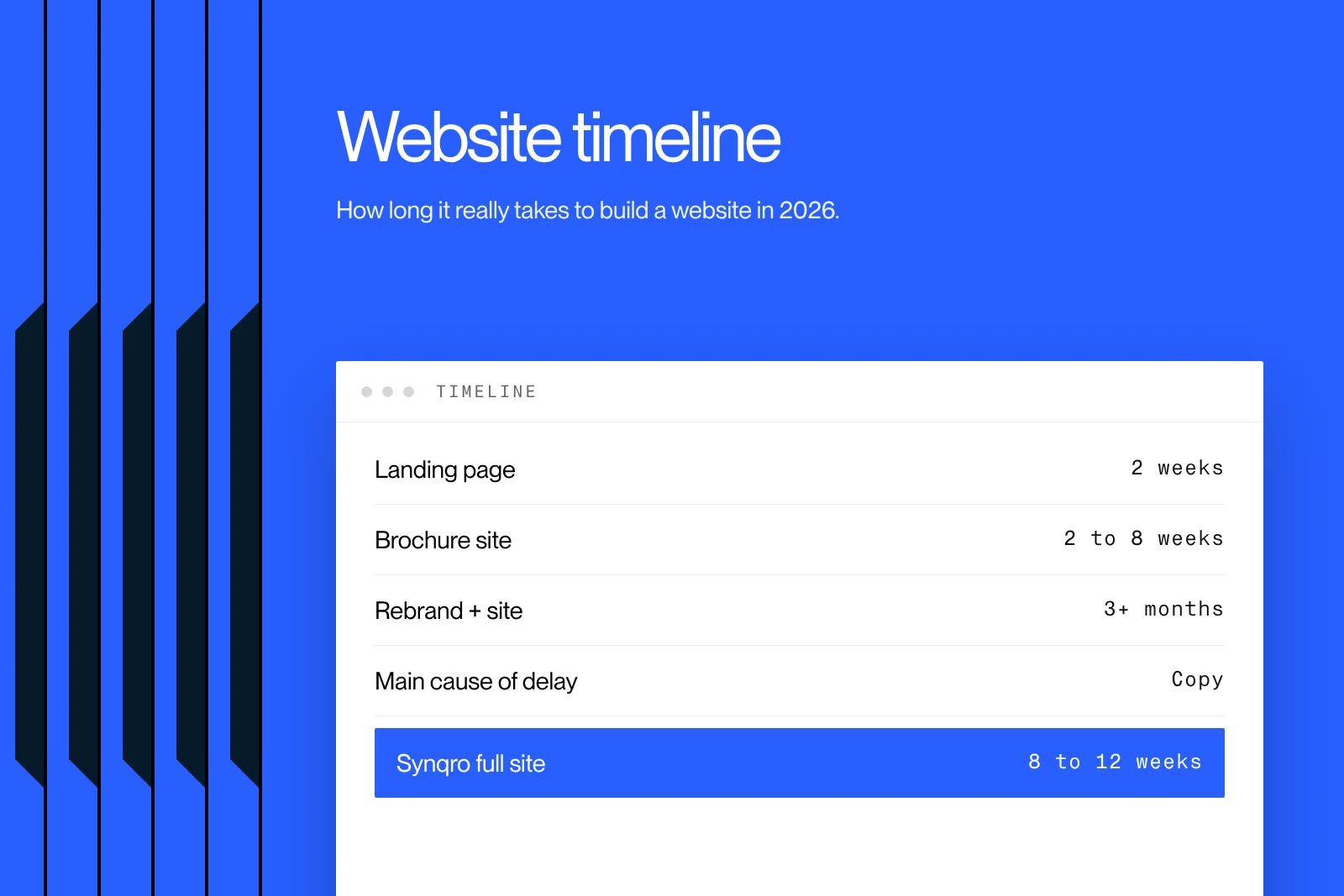
At Synqro, a full corporate website takes 8 to 12 weeks, and a landing page 2 weeks. If the brand has to be redesigned first, count three months or more, because the site is designed once the identity is set.
The schedule rarely slips on design or development. It slips on content and approvals: case studies waiting for a client's green light, team photos, legal pages. Plan those in week one. Our article on how long it takes to build a website details each step.
A clear brief saves weeks. Our website brief template lists the sections to fill in before asking for quotes.
Corporate websites, SEO and AI answers
A corporate website ranks first on your brand name. That is not enough. Its service and case study pages should also appear when buyers search for the problem you solve, before they know your name.
The same pages now feed AI answers. Google states that its AI features, AI Overviews and AI Mode, draw on the same index and ranking systems as classic search (Google Search Central). There is no special markup to add. What helps is what helps search: indexable pages, one topic per page, and facts stated plainly.
Three things we check on every corporate site:
- The same company description everywhere: site, Google Business Profile, LinkedIn, directories. AI assistants trust what they find repeated.
- An about page full of facts: founding date, locations, number of clients, leadership, key figures.
- Case studies with numbers: they are the pages most likely to be quoted when someone asks "who has done this before?".
If visibility in AI assistants is a goal, our GEO agency page explains how we approach it.
Which platform for a corporate website?
Three options cover almost every case. A CMS like Webflow suits most corporate sites: marketing can edit pages without a developer, and hosting is managed. WordPress suits teams with an in-house developer or very specific plugin needs. A headless setup suits large multilingual sites with a dedicated tech team. Our Webflow vs WordPress comparison goes into the details.
Large companies use Webflow too, which surprises some buyers. We looked at who and why in do large companies use Webflow?.
How Synqro builds corporate websites
We start with a scoping workshop: audiences, offer hierarchy, proof available, search queries. Then come the site map and content, design in components in Figma, development, acceptance testing, and training for your team. If the brand needs work first, our branding agency handles the identity and the guidelines before the site. As a Webflow agency and Webflow Premium Partner, we build and migrate the site, then hand it over so your team runs it.
Our team is based in Dubai and works in English and French with companies in France, the UAE and elsewhere. We have 51 Google reviews at 5.0 out of 5 as of October 2026.
Frequently asked questions
A corporate website is the official website a company publishes to present the whole organisation: its business, offer, references, team and contacts. It addresses several audiences at once, mainly prospects, candidates, investors, partners and the press.