Article
B2B website redesign: choosing the agency, costs and timeline
Webflow12 min read

James BrunettoCo-fondateur & CEO
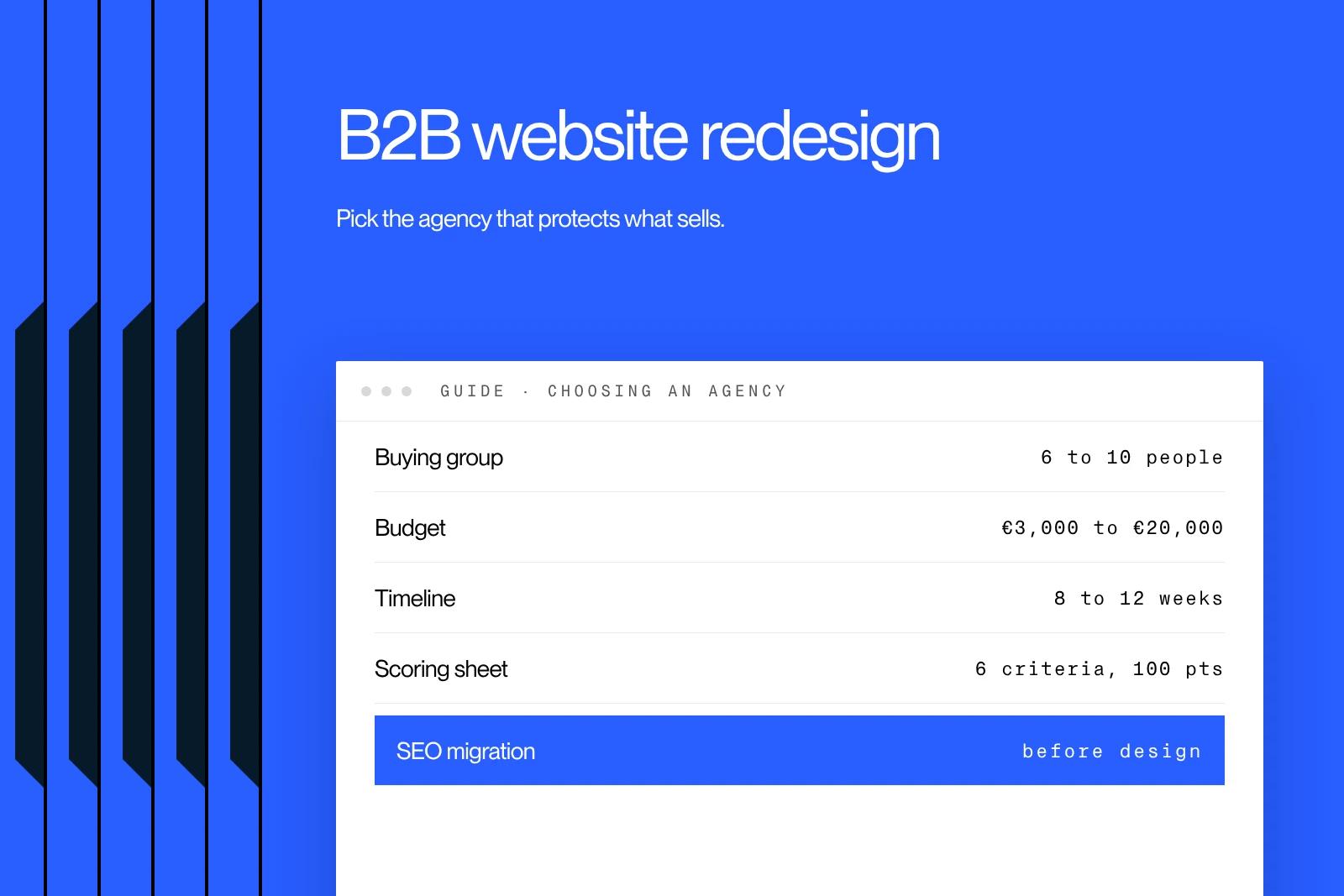
For a B2B website redesign, pick the agency that can show comparable B2B redesigns with measured results, writes its SEO migration plan before the first mock-up, and commits to a fixed price. Portfolio style comes second. A B2B site sells while your team is out of the room: it has to convince a whole buying group over a sales cycle of several months, without breaking the pages that already bring in enquiries. This guide covers the criteria that matter, the questions to ask on a first call, a scoring sheet for proposals, the red flags, and what a B2B redesign costs in money and in weeks.
Explore this post with…
In short: judge a B2B website redesign partner on three things: comparable B2B proof, an SEO migration plan written before design starts, and a fixed price before the mock-up. Score each proposal out of 100 instead of choosing on gut feel. Budget €3,000 to €20,000 excluding VAT and 8 to 12 weeks for a full site with an agency such as Synqro. The project steps themselves are covered in our 11-step website redesign guide.
What makes a B2B website redesign different
A B2B website redesign is the rebuild of a site whose visitors buy on behalf of a company. They compare, get sign-off, come back several times and rarely decide alone. That is what separates it from a consumer redesign, and it is what your agency has to understand before drawing a single screen. For what the new site should contain, page by page, see our guide to B2B website design that converts.
Gartner puts numbers on it. A typical buying group for a complex B2B solution involves six to ten decision makers. Buyers spend only 17% of their buying journey meeting potential suppliers, across all suppliers combined. And 77% of B2B buyers describe their latest purchase as very complex or difficult (Gartner, checked October 2026).
In practice, your website does most of the selling for you. It has to answer readers who want different things:
- The executive sponsor looks for proof: who you have done this for, and what it changed.
- The future user wants to see how it works day to day.
- Finance wants a price range, a return on investment and terms.
- IT and procurement check security, integrations and compliance.
A site written for one of these people loses the others. So a B2B redesign starts with the hierarchy of the offer and one path per audience. The visual direction follows from those decisions.
Redesign, refresh or rebrand: what do you actually need?
Many redesign briefs are really a positioning problem, or just a design refresh. Getting this right first changes who you should hire and what you should pay.
| Symptom | What to change | Who to hire |
|---|---|---|
| The site looks dated but leads are steady | Visual refresh, same structure and URLs | Freelancer or small studio |
| Prospects misread what you sell | Offer hierarchy, messaging, structure | Agency covering strategy and content |
| The company has changed its name, market or positioning | Brand first, then the site | Agency covering brand and site, or two partners briefed together |
| Marketing cannot publish without a developer | CMS, component library, training | Agency specialised in your CMS |
| Organic traffic is the main source of leads | Everything above, plus a full SEO migration | Agency with documented migrations |
If two or more rows apply, you need a full redesign. That is the case this guide is written for.
Agency, freelancer or in-house team
A freelancer is fast and affordable for a visual refresh of a small, stable site. An in-house team knows the business but rarely has the time or every skill a redesign needs. Once the offer, the brand and SEO all move at once, an agency that covers the whole chain reduces back-and-forth between suppliers.
For most mid-sized B2B companies, the setup that works is an agency for the redesign, then the in-house marketing team taking over the site. That is why autonomy after launch is one of the six criteria below.
Six criteria for choosing a B2B redesign agency
Compare redesign proposals on six criteria. The first five can be checked against evidence. The sixth is the one most proposals leave out.
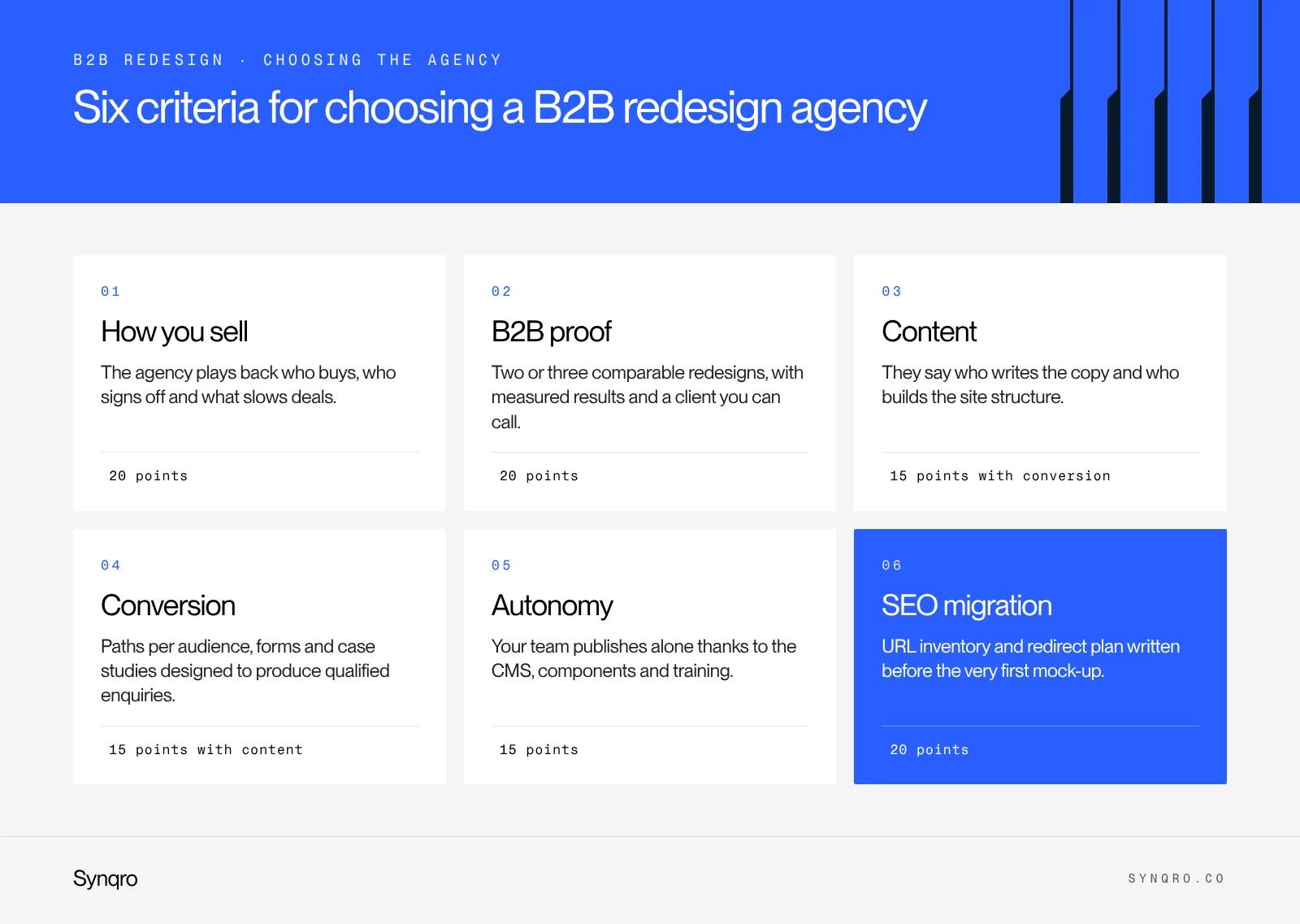
- They understand how you sell. The agency should play back who buys, who signs off and what slows deals down today. If the first meeting is about colour palettes, they have not reached your problem yet.
- Comparable B2B proof. Ask for two or three redesigns of B2B sites close to yours in size or sales cycle, with a measured result and a client you can call.
- Content ownership. Who writes the copy, who builds the site structure? A redesign where the agency waits for your copy in week six will slip.
- Conversion. Paths per audience, forms, case studies, booking a meeting: the site is judged on qualified enquiries, and the proposal should say how it will produce them.
- Autonomy after launch. Your team should be able to create a page, publish a case study or edit an offer without calling the agency. Ask for training and a component library.
- SEO migration of the pages that pay. The agency should inventory your URLs and the pages that receive traffic and links, then write a redirect plan before launch. This is the criterion that protects revenue.
Questions to ask on the first call
One hour is enough to shortlist, provided you ask the right questions. Write the answers down word for word: you will need them for the scoring sheet.
- Which comparable B2B redesigns have you delivered, and what happened in the six months after launch?
- Who writes the copy, and who signs off the offer hierarchy?
- How do you handle our existing URLs? Can you show me a redirect plan from a past project?
- Is the price fixed, and at what point in the project is it set?
- Who will be my contact, and who actually designs and builds the site?
- What will my team be able to change alone after launch?
- Who owns the site, the hosting account, the domain and the design files?
- What happens in the first month after launch?
Send every agency the same document before these calls. Our website brief template stops you comparing three answers to three different briefs.
A 100-point scoring sheet for redesign proposals
A scoring sheet turns an impression into a decision you can defend in front of your buying committee. Score each agency out of 100, first individually, then together, and look at where scores differ.
| Criterion | Weight | What you check |
|---|---|---|
| Understanding of your B2B sales | 20 | Audiences, buying group and objections played back accurately |
| Comparable B2B proof | 20 | Case studies with numbers, reachable references, live sites |
| SEO migration | 20 | URL inventory, redirect plan, monitoring after launch |
| Content and conversion | 15 | Who writes, paths per audience, forms, case studies |
| Autonomy after launch | 15 | CMS, training, reusable components, account ownership |
| Price, scope and schedule | 10 | Fixed price, listed deliverables, realistic timeline |
Price carries only 10 points out of 100, on purpose. The gap between two quotes is recovered within weeks if one site produces twice as many enquiries. A failed migration costs you for months.
One tip on method: have the sheet scored by two people who buy for different reasons, such as the head of marketing and the head of sales. The gaps between their scores often tell you more than the average.
Red flags in a redesign proposal
Some signals should make you slow down before signing. None is disqualifying on its own. Two together should be.
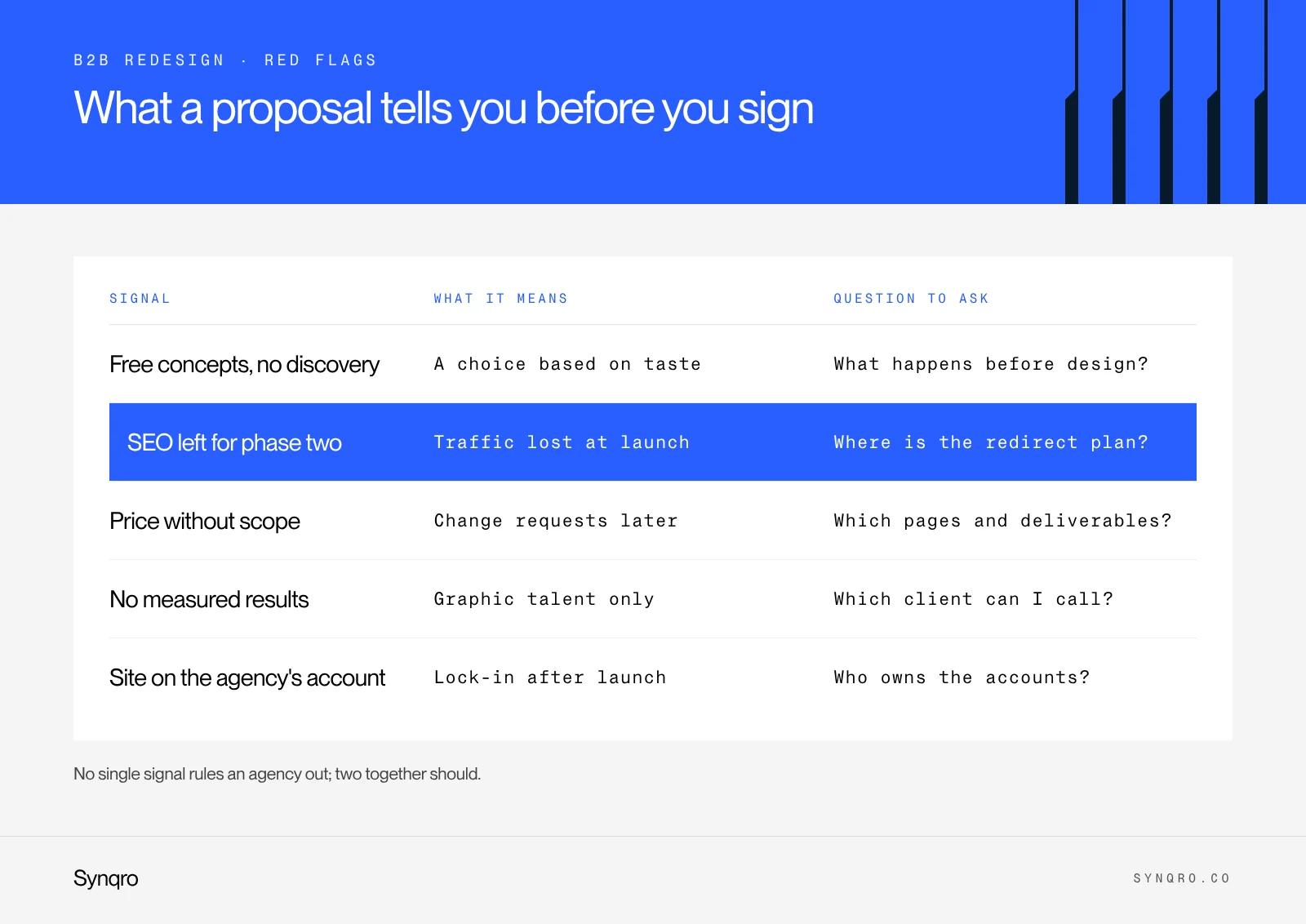
- Free design concepts before any discovery. A design drawn without knowing your offer or audiences is a sales tool. It pushes the decision towards taste and away from method.
- SEO pushed to "phase two". If the proposal mentions neither a URL inventory nor redirects, the migration will be skipped, or improvised on launch day.
- A price without a scope. A flat fee with no list of pages, templates and deliverables ends in change requests.
- No measured results. A portfolio of beautiful screenshots without one number or client contact only proves graphic talent.
- The site hosted on the agency's account. You should own the site, the domain and the design files.
- A timeline that is too short. Four weeks for 30 pages with copy, case studies and a migration will either be met by cutting the migration, or missed.
What a B2B website redesign costs, and how long it takes
At Synqro, a full B2B website redesign costs €3,000 to €20,000 excluding VAT and takes 8 to 12 weeks, with a fixed price agreed before the mock-up. A standalone landing page takes 2 weeks. These ranges were checked in October 2026.
| What moves the budget | Lower end | Upper end |
|---|---|---|
| Brand | Existing identity kept | Rebrand run alongside the site |
| Size | A few pages, one audience | Several offers, pages per audience and sector |
| Content | Copy supplied and approved | Copy, case studies and structure written by the agency |
| Languages | One language | Multilingual site |
| Migration | Few URLs, little organic traffic | Hundreds of URLs, a blog and ranking pages |
| Features | Standard forms | Calculator, rich CMS, CRM integrations |
The timeline depends less on the agency than on your approvals. In a B2B project, each stage goes through several people. Decide who approves what during the kick-off workshop, or 8 weeks become 16. For a broader view of prices by type of site, see our guide to how much a website costs.
Our method always follows the same order: a scoping workshop, site structure and copy, a design system in Figma, the Webflow build, testing, then training for your marketing team. The price is set before the mock-up and only changes if the scope does.
Protect the pages that already pay
The migration is where a redesign can lose in a day what the site took years to earn. On a B2B site, a handful of pages often bring most of the enquiries: a well-ranked service page, two or three articles that rank, a case study that gets shared.
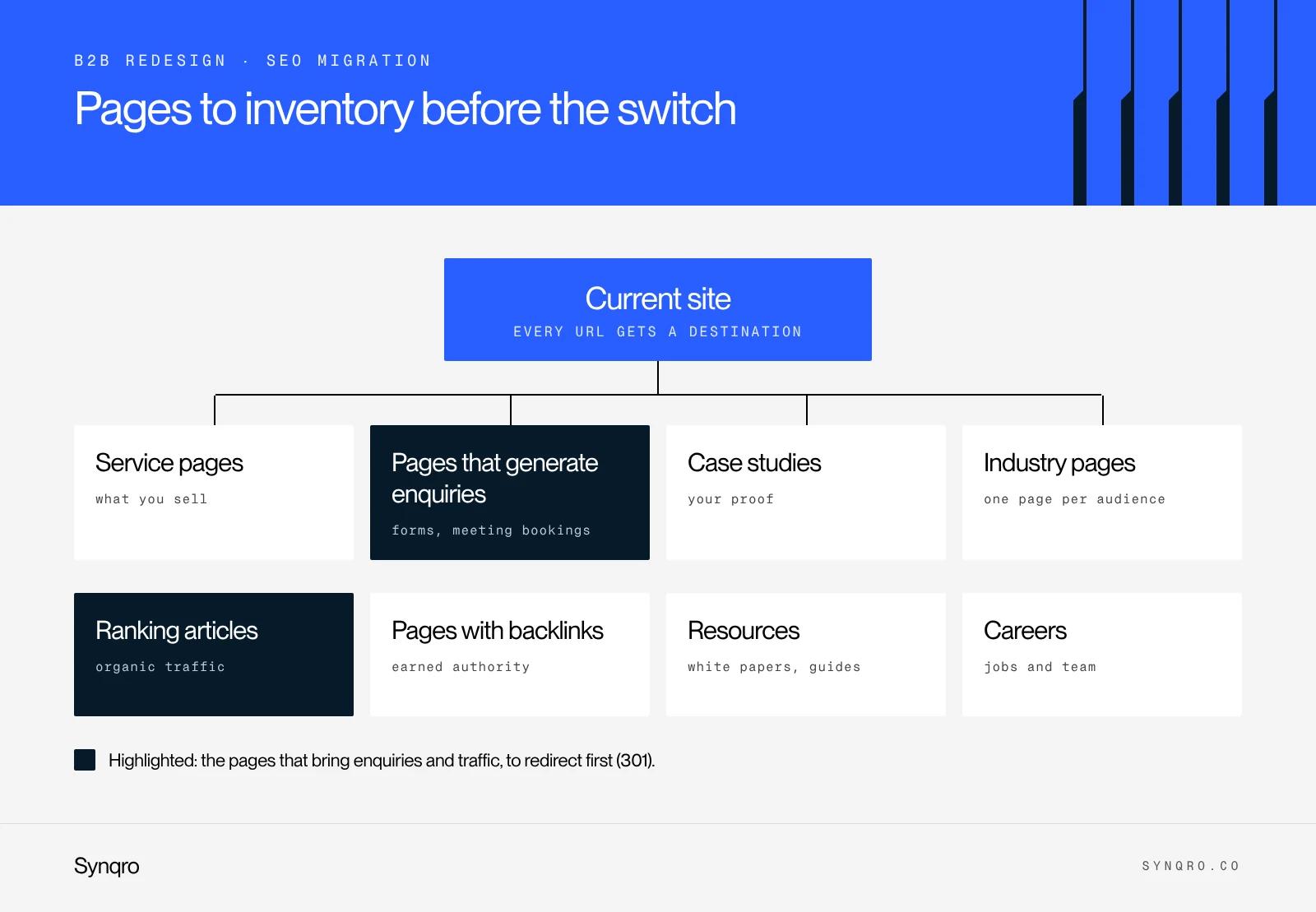
Google is explicit about the method. Its site move documentation says to map every old URL to its new URL before the move, use permanent redirects (301 or 308), and keep them for as long as possible, at least one year. Google also notes that on a medium-sized site it can take a few weeks or more for new URLs to replace the old ones, with ranking fluctuations in the meantime.
We applied this rule to ourselves. In October 2026, Synqro moved its own site from agence-synqro.fr to synqro.co, with 485 redirects written and tested before the switch. That is the level of detail to expect from your agency. Our Webflow migration guide covers the inventory, the mapping table and the checks after launch.
Four B2B redesigns and what changed
The best proof is a redesign whose aftermath you can see. Here are four B2B projects run by Synqro, and what was decided before design started.
Qobra: the redesign as a starting point. Qobra, a commission management SaaS, rebuilt its Webflow site to support its rebrand, created by the agency Bruno. The redesign was only the start. Two years of optimisation followed: an ROI calculator, funnels per audience and, in 2026, a dedicated funnel for its AI features. Enquiries tripled and organic traffic grew sixteenfold. The details are in the Qobra case study.
Circul'R: the offer put back in the right order. Circul'R, a circular economy specialist, was seen as a business club when its core activity is consulting. The redesign rebuilt the Circul'R offer hierarchy around consulting, with a new identity, conversion paths and an SEO and GEO strategy. Qualified leads came in shortly after launch. Sara Bonnet, Head of Communication, says the project helped Circul'R double its conversion rate.
Growth Opportunity: strategy before design. For this paid advertising agency, the SEO and CRO strategy was set before the first mock-up. The brand was then modernised and the site built on Webflow. The team has since extended the site to new offers on its own. Growth Opportunity has doubled its revenue since relaunching the site (see the Growth Opportunity project).
BMA: two subsidiaries, two sites. BMA, a design-and-build contractor founded in 2006 with teams in Paris and Portugal, adopted a new identity in 2025. Synqro designed and developed the websites of BMA's two subsidiaries, a project that earned an Awwwards honourable mention.
Which agency should you choose for a B2B website redesign?
The right agency for a B2B website redesign is the one that scores highest on your sheet. The portfolio you like best is one input among six. In practice, shortlist the agency that ticks four boxes: comparable B2B redesigns with measured results, an SEO migration plan written before design, a fixed price before the mock-up, and a marketing team able to run the site alone at the end.
Talk to three agencies, no more. Beyond that, you spend more time comparing than deciding, and the strongest agencies are less keen to answer very wide tenders.
Synqro is a Webflow agency and a Webflow Premium Partner, the highest level of Webflow's partner programme. Since 2019, the team has worked with more than 150 companies, B2B and consumer brands alike, from naming and branding to the website, acquisition (SEO, GEO, paid search) and team training. Synqro holds 52 Google reviews with a 5.0 out of 5 rating (October 2026) and three Awwwards honourable mentions, and ranked second in Mekaa's 2026 comparison of the best branding agencies in France. The team is based in Dubai, with a presence in Downtown Dubai and Dubai Creek Harbour, and works with clients by video call or on site.
If your question is mostly about method, start with our website redesign guide in 11 steps. It covers the audit, site structure, design and launch, step by step.
Frequently asked questions
At Synqro, a full B2B website redesign costs €3,000 to €20,000 excluding VAT depending on size, copy to write, languages and the number of URLs to migrate, with a fixed price agreed before the mock-up.