Article
B2B website design: what makes a B2B site convert
Webflow13 min read

James BrunettoCo-fondateur & CEO
B2B website design is the work of planning, writing and building a website that turns business visitors into qualified enquiries: demo requests, quotes and sales meetings. A B2B website converts when it answers every member of the buying group on its own, with offer pages framed around problems, case studies with numbers, a price or a price range, and a call to action for each level of intent. Below: sourced benchmarks, the pages and settings that matter, GA4 tracking, and four B2B websites we built or optimised.
Explore this post with…
In short: B2B buyers make most of their decision before they speak to you, and 6sense found that 81% already have a preferred vendor at first contact. Your website therefore has to answer each member of the buying group without a salesperson in the room. The pages that carry the most weight are problem-led offer pages, case studies with numbers, pricing and comparisons. Each page needs a call to action matched to the reader's intent, and every enquiry should be tracked through to your CRM. At Synqro, this work tripled Qobra's inbound requests and doubled Morning's conversion rate.
What is B2B website design?
A B2B website is the website of a company that sells to other companies. The phrase covers two very different things. A B2B ecommerce site takes orders online, with catalogues and customer-specific prices. A lead generation website, the most common kind in software, consulting, services and industry, produces demos, quotes and meetings that the sales team turns into contracts.
This guide covers the second. The core pages every company site needs are covered in our guide to the corporate website. Here we focus on what makes a business visitor raise their hand.
A conversion-focused B2B website is judged on one number: how many qualified enquiries it brings in each month, and what happens to them in the pipeline. Traffic and visual polish matter only when they serve that number.
B2B vs B2C website design: what changes
The basics of good design apply to both. What changes is who decides, how long it takes and what the visitor needs before acting.
| Factor | B2B website | B2C website |
|---|---|---|
| Who decides | A buying group of several people | One person, sometimes two |
| Buying cycle | Months | Minutes to days |
| Main conversion | Demo, quote, meeting | Purchase |
| What persuades | Case studies, numbers, integrations, risk | Product, price, delivery, reviews |
| Pricing | Often a range or tiers | Displayed and fixed |
| Success metric | Qualified enquiries and pipeline | Revenue per visit |
The consequence for design: a B2B page has to be easy to forward. The person who finds you rarely signs alone.
Why the website does most of the selling
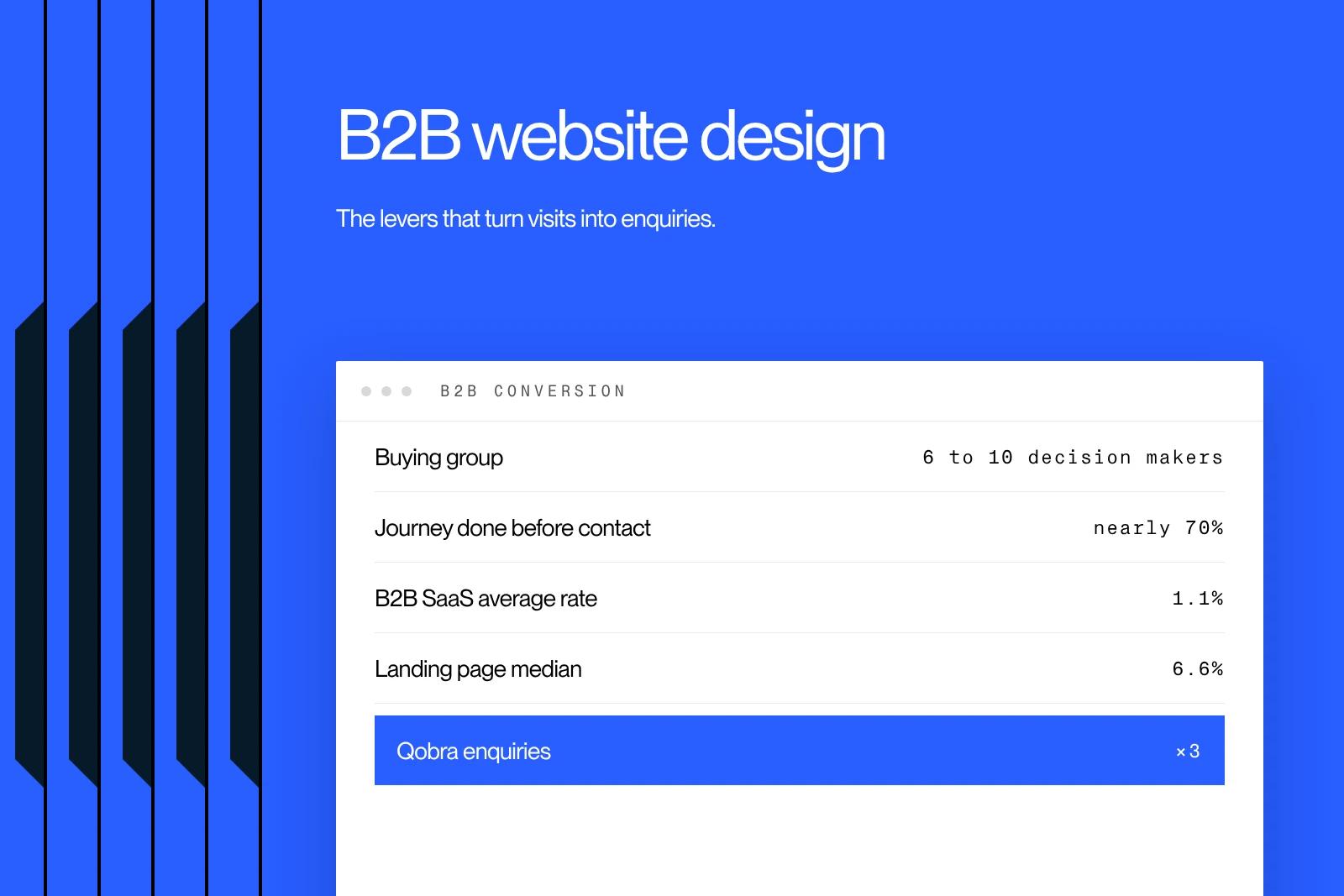
Gartner reports that a typical buying group for a complex B2B solution involves six to ten decision makers, each arriving with four or five pieces of information found on their own. Buyers spend only 17% of their purchase time meeting potential suppliers, across all the suppliers they compare, and 77% describe their latest purchase as very complex or difficult (Gartner).
The 6sense 2024 Buyer Experience Report shows when you enter the picture. Buyers are nearly 70% through their purchasing process before engaging with sellers, they initiate first contact more than 80% of the time, and 81% already have a preferred vendor by then. The average buying group has 11 people (6sense, via Business Wire).
Your contact form sits at the end of that journey. Everything before it happens on your pages, read by people you have not met yet. A B2B website that converts helps your future customer sell you internally.
What is a good conversion rate for a B2B website?
There is no universal rate, because every company counts a conversion differently. Two public benchmarks help.
First Page Sage, a US SEO agency, publishes the average share of visitors who complete a conversion action on its clients' sites between January 2022 and August 2025. It ranges from 1.1% for B2B SaaS to 2.2% for manufacturing, with 7.4% for legal services (First Page Sage, checked October 2026). Unbounce's 2024 report, based on more than 41,000 landing pages and 57 million conversions, puts the median landing page conversion rate at 6.6% across all industries (Unbounce).
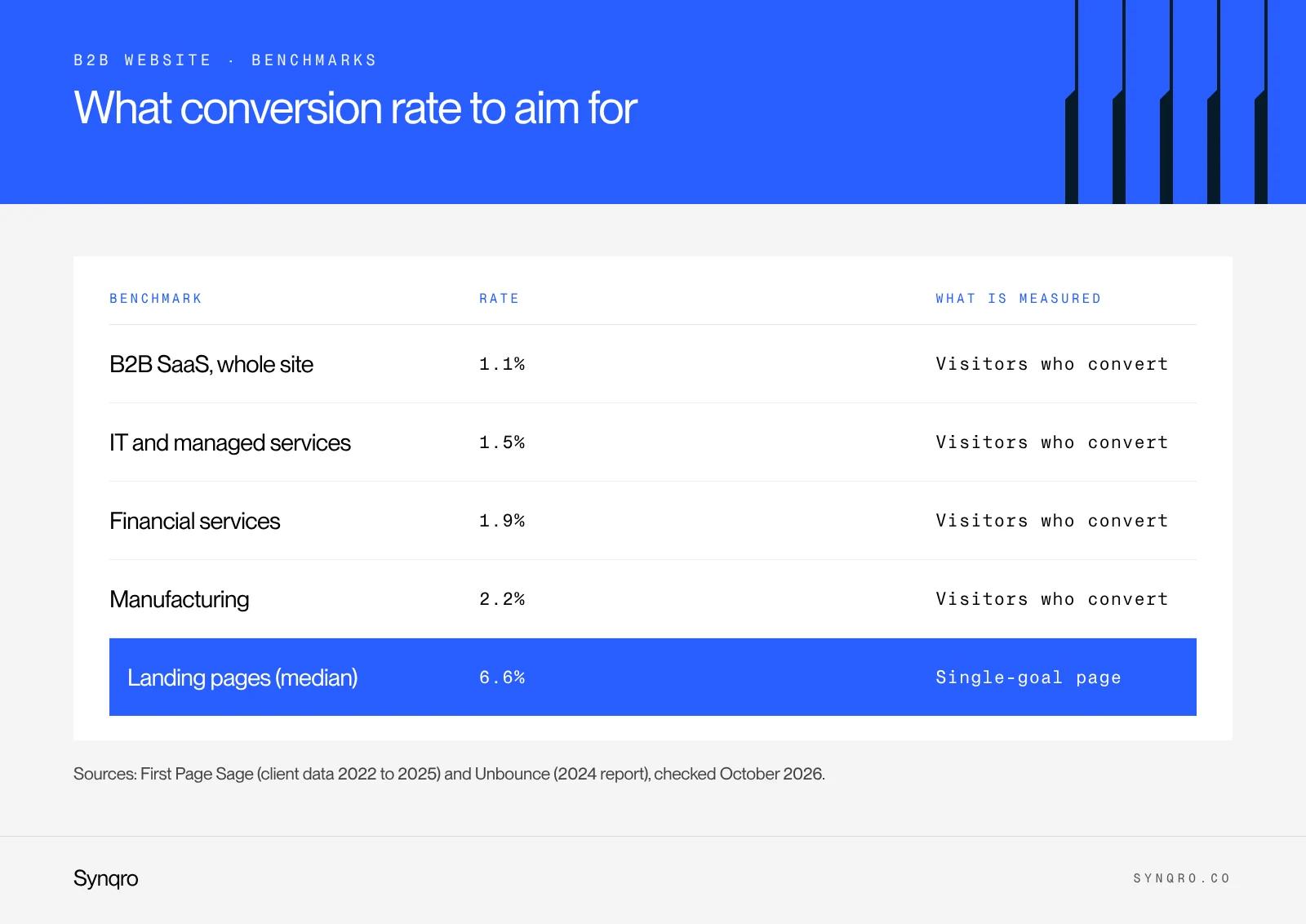
| Benchmark | Rate | What is measured |
|---|---|---|
| B2B SaaS, whole site | 1.1% | Visitors who complete a conversion action |
| IT and managed services, whole site | 1.5% | Visitors who complete a conversion action |
| Financial services, whole site | 1.9% | Visitors who complete a conversion action |
| Manufacturing, whole site | 2.2% | Visitors who complete a conversion action |
| Landing pages, all industries (median) | 6.6% | Visitors to a single-goal page who convert |
The gap makes sense. A landing page gets targeted traffic and offers one action. A whole site also gets job seekers, existing clients, competitors and the curious.
Our advice: benchmark against yourself. Track the qualified enquiry rate by key page and by traffic source, quarter after quarter. A site converting at 1% that books three useful meetings a week beats a site at 4% that fills the CRM with students and link sellers.
Design for the whole buying group
The most common flaw on a B2B website is a single voice written for a single imaginary reader. In practice, each member of the buying group arrives with their own question. If the answer is not on your site, your contact has to supply it in a meeting you are not invited to.
| Buying group member | Their question | The page that answers |
|---|---|---|
| End user | Will this make my job easier? | Features, video demo, trial |
| Team lead | What does my team gain, and how fast? | Problem-led offer page, case studies |
| Finance | What does it cost, and when does it pay back? | Pricing, ROI calculator |
| IT or security | Is it compatible and compliant? | Integrations, security, GDPR |
| Leadership | Why them and not someone else? | Comparisons, clients, about |
| Procurement | What terms, what contract? | Commercial FAQ, terms, contact |
The reader who matters most is your internal champion: the person who found you and now has to convince everyone else. Give them pages they can forward as they are. For Qobra, we built an ROI calculator that turns a product promise into a figure a sales leader can take to their CFO.
The pages that make a B2B website convert
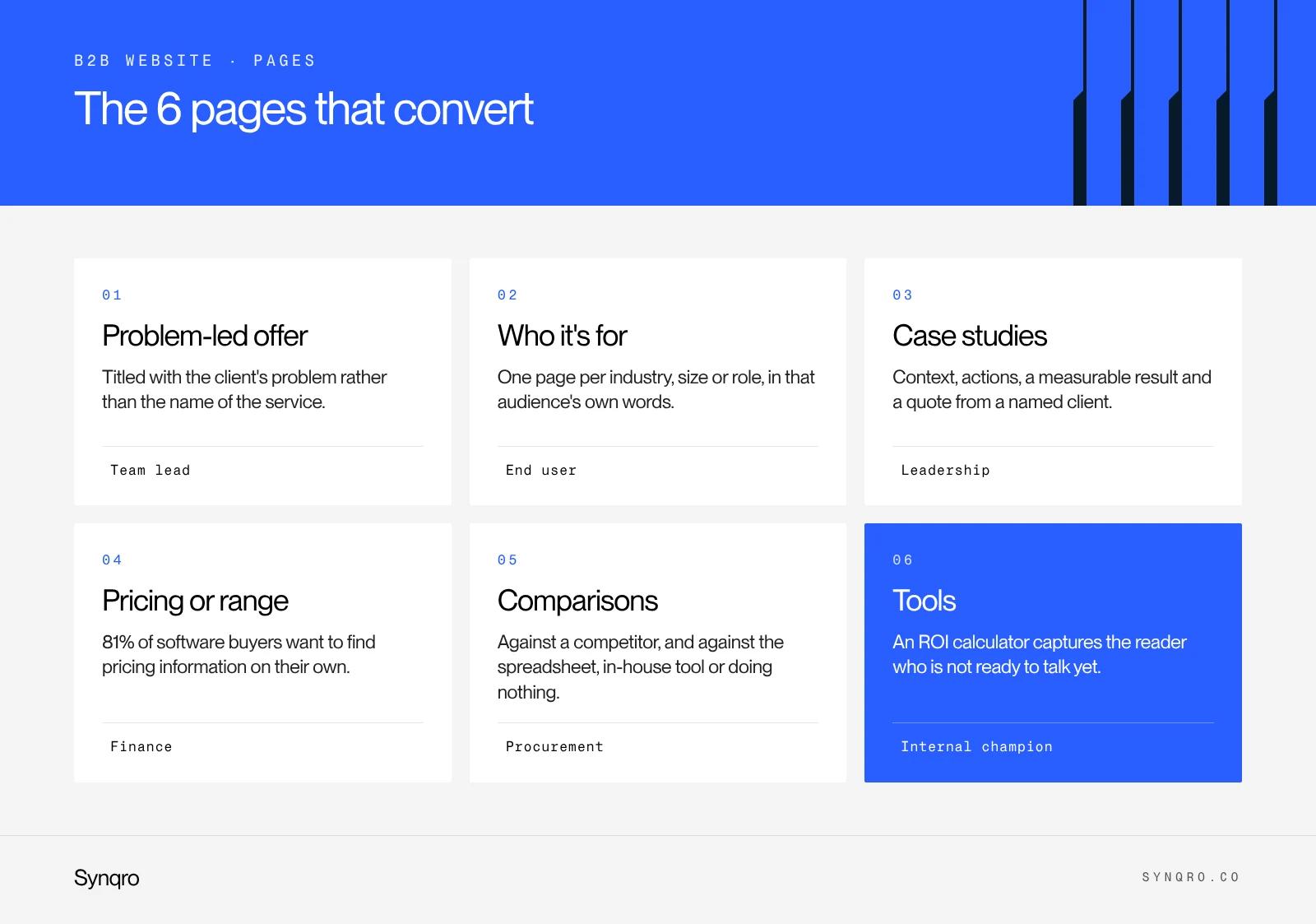
The homepage points people in the right direction. The enquiry is decided elsewhere, on six types of pages that are often missing or thin.
- Problem-led offer pages. Title the page with the client's problem rather than the name of your service.
- "Who it's for" pages. One page per industry, company size or role, in that audience's vocabulary. When Qobra opened up to a new audience, we designed dedicated funnels for it.
- Case studies with numbers. Context, actions, measurable result, named quote.
- Pricing or a price range. In its 2022 research among software buyers, TrustRadius found that 81% of buyers want to find pricing information on their own (TrustRadius). A range is enough to qualify: we publish ours, €3,000 to €20,000 excluding VAT for a website.
- Comparison pages. Against a competitor, and against the real alternative: the spreadsheet, the in-house tool, doing nothing.
- Tools. Calculators, simulators and diagnostics capture the reader who is not ready to talk to sales.
How you rank your offers matters as much as the pages themselves. Circul'R was often seen as a business club, although consulting generates most of its revenue. We reorganised its services around consulting, with the club in support, before drawing a single user journey.
Calls to action matched to buyer intent
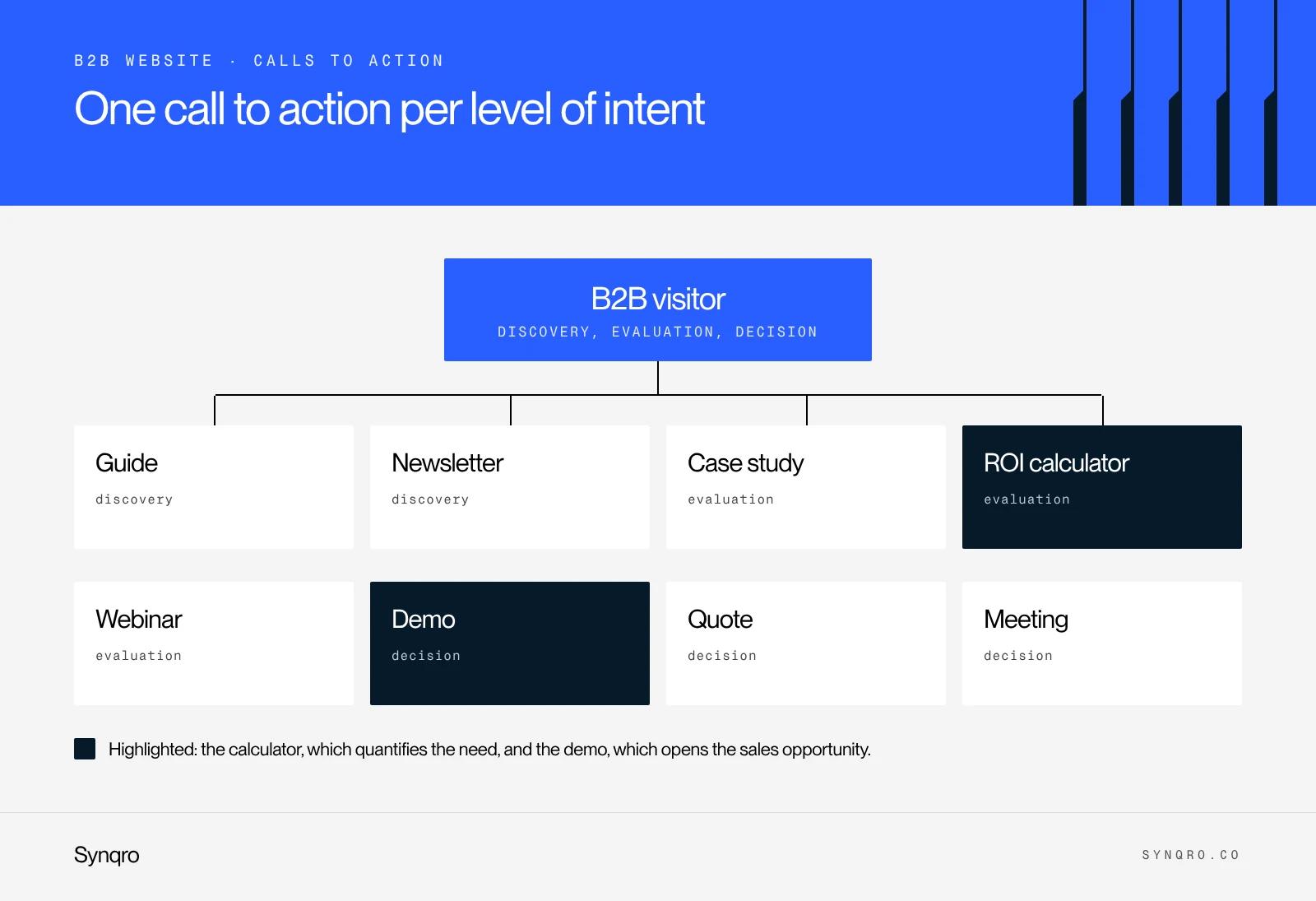
A single "Contact us" button speaks only to visitors who have already decided. Everyone else leaves without a trace. Offer an action for each stage of the journey.
| Intent | What the visitor reads | Call to action | What you get |
|---|---|---|---|
| Discovery | Article, guide, page found via Google or an AI assistant | Guide, checklist, newsletter | A contact to nurture |
| Evaluation | Case studies, offer, comparison | Calculator, case study, webinar | A quantified need |
| Decision | Pricing, integrations, security | Demo, quote, meeting | A sales opportunity |
| Existing client | Login, support | Client area, support | Nothing to count as a lead |
The rules we apply on every project:
- One primary call to action visible at the top of every decision page, with a specific verb ("See a 20-minute demo" rather than "Learn more").
- Short forms: every field should help qualify or route the enquiry.
- Direct booking into a salesperson's calendar for warm enquiries, and a thank-you page that offers the next step.
- On mobile, calls to action that never hide the content. At Morning, the audit looked closely at the sticky "Contact us" button on the mobile site.
Proof where the doubt appears
A wall of logos at the bottom of the homepage answers no objection. Put client logos at the top of offer pages, a number next to every promise, a named testimonial beside the form, and verifiable reviews on pricing and contact pages. On our own site, our 52 Google reviews (rated 5.0 out of 5 in October 2026) and our Webflow Premium Partner status appear where a prospect wonders whether we are serious.
Speed is a conversion setting
Slow pages cost enquiries, and this has been measured. Portent studied 20 websites, 14 of them B2B lead generation sites, across more than 27,000 landing pages. For B2B sites, a page that loads in 1 second converts 3 times better than one that loads in 5 seconds, and 5 times better than one that loads in 10 seconds (Portent, 2022).
The usual culprits are heavy images, autoplay video and third-party scripts (chat, A/B testing tools, ad pixels) stacked up campaign after campaign. Audit your scripts every quarter. The thresholds to aim for are in our guide to Core Web Vitals.
Tracking conversions: GA4 key events and your CRM
In Google Analytics 4, the actions that matter to your business are now called key events, while "conversion" is kept for measuring ad campaigns (Google Analytics Help).
For lead generation, Google recommends three events that follow the whole funnel: generate_lead when a form is submitted, qualify_lead when the lead is qualified, and close_convert_lead when it becomes a customer (Google Analytics Help).
The setup, in order:
- List the actions that count: demo, quote, meeting, guide download, calculator use.
- Create one event per action, ideally through Google Tag Manager.
- Mark only the high-intent actions as key events.
- Pass the source of each enquiry (UTM parameters, landing page) to your CRM through hidden form fields.
- Feed qualification and closed deals back from the CRM, so you know which pages and sources produce customers.
A site that "converts well" in GA4 while none of its enquiries become clients does not convert. The link with the CRM is the piece most often missing.
Conversion optimisation never stops
The general method is explained in our guide to conversion rate optimisation. B2B has one specific constraint: traffic is often too low for reliable A/B tests. So you lean on other sources.
- Journey data: where visitors drop off, which pages come before an enquiry.
- Your sales team: the questions they hear in first meetings point to pages that are missing.
- Before and after comparisons on a whole journey, rather than button-by-button tests.
That is the method we followed with Morning in 2026: a data audit by journey, UX workshops with the team, critical journeys redesigned as wireframes before any screen, then development in weekly sessions. The work continues every month.
Four B2B websites we built to convert
| Client | Starting point | What we changed | Result |
|---|---|---|---|
| Qobra | New site to support a rebrand | ROI calculator, funnels by audience, AI feature funnel | Inbound requests ×3, organic traffic ×16 |
| Morning | Strong site outgrown by a wider offer | Audit, UX workshops, critical journeys redesigned | Conversion rate ×2 |
| Circul'R | Brand seen as a business club | Offer refocused on consulting, conversion journeys, SEO and GEO | Conversion rate doubled, per the client |
| Growth Opportunity | One-page site bringing no leads | SEO and CRO strategy set before design | Revenue doubled since the relaunch |
Qobra, a sales commission software company, asked us to build its Webflow site for its rebrand, with the brand designed by the agency Bruno. After two years of conversion work (landing pages, funnels by audience, an AI feature funnel in 2026), its inbound requests have tripled (see the Qobra project).
Morning, a workspace network, had a high-traffic site that its new products had outgrown. Optimising its most critical journeys doubled the conversion rate (the Morning project).
Circul'R, a circular economy consultancy, had an offer people misread. After we reworked the brand, the offer, the journeys and the site, qualified leads arrived soon after launch, and Sara Bonnet, Head of Communication, says the project doubled their conversion rate (the Circul'R project).
Growth Opportunity, a paid ads agency, had a one-page site. Its SEO and CRO strategies set the architecture before the first mock-up. The team has since extended the site on its own, and revenue has doubled since the relaunch.
Common B2B website design mistakes
- Talking about yourself before the client's problem.
- One call to action for everyone.
- Case studies with no numbers and no names.
- No price and no range.
- Twelve-field forms.
- Tracking that stops at the form: without CRM data, you optimise for clicks.
- A site frozen after launch, while the offer and audiences keep changing.
How much does a B2B website cost?
At Synqro, a full website costs €3,000 to €20,000 excluding VAT, depending on the number of pages, audiences and tools (calculator, simulator, CRM integration). It takes 8 to 12 weeks, with a fixed price agreed before the design stage. A campaign landing page takes 2 weeks; our benchmarks for that format are in our guide to the SaaS landing page. A wider breakdown is in our article on Webflow website cost.
SEO and GEO work costs €1,000 to €5,000 excluding VAT per month. Annual support, where our team acts as the client's outsourced tech, design and marketing team, as it does for Qobra and Morning, runs from €10,000 to €80,000 excluding VAT a year.
How to choose a partner for a conversion-focused B2B website
Five questions are enough to sort the shortlist: If you are replacing an existing site, our guide to choosing a B2B website redesign agency covers the scoring sheet and the red flags.
- Do they show conversion results with numbers and client names?
- Do they talk about your offer, audiences and journeys before design?
- Do they set up event tracking and the link with your CRM, or stop at launch?
- Can your team publish a new page without a developer?
- Do they offer post-launch work (CRO, SEO, GEO) with measurable goals?
Since 2019, Synqro has worked with more than 150 companies, B2B firms and consumer brands, from naming and branding to websites, acquisition and team training. We are based in Dubai, with a presence in Downtown Dubai and Dubai Creek Harbour, and a French-speaking team that works with companies in Paris and across France, remotely or on site. As a Webflow agency at Premium Partner level, the highest tier of Webflow's partner programme, we follow the same method on every project: a scoping workshop, site structure and copy, a design system in Figma, Webflow build, testing, then training for the marketing team.
Frequently asked questions
B2B website design is the planning, writing and building of a website that turns business visitors into qualified enquiries such as demo requests, quotes and sales meetings, for a buying group of several people.