Article
Brand Territory: definition, components and examples
Branding6 min read

James BrunettoCo-fondateur & CEO
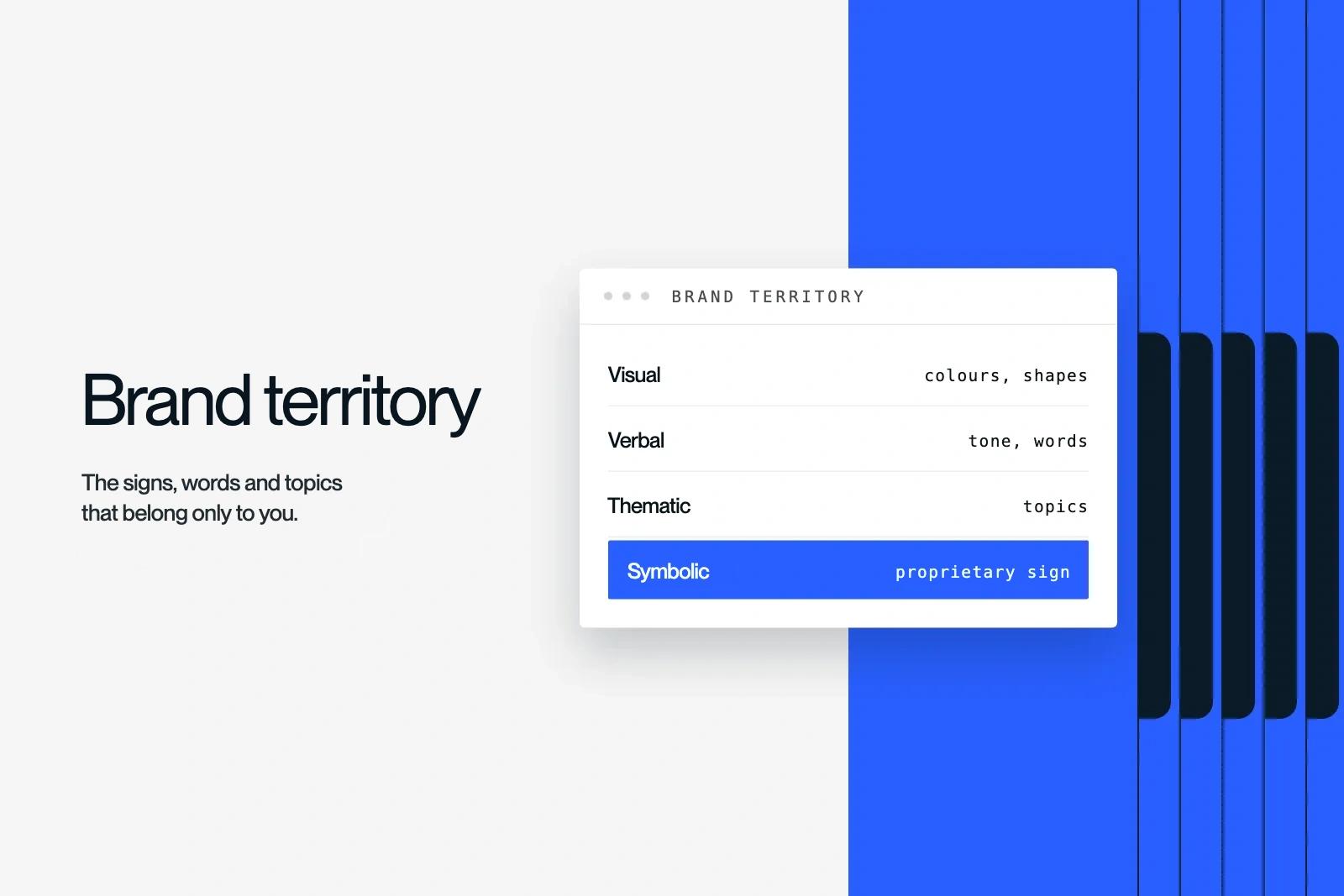
A brand territory is the space of expression a brand makes its own: the visual signs, words, topics and symbols through which the public recognises it, even without its name. It sets out what "is" the brand, and what does not look like it.
Here is the definition, its four components, the method to define it and four examples from our projects.
Explore this post with…
In short: the brand territory is the brand's field of expression: visual, verbal, thematic and symbolic. The brand platform says who you are, the territory says how that looks and sounds. A good territory comes down to a few proprietary signs, repeated everywhere. You define it by first looking at your sector's codes, to choose which ones to leave behind.
Brand territory: the definition
It is also called a "territory of expression". The idea is the same: every strong brand occupies a space people recognise. A colour, a way of framing photos, a tone, favourite topics. The territory has two functions.
- Recognition. The public identifies the brand in a second, on any format.
- Decision. The team knows whether an idea, a visual or a topic is "on brand" or not.
Without a defined territory, every new format starts from scratch. Over time, the brand ends up looking like its competitors.
Territory, platform, positioning, visual identity: the differences
| Concept | Role | Form |
|---|---|---|
| Positioning | The place you aim for in the client's mind | One sentence |
| Brand platform | The foundation: mission, values, promise, personality | A strategy document |
| Brand territory | The space of expression that follows from it | Signs, words, themes |
| Visual identity | The visual part of the territory | Logo, colours, typefaces |
| Brand guidelines | The usage rules | A guide |
Positioning and the brand platform come first. Visual identity is only one of the territory's four parts.
The 4 components of a brand territory
The visual territory
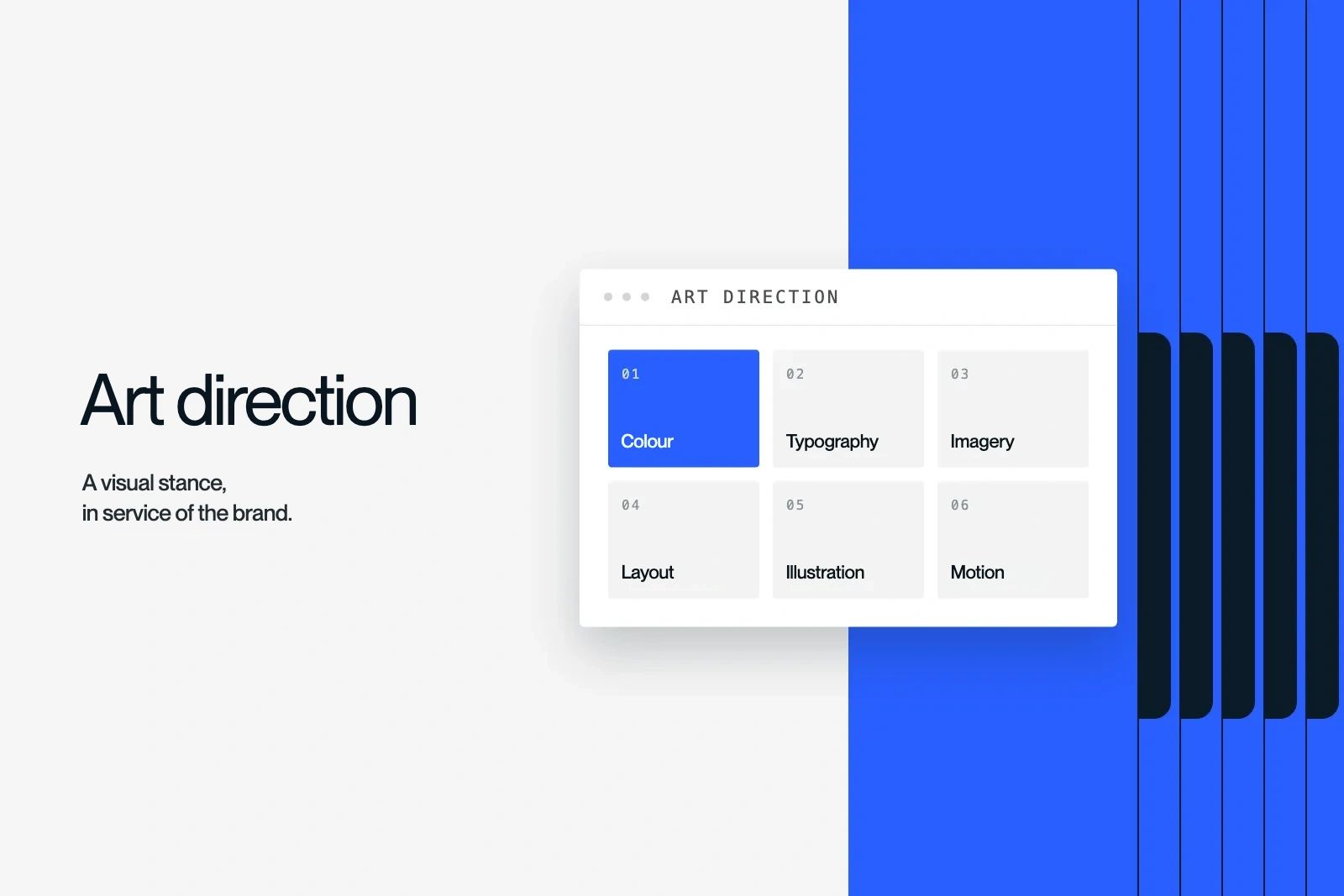
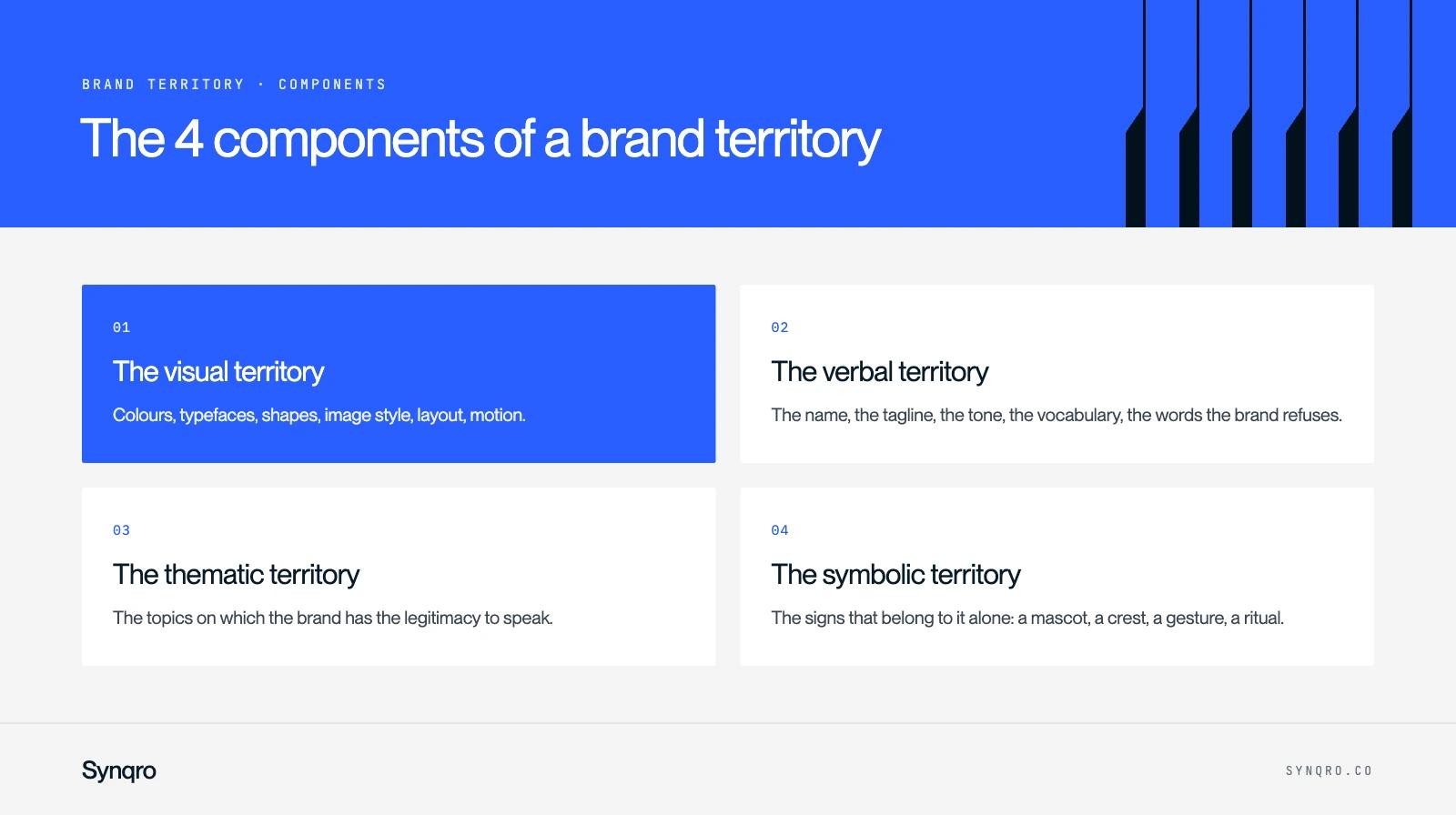
Colours, typefaces, shapes, image style, layout, motion. It is the most visible part, and the most copied.
The verbal territory
The name, the tagline, the tone, the vocabulary, the words the brand refuses. Naming is its first building block.
The thematic territory
The topics on which the brand has the legitimacy to speak. It guides the editorial line, talks and website content.
The symbolic territory
The signs that belong to it alone: a mascot, a crest, a gesture, a ritual. They are the hardest to find and the longest-lasting.
How to define your brand territory
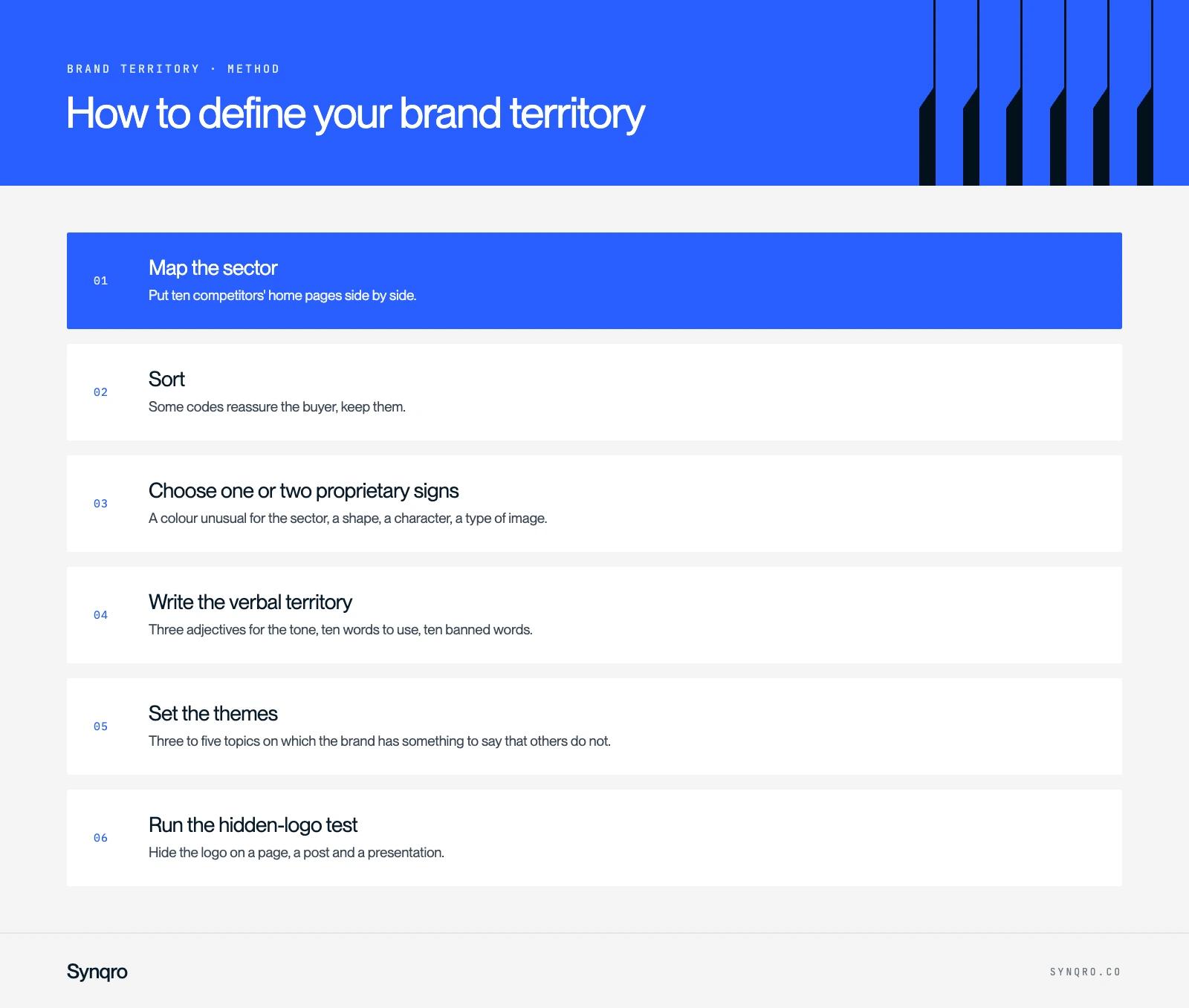
- Map the sector. Put ten competitors' home pages side by side. The shared codes jump out: same colours, same photos, same words.
- Sort. Some codes reassure the buyer, keep them. Others only help you blend in, leave them.
- Choose one or two proprietary signs. A colour unusual for the sector, a shape, a character, a type of image.
- Write the verbal territory. Three adjectives for the tone, ten words to use, ten banned words.
- Set the themes. Three to five topics on which the brand has something to say that others do not.
- Run the hidden-logo test. Hide the logo on a page, a post and a presentation. If people still recognise you, the territory exists.
4 real examples of brand territories
Sleeq: a badge and a neon yellow
Sleeq was born with TikTok and now aims at influence on a global scale. Its territory rests on a single sign: a badge inspired by the notification dot, both signal and mascot, which gives the brand a face. The palette comes down to three colours: black, white, neon yellow. The Sleeq case study shows how that sign is rolled out.
Mocade: borrowing its clients' territory
Mocade maintains the carpets of luxury hotels and restaurants. Its trade was rarely seen as glamorous. We made a clear choice: a crest, as for a house steeped in history, and the codes of luxury. The brand moved from carpet cleaning to the care of precious textiles. The details are in the Mocade case study.
Circul'R: circularity as a business decision
Circul'R argues that the circular economy is a strategic advantage. Its territory says so: bright colours, a modular pattern the team adapts on its own, an institutional tone that speaks to executives. The images show circular transformation as a concrete reality, never as a green promise. See the Circul'R case study.
LM Factory Motors: red
A bold red, a sporty and deliberately aggressive energy, premium codes. The territory comes down to one colour and one attitude, designed for a new generation of riders.
| Brand | Proprietary sign | Territory left behind | Territory taken |
|---|---|---|---|
| Sleeq | Notification badge, neon yellow | The single-platform agency | Global influence |
| Mocade | Crest | Carpet cleaning | Care of luxury textiles |
| Circul'R | Modular pattern, aerial views | The green promise | Business performance |
| LM Factory Motors | Bold red | The established equipment maker | The brand of a new generation |
Extending your territory without diluting it
A brand grows: new country, new offer, new audience. The territory has to follow without dissolving. Two rules are enough.
- Proprietary signs do not move. The badge, the colour, the crest stay the same everywhere.
- Everything else adapts. Language, references and themes change with the market.
Sleeq is a good example. For its arrival in the United States, the brand kept its signs and relied on a multilingual SEO and GEO strategy.
Brand territory in the age of AI
Assistants like ChatGPT describe a brand from what the web says about it. A clear thematic territory helps you get associated with your specialty: the same topics, the same words, on your site and elsewhere. That is the principle behind GEO.
The most common mistakes
- Confusing territory and logo. The logo is one sign among others.
- Trying to occupy everything. A territory is also defined by what it leaves out.
- Following the trend of the moment. What everyone adopts sets no one apart.
- Forgetting the verbal side. Two brands with similar visuals are told apart by their tone.
- Not handing it over. A territory only the agency knows disappears with the first in-house asset.
Defining a territory takes an outside view, on strategy as much as on creative work. That is the work our branding agency leads.
Frequently asked questions
It is a brand's own space of expression: its visual signs, tone, topics and symbols. It lets people recognise the brand without seeing its name.