Article
What is a brand book? Contents, examples and how to make one
Branding11 min read

James BrunettoCo-fondateur & CEO
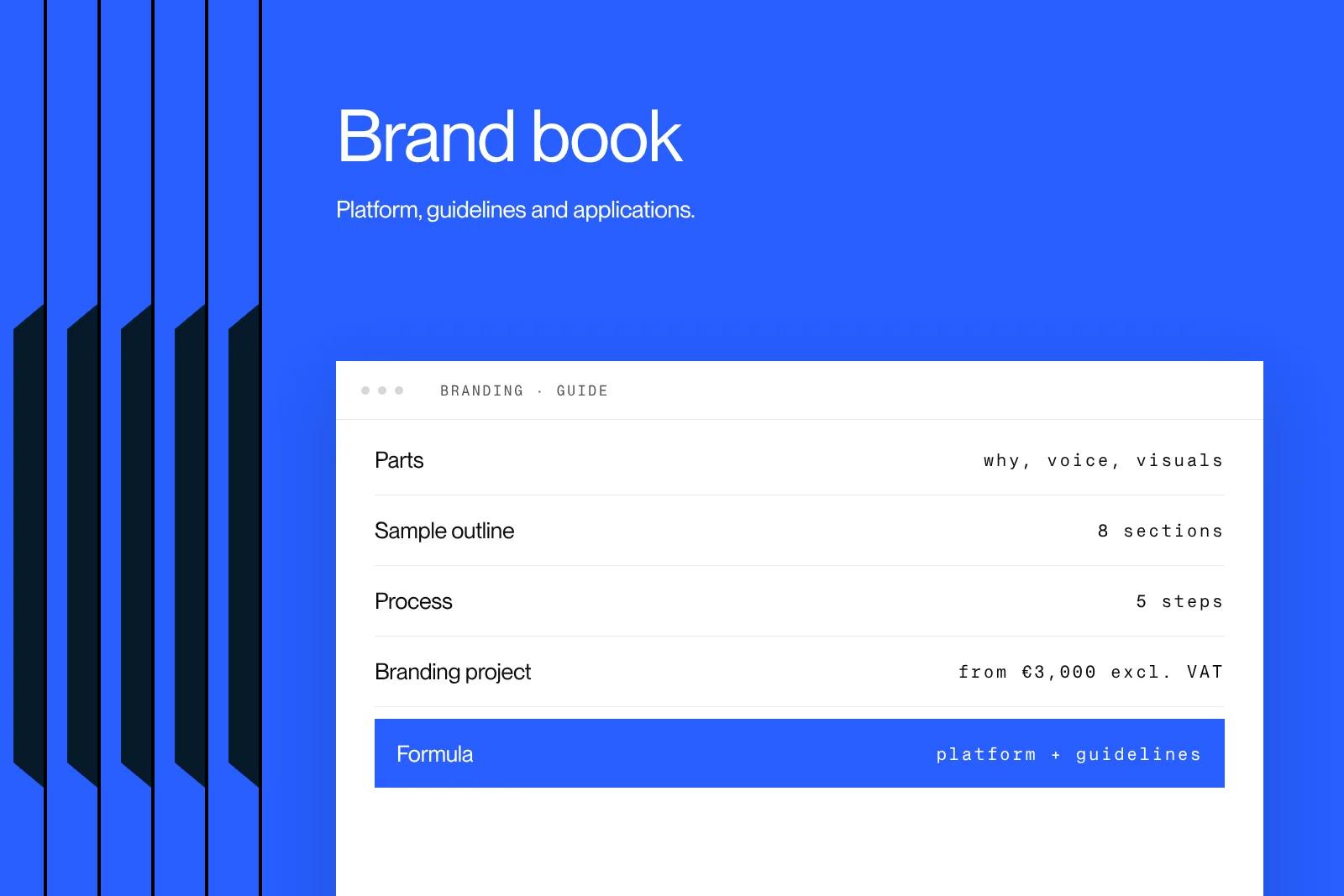
A brand book is the single document a team uses to run its brand day to day: why the brand exists, how it speaks and what it looks like. It combines the brand platform and the visual guidelines, then adds real applications on the materials people actually use. This guide covers what goes inside, an 8-section table of contents, the best formats and public examples from Uber, Mailchimp and NASA. You will also see who writes it, what it costs and the mistakes that turn it into shelfware.
Explore this post with…
What is a brand book?
A brand book is the reference manual for your brand. It explains why the brand exists, how it sounds and how it looks, then shows how to apply all of it to a sales deck, a LinkedIn post or a trade show booth.
It is written for everyone who speaks for the brand without having been in the room when it was created: new hires, sales reps, freelance designers, media agencies, printers.
People often use "brand book" and brand guidelines interchangeably. That is a shortcut. Guidelines set the rules for visual assets. A brand book starts earlier, with meaning, and only then moves on to colors and fonts.
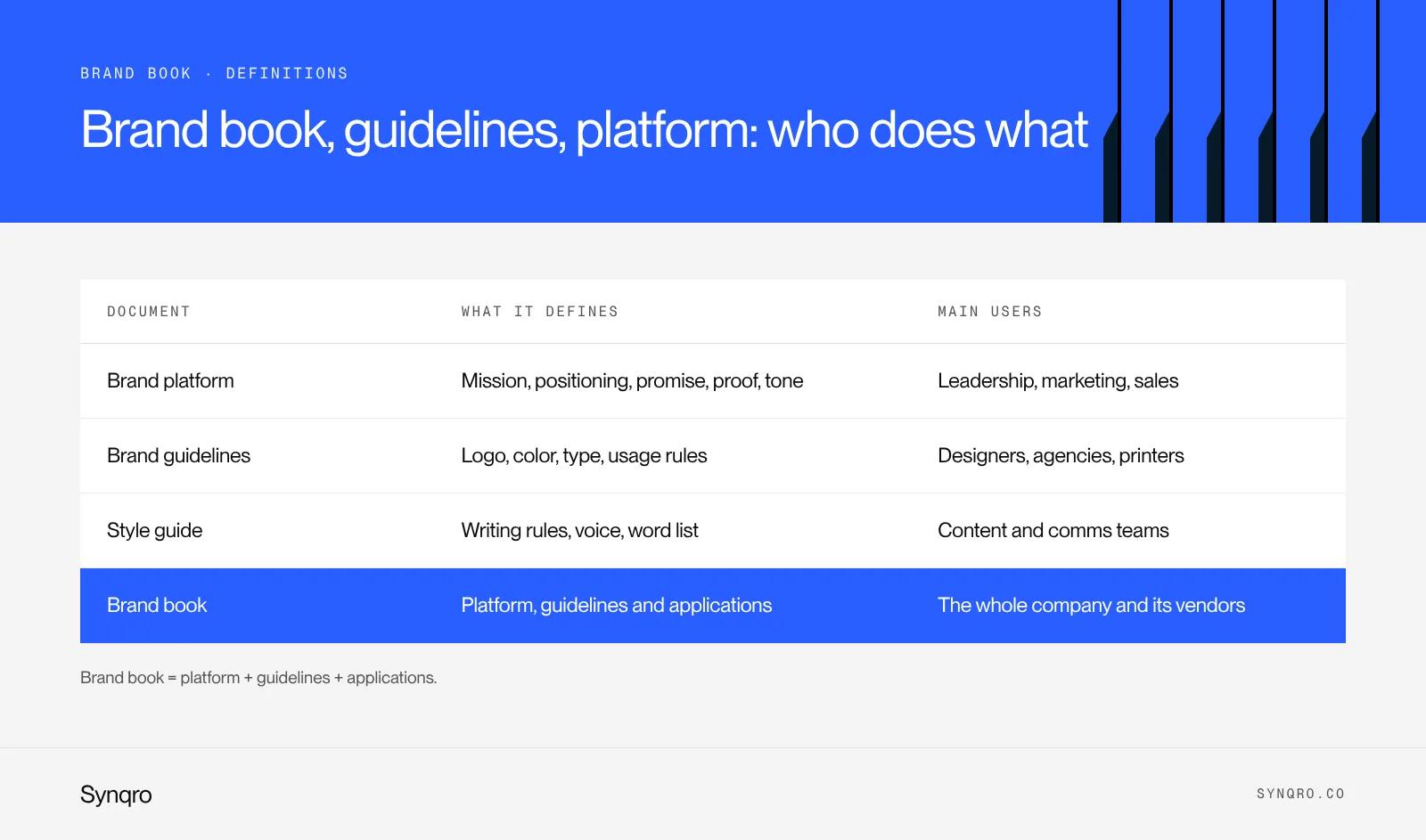
At Synqro we put it as a simple formula: brand book = platform + guidelines + applications. Drop any one of the three and the document becomes theory. Within a quarter, the team is improvising again.
What goes into a brand book
A useful brand book has four parts, in this order. The order matters, because a visual decision can only be defended against a positioning.
- The why. Mission, vision, values, positioning, promise and proof points. This is the core of your brand platform, cut down to what the team needs to remember.
- The voice. Tone, words to use and avoid, key messages by audience, and before and after rewrites.
- The visual system. Logo and clear space, color codes, typography, iconography, photography, motion. This is the visual identity section.
- The applications. Templates and real examples: sales deck, email signature, social posts, print, website.
The fourth part is the one most brand books skip. It is also the one that turns a presentation document into a working tool.
An example from our work
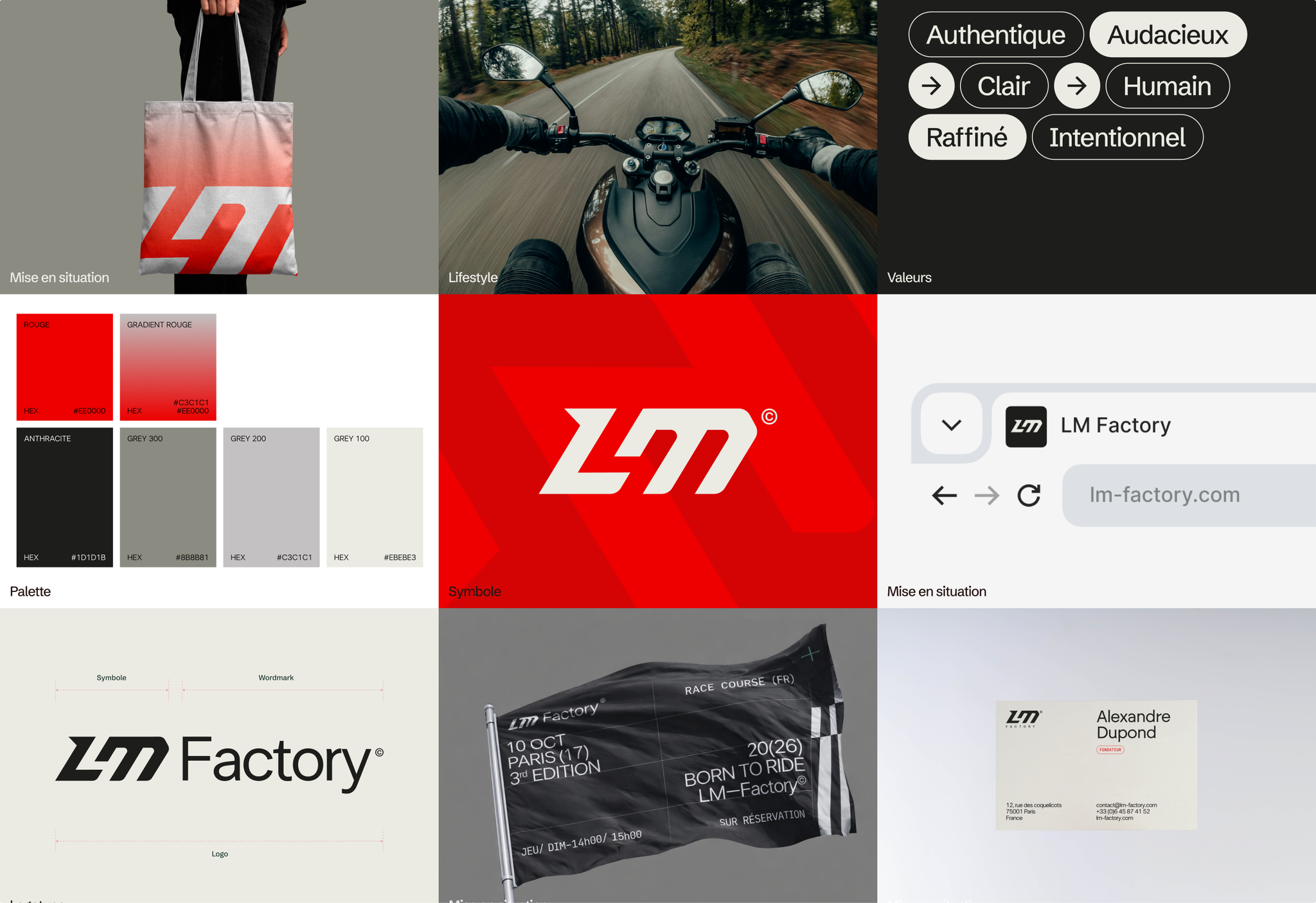
For LM Factory Motors, a motorcycle gear brand, the brand board we delivered puts the logo, palette, values, a flag and the logo variations on a single page. Values and colors are read together. That is the whole idea of a brand book: meaning and signs side by side.
A sample brand book table of contents
This is the outline we start from. It fits in 8 sections and scales with the size of the company.
- Our story and mission. One page, written to be read out loud at onboarding.
- Positioning and promise. Who we serve, what we promise, and the proof that makes it credible.
- Values and personality. Three to five values, each translated into concrete behaviors.
- Voice and messaging. Writing rules, banned words, messages by audience, before and after examples.
- Logo. Versions, minimum sizes, clear space, misuse.
- Color and typography. HEX, RGB, CMYK and Pantone values, type hierarchy, contrast rules.
- Imagery and graphic elements. Photo style, icons, patterns, illustration, motion principles.
- Applications. The company's real materials, with downloadable templates.
A small company can merge sections 1 to 3 into two pages. A multi-brand group will add a section on brand architecture. Everything else stays.
Brand book vs brand guidelines vs brand platform
These terms overlap, and every agency uses them a little differently. Here is the split we use with clients, which is the clearest one we know.
| Document | What it defines | Main users |
|---|---|---|
| Brand platform | The why: mission, positioning, promise, proof, tone | Leadership, marketing, sales |
| Brand guidelines | The visual rules: logo, color, type, usage | Designers, agencies, printers |
| Style guide | Usually the writing rules: voice, grammar, word list | Content and comms teams |
| Brand book | Platform, guidelines and applications in one tool | The whole company and its vendors |
In practice, the platform is leadership's working document. The guidelines are the creative team's technical spec. The brand book is the one you hand to everyone on day one.
If you already have a platform and guidelines, you do not need to start over. The job is to assemble them, cut what nobody uses and add the applications that are missing.
Which format: PDF, website, Figma or Notion?
The format decides whether the brand book gets opened or forgotten in a shared drive. Pick it based on who will use it.
| Format | Strengths | Weakness |
|---|---|---|
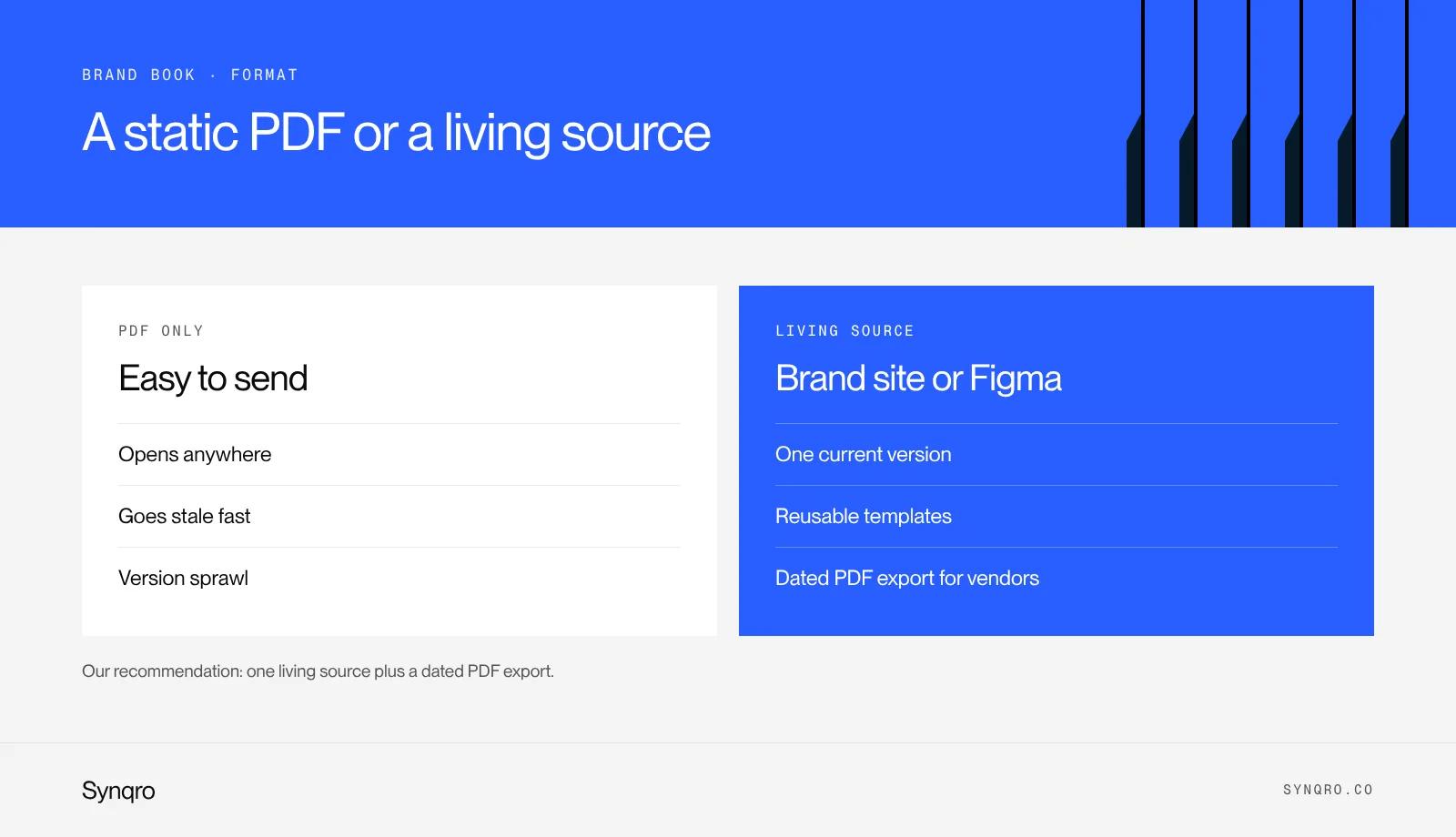
| Easy to send to vendors, opens anywhere | Goes stale fast, version sprawl | |
| Brand website | One up-to-date URL, works on mobile | Needs some upkeep |
| Figma | Components and templates ready to reuse | Hard to read for non-designers |
| Notion | Easy for marketing to edit | Weaker visual presentation |
| Slide deck | Great for onboarding new hires | Clumsy as a day-to-day reference |
Our recommendation: one living source (a brand site or Figma) plus a dated PDF export for outside vendors. The PDF says "March version". The source is the truth.
Brand book examples worth studying
Several large brands publish their brand books online. They show the gap between a visual manual and a document that also covers voice.
- Uber. The Uber brand site covers nine elements: logo, color, composition, iconography, illustration, motion, photography, tone of voice and typography. Tone sits on the same level as the logo.
- Mailchimp. The Mailchimp Content Style Guide is entirely about writing: voice and tone, grammar, social media, accessibility, translation. It was built for employees and can be adapted by others under a Creative Commons license.
- NASA. NASA's history site links to the original 1976 Graphics Standards Manual, the one behind the "worm" logotype by Danne & Blackburn. A purely visual manual that designers still study.
These were built for organizations with thousands of people. A growing company does not need that scale. It needs the same sections, in far fewer pages.
Synqro's own brand book, in short
Here is what our own document says about the visual system, to show the level of precision a brand book needs.
- Color. Blue #285EFF, night #051A2A, light grey #F4F4F4. One blue accent, never two bright colors on the same screen.
- Typography. PP Neue Montreal, Regular 400 for headings and Medium 500 for buttons.
- Shapes. 2 px corners, no large rounding.
Three lines, and a designer who has never met us can produce an on-brand visual. That is the test we apply to every brand book: a stranger should be able to use it without calling anyone.
Who writes a brand book?
A brand book is written by several people. The useful question is who makes the call at each stage.
- Leadership signs off the why: mission, positioning, promise. Nobody else can.
- The brand strategist writes the platform and voice from interviews with founders, sales reps and a few customers.
- The art director designs the visual system and writes the guideline rules.
- Marketing owns the document after delivery and keeps it current.
The person most often left out is sales. At Synqro we have sales reps review the messaging before it is locked, because they hear the objections every day.
If the name itself is in doubt, the brand book can wait. Brand naming comes first, and at Synqro it starts at €1,500 excluding VAT.
How much does a brand book cost and how long does it take?
A brand book is rarely priced on its own, because the work depends on what already exists. There are three typical cases.
| Starting point | What needs to be produced | Relative effort |
|---|---|---|
| Solid platform and guidelines | Assembly, voice, applications, templates | Lightest |
| Visual guidelines only | Platform, voice, then assembly | Medium |
| New brand or full rebrand | Platform, identity, guidelines, applications | Full branding project |
At Synqro, the brand book is part of our branding projects, which range from €3,000 to €20,000 excluding VAT depending on the share of strategy, identity and website work. A full project, website included, takes 8 to 12 weeks. You can see the scope on our branding service, from platform to website.
The real hidden cost is not having one. Every vendor reinterprets the brand, every deck gets rebuilt, and the image drifts without anyone deciding it should.
How to create a brand book in 5 steps
This is the process we follow, whether the brand book starts from scratch or from existing guidelines.
- Audit what exists. Collect the platform, the guidelines, the decks and the materials people really use, including the ones nobody is proud of.
- Write the why. Interviews, positioning, promise and proof, signed off by leadership before any visual work.
- Lock the visual system. Logo, color, type, imagery, with measurable rules and clear misuse examples.
- Show the applications. Apply the brand to real materials: sales deck, proposals, social posts, website.
- Publish and hand over. Put the living source online, train the team, name an owner.
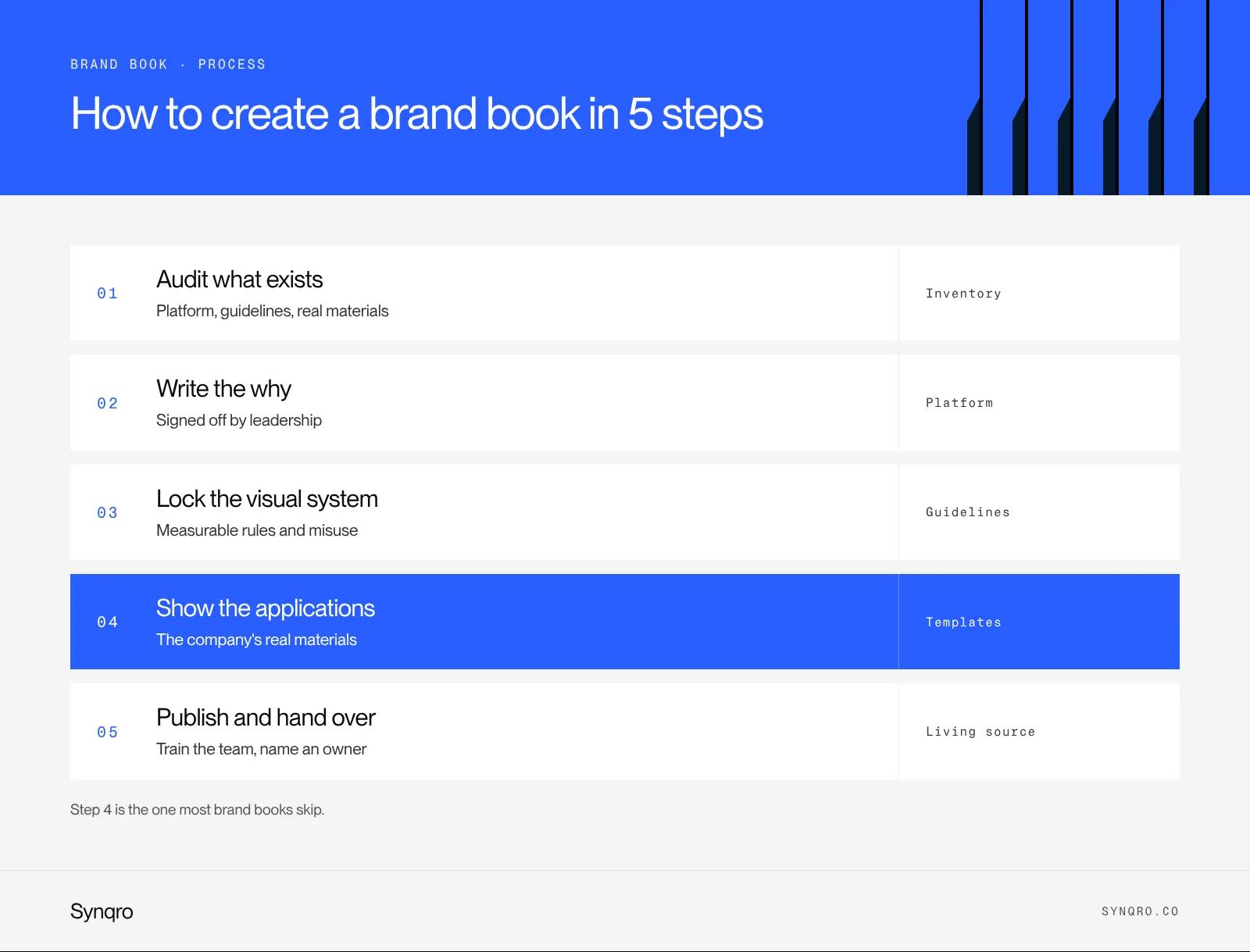
For Circul'R, a circular economy consultancy, we pushed step 4 all the way. Beyond the guideline pages (logo, color, typography, iconography), we created a modular pattern and built a tool that lets the team adapt it on their own while staying within the guidelines. The details are in the Circul'R case study.

Same logic for Lumera, an influencer marketing agency: we designed the templates the team uses daily, email signatures, Instagram posts and stories, creator recruitment carousels. The team now publishes on its own with the same light on every touchpoint, as shown in the Lumera project.
Mistakes that make a brand book useless
Most brand books fail for simple reasons. These are the ones we see most often when we take over an existing brand.
- Starting with the logo. Without a platform, every visual choice becomes a matter of taste.
- Writing for the agency. A document full of creative jargon that sales never opens.
- Skipping applications. Abstract rules with no example on the company's actual materials.
- Freezing it. A long PDF that never gets updated while the offer changes twice.
- Naming no owner. Without one, the brand book dies on delivery day.
- Changing everything in a rebrand. A rebranding strategy should keep what customers already recognize, and the brand book should say so.
Our view is blunt: a short brand book used every week beats a thick one admired once. We do not deliver guidelines without the templates the team will use the following Monday.
Want a second opinion on your brand and the documents you already have? Talk to our team. We look at what exists before proposing anything.
Frequently asked questions
Brand guidelines cover the visual rules, while a brand book adds the brand platform and real applications. Guidelines are mainly for designers and printers. A brand book is for the whole company and every vendor working on the brand.