Article
B2B brand storytelling: the 5-part structure, examples, metrics
Branding12 min read

James BrunettoCo-fondateur & CEO
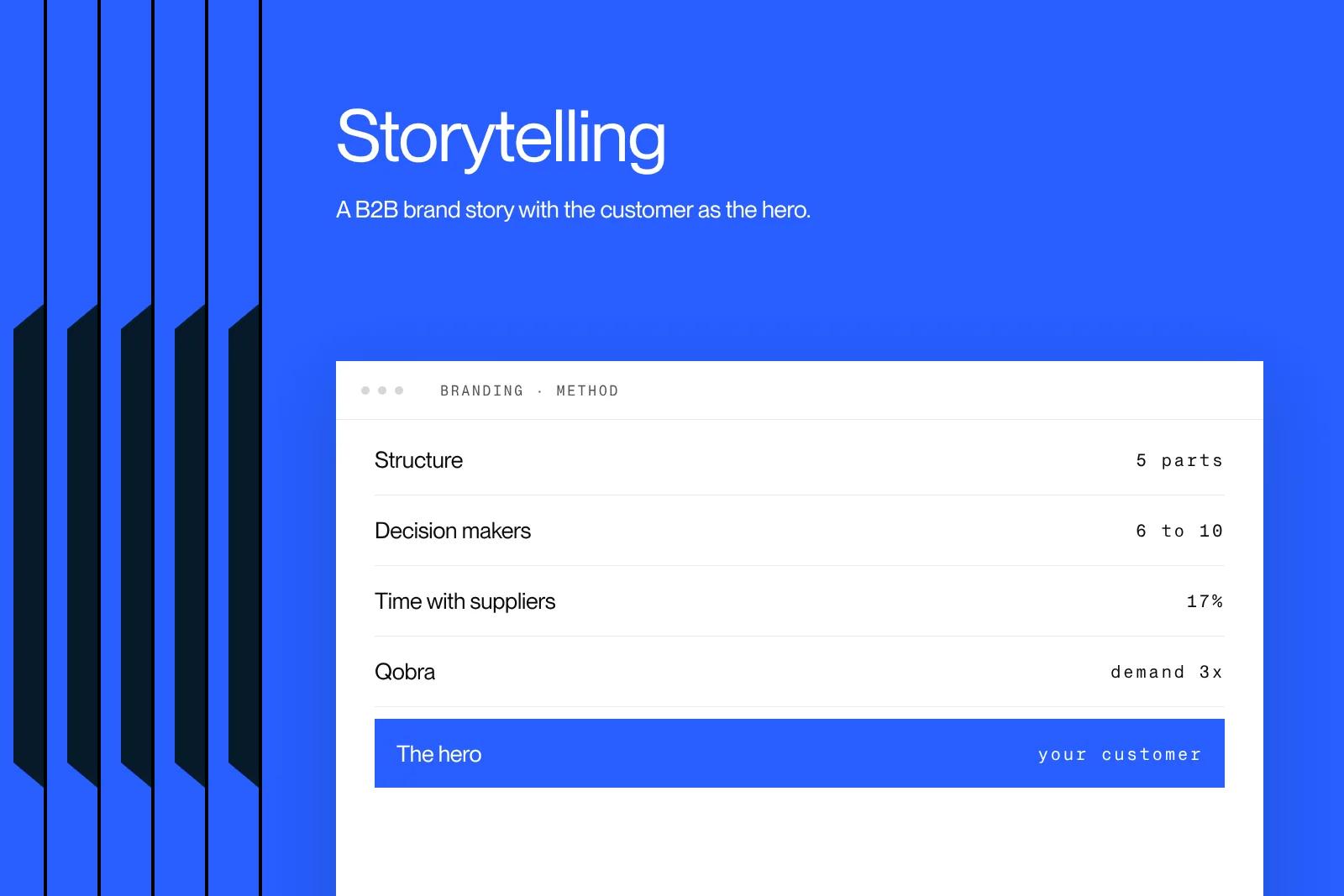
B2B brand storytelling means telling how your customer gets from a costly problem to a better situation, with your company cast as the guide. It is not the founder's biography or a tearjerker video: it is a message structure built to help a deal close. It has five parts (the customer, the problem, the stakes, the proof, the transformation) and it plays out on your homepage, case studies, LinkedIn and sales calls. This guide covers the method the Synqro team uses, real examples and the mistakes that lose a B2B buyer.
Explore this post with…
What is B2B brand storytelling?
Brand storytelling is how a company organizes what it says around a story: a character, an obstacle, an outcome. In B2B, the main character is your customer, the obstacle is a business problem that costs them money or time, and the outcome is what changes after you step in.
The story is not a single piece of copy. It is a narrative spine you reuse everywhere: a homepage headline, a case study, a LinkedIn post, the first minute of a discovery call. When it is set up properly, every channel tells the same story in different words.
Brand storytelling for B2B differs from consumer storytelling in one practical way. A consumer buys for themselves. A B2B buyer has to defend the purchase to colleagues, which changes what the story needs to contain.
What brand storytelling is not
Most "Our story" pages miss for one reason: they are about the company. A B2B buyer wants to know whether you understand their problem.
- Not the founder's biography. The garage, the lifelong passion and the founding year rarely help anyone sign. The founder's story earns its place only if it explains why you see a problem others miss.
- Not a tagline. A tagline sums up a story. It does not replace it.
- Not fiction. In B2B, every claim gets checked. A made-up customer result costs you credibility, often in front of a buying committee.
- Not only video. Most B2B storytelling is read: web pages, case studies, proposals.
- Not a dressed-up feature list. If you can swap your name for a competitor's and nothing breaks, it is not a story.
| Approach | What it tells | Effect on a B2B buyer |
|---|---|---|
| Founder story | Where the company came from | Likeable, rarely decisive |
| Feature list | What the product does | Looks like every competitor |
| Customer-centered story | What changes for the customer | Can picture it and defend it internally |
| Tagline alone | A one-line promise | Memorable, but no proof |
Why story matters more in B2B than people think
B2B purchases are group decisions. According to Gartner, a complex purchase typically involves six to 10 decision makers, and buyers spend only 17% of their buying journey meeting with potential suppliers. The rest of the time they read, compare and argue among themselves, without you in the room.
That is where your story does the work. Your contact has to repeat your message to the CFO, their team and procurement. A simple story with a clear problem and a hard number travels. A list of ten selling points does not.
Forrester names the most common failure: B2B content that is "focused on product and buzzwords", when stories work better with the audience at the center. At Synqro we put it more bluntly: if your customer is not the hero of the page, the page does not sell.
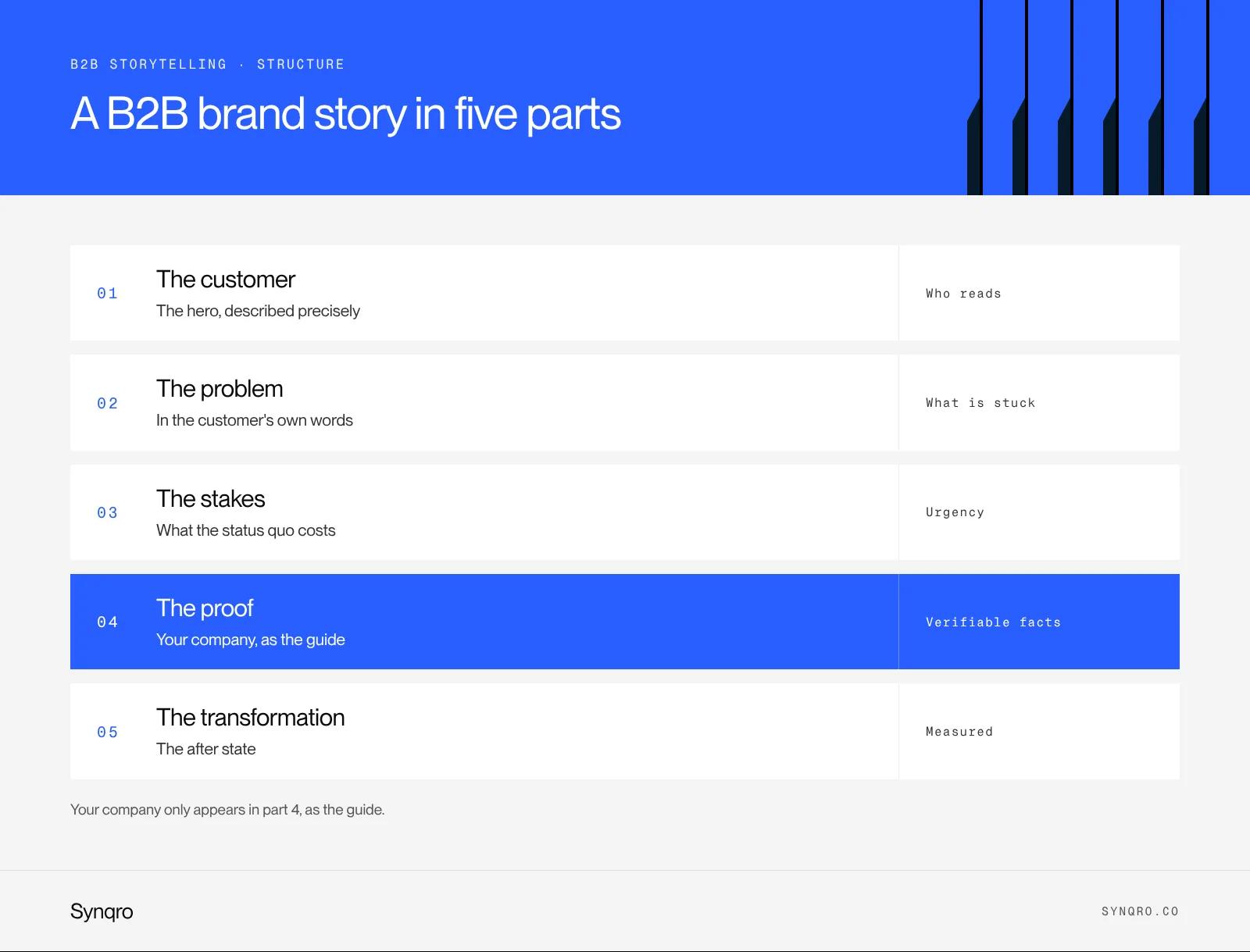
The 5-part structure of a B2B brand story
Every strong B2B story we write follows the same skeleton. It borrows from classic narrative structure, adjusted for a buyer who has to justify the decision.
- The customer as hero. Who they are, precisely: industry, size, the role of the person reading. "Sales teams running commissions on spreadsheets" beats "businesses".
- The problem. What is stuck, in the customer's own words. Something concrete and observable: calculation errors, unqualified leads, a positioning nobody understands.
- The stakes. What the status quo costs. Money, time, risk, reputation. Urgency comes from the stakes, not from your offer.
- The proof. Why you are a credible guide: method, past work, verifiable numbers, customer reviews.
- The transformation. The after state, described as concretely as the problem. Measured, ideally.
Your company shows up in part 4. It is neither the hero nor the subject. It is the guide that makes the transformation possible.
Two real examples, broken down
Most storytelling examples you will find online are consumer brands. Here are two B2B stories we know from the inside because the Synqro team built them with the clients, plus one well-documented reference.
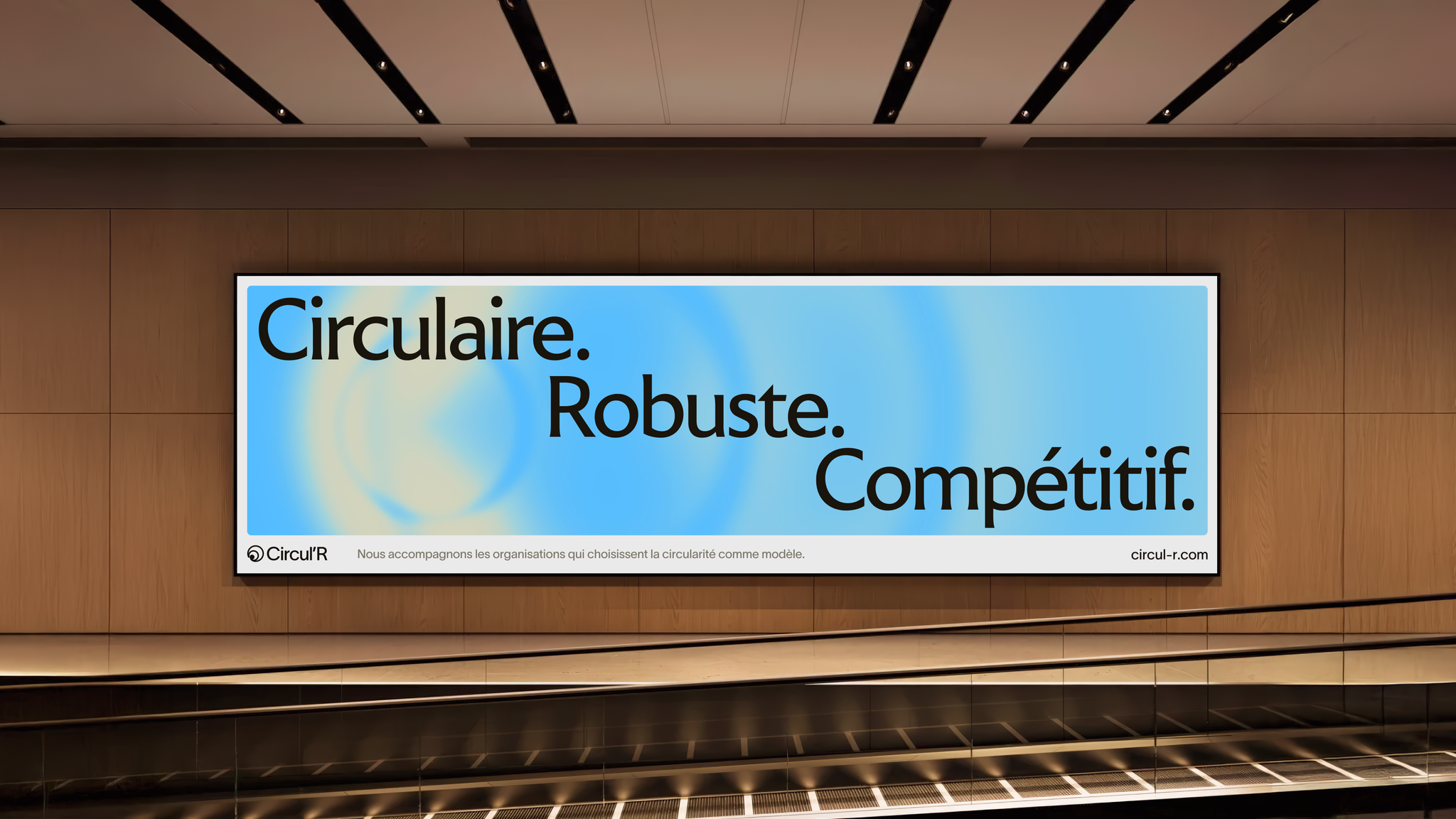
Circul'R: putting consulting back at the center
Circul'R helps companies move to a circular economy. The problem, as described in the Circul'R case study: the company was often seen as a business club, even though consulting generates most of its revenue. Its story was selling the wrong business.
We reordered the hierarchy of services, with the club in a supporting role, and set one message: the circular economy as a performance lever, never as a green promise. That message runs through every touchpoint, from pitch decks to social posts. After launch, qualified leads started coming in shortly afterwards.
Qobra: turning a promise into a number
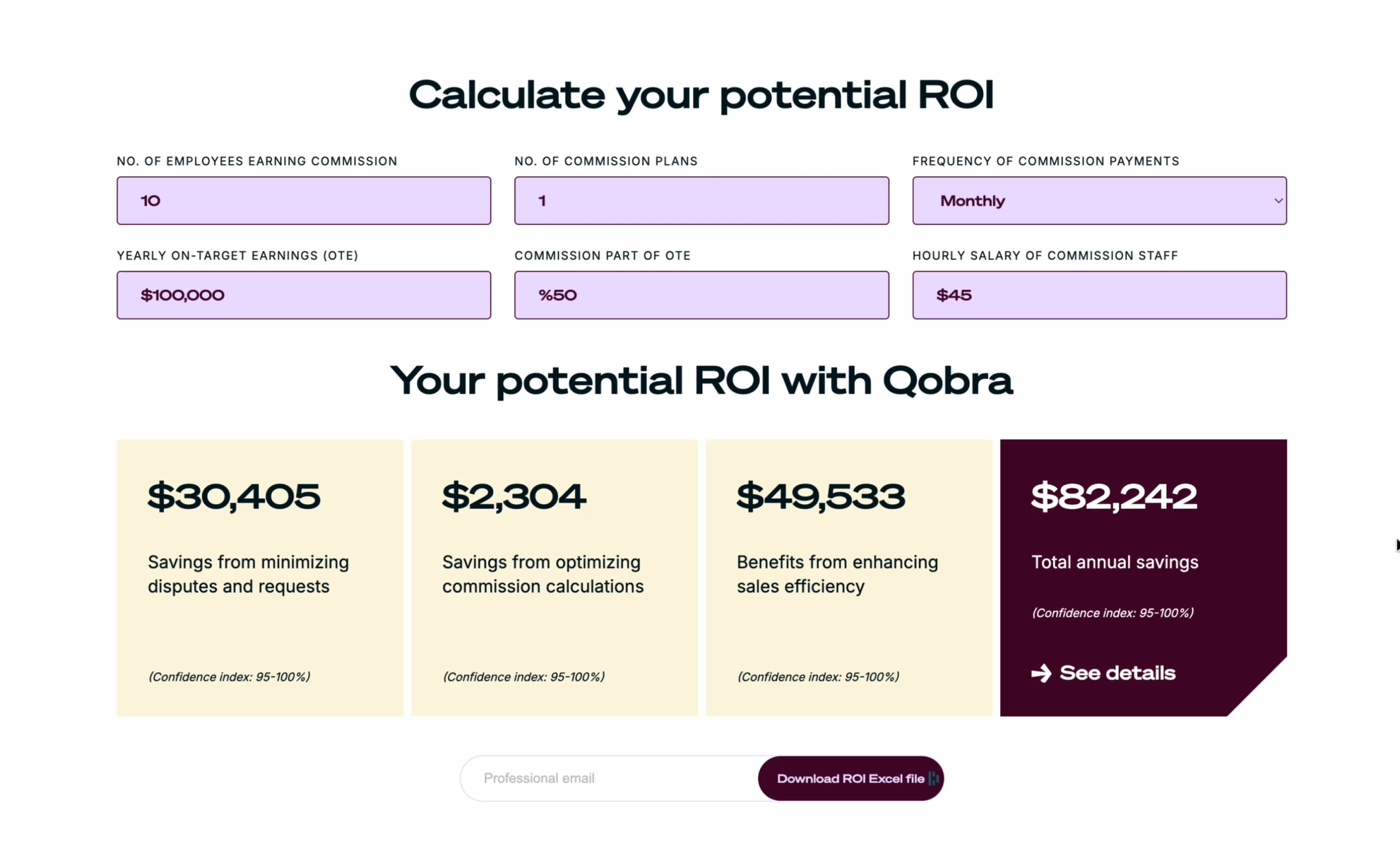
Qobra automates commission management for sales teams. The hero is the sales leader who has to convince their CFO. To hand them that argument, we built an ROI calculator that turns a product promise into a figure they can take into the meeting. That is storytelling as a tool: the prospect writes the ending with their own data.
The published result on the Qobra project page: inbound demand up 3x and organic traffic up 16x.
Salesforce and "The End of Software"
In February 2000, Salesforce launched around the theme "The End of Software", according to Salesforce's own company history. The story named a clear enemy, on-premise software, and a simple transformation for the customer. A quarter of a century later, it is still a textbook B2B story built on a problem rather than a feature.
| Example | Hero | Problem | Proof or outcome |
|---|---|---|---|
| Circul'R | Executives to win over | Seen as a club, not a consultancy | Qualified leads soon after launch |
| Qobra | Sales leader facing the CFO | Value hard to put a number on | Demand 3x, organic traffic 16x |
| Sleeq | An agency aiming at the US market | Brand still sized to its TikTok roots | Revenue tripled within a year |
| Salesforce, 2000 | Companies stuck with heavy software | Installing and maintaining on-premise | Story carried the product launch |
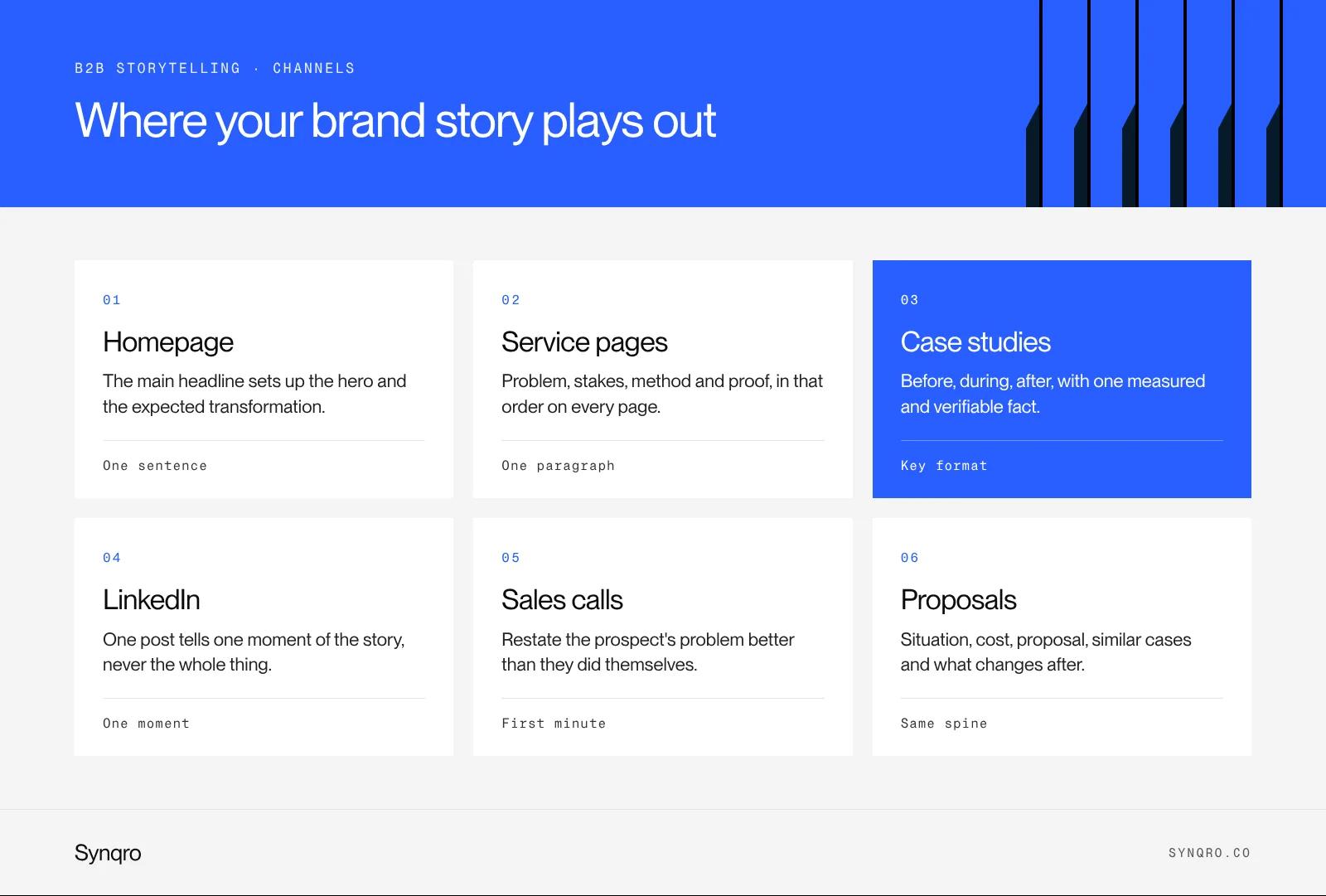
Where your B2B brand story plays out
A story that lives only in a brand platform document does nothing. It has to show up wherever the buyer goes.
- The homepage. The main headline sets up the hero and the transformation. On synqro.co the homepage reads "Strategy, technology and marketing, working as one team to grow B2B companies": the subject is the client's growth.
- Service pages. Each one follows the structure: problem, stakes, method, proof. A service page that opens with "Our team" opens with the wrong character.
- Case studies. The most natural format. Before, during, after, with one measured fact. On the Sleeq project, every case study on the site carries the pitch, and the site tells a move: from TikTok agency to worldwide cultural impact.
- LinkedIn. One post tells one moment of the story: a customer problem, a project decision, a result. Not the whole story at once.
- Sales calls. In the first minute you should restate the prospect's problem better than they did. It is the toughest test of your storytelling.
- Proposals. Same spine: your situation, what it costs, what we propose, similar cases, what changes.
The step-by-step method we use at Synqro
At Synqro we never write a brand story from a blank page. We start from the client's raw material: sales decks, won proposals, customer quotes, real numbers. It is the same rule we apply to our SEO and GEO work, for a simple reason: generic content convinces neither a buyer nor a search engine.
- Collect the material. Three to five customer interviews, the latest won and lost proposals, the objections heard on calls. The problem lives in the customer's words, not marketing's.
- Pick one hero. One primary buyer profile per story. If you sell to three audiences, write three versions, as we did with Qobra's dedicated funnels.
- Name the problem and the stakes. One sentence each. If the stakes cannot be put in numbers, describe a concrete consequence: a lost deal, a failed hire, a team losing a day a month.
- Gather the proof. Publishable projects, dated numbers, customer reviews. At Synqro we check that every client can be named before we name them.
- Write the transformation. The after state, as concrete as the problem.
- Compress it into three formats. One sentence (the homepage headline), one paragraph (a service page intro), one page (the full narrative in your brand platform).
- Roll it out and test. Homepage, pages, case studies, LinkedIn, sales pitch. Then we revisit the message in a quarterly review, based on what actually worked in sales conversations.
The writing itself is copywriting. Storytelling sets the spine, copywriting picks the words page by page.
Our own story: from agence-synqro.fr to synqro.co
We apply the method to ourselves. For years our old site, agence-synqro.fr, mostly told the story of a tool: Webflow. It was true, but it was our story, not our clients'.
In October 2026 the site moved to synqro.co with a different story. The hero is the B2B company that wants to grow. The problem is set up on the homepage: "The technology moves fast. The message has to keep up." The Vision page says "We care about your business more than the brief". And the proof is a set of checkable facts: over 150 companies supported since 2019, 52 Google reviews with a 5.0 out of 5 rating, three Awwwards honorable mentions.
Webflow is still a tool we know inside out, as a Premium Partner. It simply moved from subject to means. If you are considering a story change on that scale, our guide to rebranding strategy covers the steps and the SEO risk of a domain change.
Common B2B storytelling mistakes
These are the mistakes we fix most often during a brand audit or a redesign.
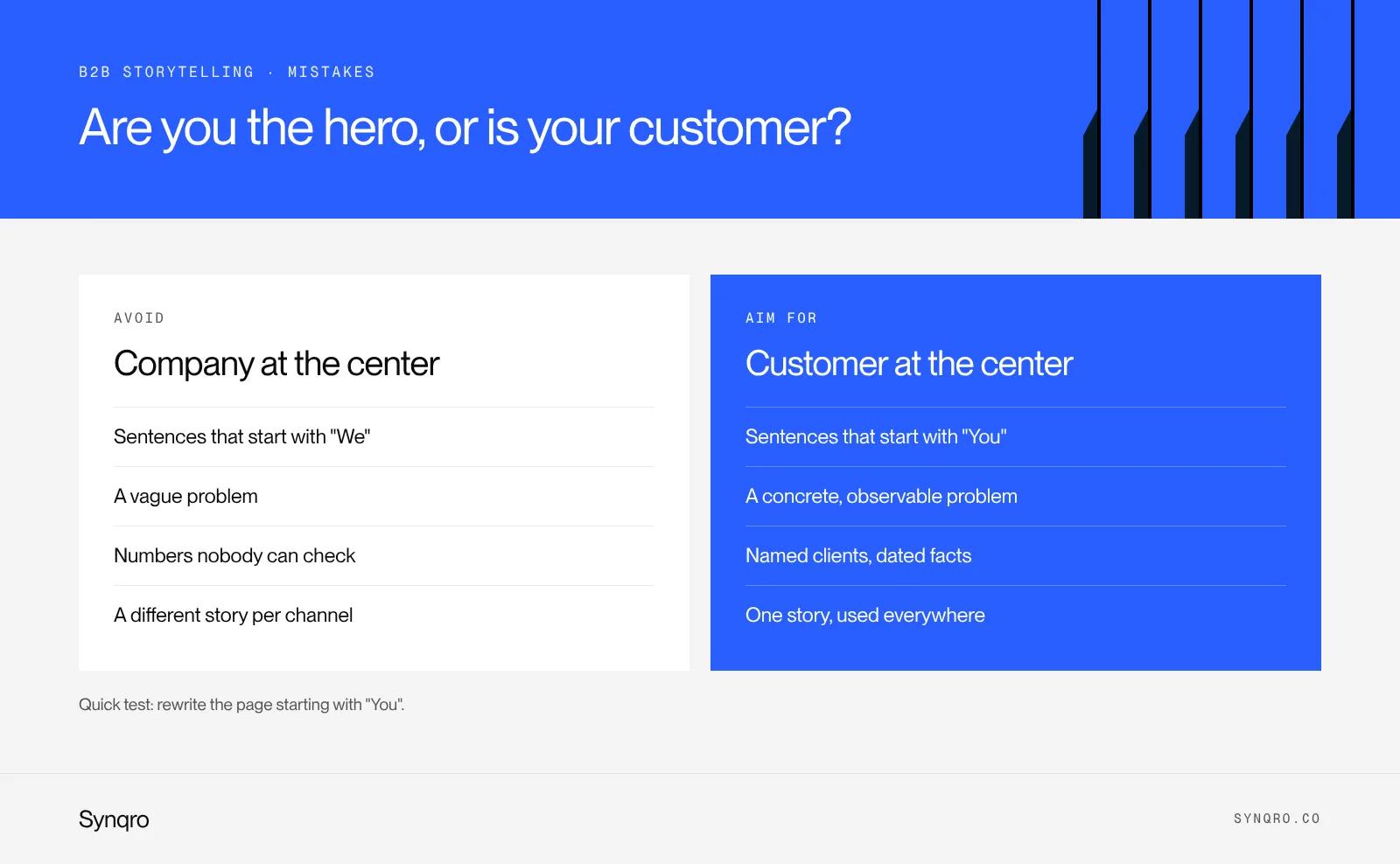
- You are the hero. Every sentence starts with "We". Rewrite the page starting with "You" and see what survives.
- The problem is vague. "Accelerate your digital transformation" describes no real problem.
- No proof. A story with no number and no named customer is just a promise.
- Numbers nobody can check. Serious B2B buyers verify. A modest true fact beats a spectacular percentage from nowhere.
- A different story on every channel. The homepage says one thing, sales says another, LinkedIn a third. The buyer no longer knows what you do.
- Too much emotion, not enough stakes. B2B emotion is mostly fear of a bad call and relief at a risk removed. It comes from the stakes, not the soundtrack.
- Forgetting the other decision makers. The CFO, the technical team and procurement read too. Give each of them a proof.
How to measure B2B brand storytelling
You do not measure a story in likes. You measure what it changes in the sales cycle. These are the indicators we track with clients, without promising a number in advance.
| Indicator | Where to read it | What it says about the story |
|---|---|---|
| Conversion rate of key pages | Site analytics | Does the page message trigger contact? |
| Quality of inbound requests | CRM, forms | Do prospects describe the right problem? |
| Lead to meeting rate | CRM | Does the story hold up with a real buyer? |
| Branded searches | Google Search Console | Does the story travel beyond your site? |
| Case studies prospects mention | Call notes | Which proof actually makes the difference? |
| Consistency of the sales pitch | Call reviews | Is the team telling the same story? |
Measure before and after over the same period, and change one thing at a time. If you rebuild the homepage, the site and the pitch all at once, you will know something worked without knowing what. On a B2B website, we usually start with the homepage and the most visited service page.
Storytelling, brand platform and B2B branding: who does what?
The three overlap, and that is where projects often get lost.
| Concept | What it defines | Typical deliverable |
|---|---|---|
| Brand platform | Mission, positioning, values, tone | Internal reference document |
| Brand storytelling | The narrative spine: customer, problem, stakes, proof, transformation | Master story and channel versions |
| Copywriting | The exact words on each page and asset | Site copy, posts, proposals |
| Visual identity | What the story shows | Logo, colors, typography, imagery |
At Circul'R the story even drove the imagery: aerial shots that show circularity as a concrete business decision. That link between story and identity is what we cover in our guide to B2B branding, and what we deliver in our brand identity and branding engagements.
If you want us to look at the story your site tells today, get in touch with the Synqro team: we will show you where your customer drops out of the story.
Frequently asked questions
B2B brand storytelling is how a company organizes its message around a story in which the customer faces a problem and comes out transformed. The company plays the guide, not the hero, and every step rests on verifiable proof.